Powering forward

For the past years, China has made major breakthroughs in science and technology that indicate it is on the path to national rejuvenation. Li Yang takes a look at four best of them.
Aerospace
China's Tiangong II space lab blasted off in September last year, marking another milestone in the country's increasingly ambitious space program, which envisions a space station and sending a probe to Mars at the start of the next decade.
One month later, the Shenzhou XI manned spacecraft carried two astronauts into space to dock with the lab. The astronauts worked in the lab for 30 days before returning to Earth.
In April this year, China's first space cargo ship Tianzhou 1, was sent into orbit to dock with the space lab, providing fuel and other supplies.
Its predecessor Tiangong 1, which docked with the unmanned Shenzhou 8, and manned Shenzhou IX and Shenzhou X spaceships, was used to verify the technology involved in space docking and served as a simple platform for a number of scientific experiments.
Tiangong 1 ended its data service earlier this year and will, reportedly, burn up as it falls into Earth's atmosphere in the latter half of 2017.
Tiangong II will drop into the Pacific Ocean at the end of its mission, according to the manned space engineering office.
The successful launch of Tiangong II along with the maiden flight of China's new generation carrier rocket Long March 7 in June last year, bodes well for the final phase of China's three-step manned space program.
The first step, to send an astronaut into space and return safely, was fulfilled by Yang Liwei in Shenzhou V in 2003.
The second step is to develop advanced space flight techniques and technologies including extravehicular activity and orbital docking. This phase also includes the launch of two space laboratories - effectively mini space-stations that can be manned on a temporary basis.
The final step will be to assemble and operate a permanent manned space station.
Construction of the space station is planned for completion by around 2020.
It will enter into service around 2022, with an initial designed life of at least 10 years.
Now China is preparing Tianhe I, a core space station module, which is due to be carried into space by the powerful Chinese rocket Long March 5 in 2018. Additionally, Chinese scientists are making a Hubble-like telescope to orbit near the planned space station. China also aims to land a probe on Mars by 2020.
Aviation
The C919, the first Chinese-built passenger jet, made its maiden flight in May. A total of 23 foreign and domestic customers, including China's national carrier Air China and leasing company GE Capital Aviation Service, have already placed orders for 570 aircraft, according to the Commercial Aircraft Corporation of China.
With 158 seats and a standard range of 4,075 kilometers, it competes with the updated Airbus 320 and Boeing's new generation 737.
China has invested heavily in commercial passenger jet manufacturing. In 2007, plans to develop a domestic large passenger jet were approved by the State Council. In November 2015, the first C919 jet rolled off the assembly line.
The ARJ21, the country's first regional aircraft also produced by COMAC, began commercial operations in June 2016 following its maiden flight in 2008.
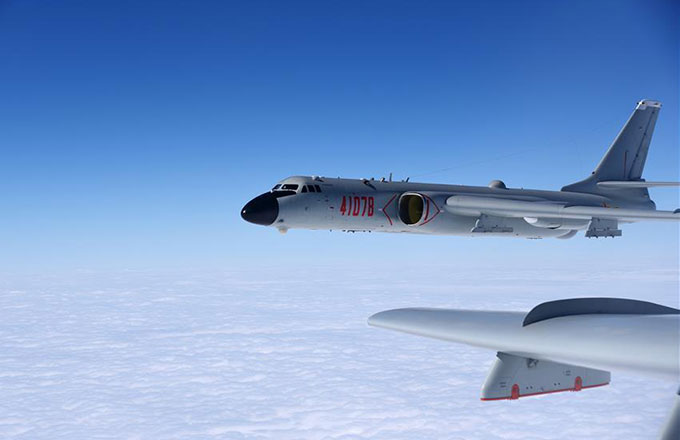
Likewise, it has invested heavily in the development of military aircraft. China's J-20 stealth fighter made its public debut at the China Air Show in Zhuhai, South China's Guangdong province, in November last year.
The development of the J-20 is progressing as scheduled, and it is expected to further boost the fighting capacities of the Chinese air force, said Shen Jinke, spokesperson for the People's Liberation Army Air Force, at a news conference at the show.
Shen said that the fighter will help the air force better fulfill the mission of "safeguarding national sovereignty, security and territorial integrity," adding that the J-20 is adaptable for the future.
Before the public unveiling of the J-20, China's first domestically developed heavy air freighter, the Y-20, made its maiden flight in January 2013. The development of the two planes shows the country is well on the way to achieving its goal of becoming a strategic air power, according to analysts.
"A genuine strategic air power must possess a strong power projection capability, which is highly reliant on large aircraft, namely a strategic air freighter and a strategic bomber," Wang Yanan, deputy editor-in-chief at Aerospace Knowledge magazine and a military analyst, said.
"The long-range power projection capability of the Chinese air force still lags behind. But the Y-20 means we have made strides toward building a strategic air power."
The Y-20, with a crew of three, has a maximum payload of 66 metric tons and a maximum takeoff weight of more than 200 tons. The length of the Y-20 is 47 meters and its wingspan is 50 meters.
High-speed railways
Former state leader Deng Xiaoping was impressed by Japan's bullet trains when he visited the country in 1978. At that time, China had less than 9,000 locomotives - of which only 200 were electric - running at an average speed of about 40 kilometers per hour.
Since then, Chinese people have regarded the speed of its trains as an indication of the country's development level.
China named its first high-speed train, which came into use in 2007 with operating speeds of 200 to 300 kilometers per hour, as Hexie, or Harmony, conveying its wish for a harmonious society in the fast-changing country.
The latest Chinese bullet trains, which China developed independently, have an operating speed of 350 km an hour. The new high-speed trains are called Fuxing, or Rejuvenation, demonstrating the country's resolve to achieve national renewal. They went into operation on June 25 between Beijing and Shanghai.
"The launch of the Fuxing bullet trains symbolizes China's high-speed railway construction is among the most advanced in the world, and China has mastered the technology of high-speed train's manufacturing, operation control, traction power supply and communication signal systems, as well as other things," said Liu Hui, vice-president and chief engineer of CRC.
Among the 254 important standards of the Fuxing bullet trains, 84 percent are Chinese, showing China has largely acquired the ability to manufacture high-speed trains independently, according to Cao Gangcai, deputy chief economic manager of the CRRC Group, China's largest locomotive and rolling stock manufacturer.
China is a large country with diverse geological conditions. The high-speed railway network extends 5,200 km from east to west and 5,500 km north to south, covering areas that not only experience extremely low temperatures and strong winds, but also areas where the earth is frozen or which are prone to landslides, among other things.
"To overcome these difficulties, the researchers, engineers and constructors had to make concerted efforts, and optimize many technologies and designs to adapt the high-speed rail lines to different environmental conditions," Cao said.
At the end of last year, China had 66 high-speed railways, whose total length was 220,000 km, the longest in the world. Nearly 1.5 billion passenger trips were made on them last year. By 2025, the total length of the high-speed railways in China is expected to reach 380,000 km.
Quantum communications
The quantum communications network connecting Beijing and Shanghai, about 2,000 kilometers apart, recently passed a technological examination, meaning the world's first quantum communications network is ready to be launched in China.
Quantum communications allow the sharing of a messages that are encrypted by a key made up of quantum particles, which means they are generally regarded as being "unhackable", because if a third party tries to intercept the message it will immediately alter the information being relayed, with the disturbance being instantly known.
Quantum communications technology has developed rapidly in recent years, with the United States, Europe, the Republic of Korea and China all investing heavily in R&D, as quantum technology is regarded as being one of the major technological advances of the 21st century that will support the next generation of telecommunication and the computing technology.
China launched the world's first quantum communications satellite into orbit in August last year. The satellite can be used to transmit encoded data through quantum keys transmitted via light pulse signals. It also announced it had successfully built the world's first optical quantum computer in May.
Pan Jianwei, professor of quantum studies at the University of Science and Technology of China and head of the research team of the quantum communications satellite, said quantum communications technology not only has practical applications but also lays a solid foundation for theoretical breakthroughs in physics and space studies.
The central government regards quantum communications as "disruptive technology that can lead a new industrial revolution" in its State Science and Technology Innovation Plan for the 13th Five-Year Plan Period (2016-20), and so supports the research and development of it accordingly.
Pan appreciates the support of the government and multiple research institutes across the country for the project. "Different parts of the satellite come from the hard work of different institutes. It is basically teamwork," he said.
Experts say the launch of the Beijing-Shanghai quantum communications network marks China's transformation from being a leading researcher in the field to the first user of the advanced technology, which will give China a considerable advantage in the development of related technologies and industries.
Xinhua contributed to this story.