For the greater good


The Guangdong-Hong Kong-Macao Greater Bay Area promises increased prosperity and more choices for talents across the 11-city cluster, reports Shadow Li.
Hong Kong has secured a pivotal footing in both the nation's economic and social development since it returned to the country two decades ago. Thus Guangdong province, with its rich heritage and barrier-free language environment, is the natural choice for Hong Kong people looking for another place they can study, work and live in.
The concept of a city cluster in the Guangdong-Hong Kong-Macao Greater Bay Area (GBA) was officially put forward by Premier Li Keqiang in the central government's work report in March. The strategic plan will give full play to the distinctive strengths of the Hong Kong and Macao special administrative regions and further strengthen the roles of both SARs in the country's opening-up and economic development.
Geographically, the bay area comprises 11 cities-the two SARs and another nine cities in Guangdong province, namely Guangzhou, Shenzhen, Zhuhai, Dongguan, Huizhou, Zhongshan, Foshan, Zhaoqing and Jiangmen.
The formation of the bay-area city cluster is a natural outcome of decades of integrated cross-boundary exchanges at all levels-especially the exchange of talents.
Mobilizing talents
A thematic household survey by Hong Kong's Census and Statistics Department revealed in 2013 that the top seven cities Hong Kong people frequently visited all fell under this city cluster.
The migration and mobility of talents is driven by economic incentives, observed Professor Shen Jianfa, an expert in closer Pearl River Delta ties in the Department of Geography and Resource Management at the Chinese University of Hong Kong (CUHK).
The fl ow of talents used to be mainly from the mainland to Hong Kong when the SAR had the upper hand in economic development. But the trend reversed in 2008 when the mainland economy really took off. However, the new trend saw stagnant growth in recent years, according to a government survey on Hong Kong people who work cross-boundary, reportedly due to a number of economic reasons and social differences.
"There has been an ongoing trend of growing relationships at all levels between Hong Kong and the Pearl River Delta area (where most of the nine cities lie) since China resumed the exercise of sovereignty over the city in 1997," Shen said.
He said the relationships, though not without ups and downs, are expected to spur a mutual flow of talents in many sectors, which will become more frequent in the future under the GBA.
Shen predicted the GBA will give another push to the recently lackluster mobility of talents from Hong Kong to the mainland-possibly leading to an all-time high.
Of course, people-to-people bonding and exchange must build on "hardware", especially the well-established and fully connected infrastructure.
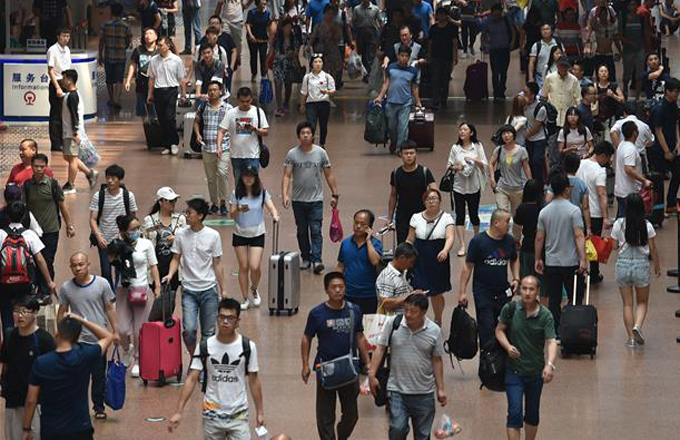
In April, Chief Executive Leung Chun-ying revealed that about 300,000 Hong Kong people are working on the mainland-accounting for 8 percent of the total working population of Hong Kong. This cross-boundary workers group will expand with better infrastructure and transport networks within the bay-area city cluster.
The imminent completion of infrastructure projects of the Hong Kong-Macao-Zhuhai Bridge and the high-speed rail link between Guangzhou and Hong Kong, expected to open in December 2017 and the third quarter of 2018, respectively, will undoubtedly accelerate the growth.
The relationship between the flow of talents and economic growth is symbiotic. For cities inside the GBA, Guangzhou, Shenzhen and Hong Kong all have clear industrial divisions requiring diverse talents. For example, Hong Kong has a full-fl edged service industries, including the finance industry and arbitration services. Meanwhile, Shenzhen is a city with a high-tech base that can attract talents in the GBA that possess innovative research and development skills.
Chain reactions
That being said, the three cities are not essentially rivals but have supplementary relationships with each other, leading to a win-win situation in the area, Shen said.
Echoing Shen, Professor Susanne Choi Yuk-ping of the Department of Sociology at CUHK said cross-boundary flows of talents are incentivized by economic opportunities, with changes of flow being mutual.
The convergence of regional economic development is a trend of no return and will gradually expand and dilate to form an even bigger area of cooperation, from coastal cities to inland areas, Choi said.
Despite calls for more integrated exchanges within the GBA, obstacles remain-such as Hong Kong identity card holders working in the rest of the GBA being treated as non-locals. They are mostly excluded from residential benefits, no matter how long they have been living on the mainland.
Such inconvenience for greater talent exchange inside the GBA still discourages Hong Kong people, for whom some social benefits such as medical insurance are not covered.
At the government level, there should be greater relaxation of policies to align the city clusters, Shen explained. He cited the example of long-distance phone calls to Hong Kong still being considered as international roaming service, leading to higher roaming charges. Shen added that technically this barrier should be easy to remove.
Another example of alignment would be the unification of transport cards in the GBA, making them convenient and compatible for all 11 cities. All these should be taken care of at governmental level to clear the path for more profound integration, Shen suggested.
Despite some teething problems, Choi observed positive effects brought about by increasing relationships within the bay area.
As more people seek better job opportunities in the GBA, Choi believed, they will gradually form a strong basis that will trigger other various forms of growth. More international schools will be built for their children's education; and more residential buildings will be needed, with better supporting facilities-and so on, in a variety of chain reactions.