Still much to be done in fight against poverty
Today, the World Bank is releasing a new report that assesses poverty and inequality in China entitled From Poor Areas to Poor People: China's Evolving Poverty Reduction Agenda. As a longstanding researcher of poverty issues in China, I have a keen interest in the report's findings. But I have a special interest in this particular report because I was a key member of the analytical team that produced many of its findings.
There is always great attention paid to World Bank estimates of the number of China's poor, perhaps because many feel that China's poverty count serves as a marker for China's economic and social progress. At the same time, poverty estimates are often controversial because they depend on assumptions about how to construct a poverty line and how to measure welfare, about which reasonable people can disagree. For instance, whatever our view of how many poor exist in China, we can certainly agree that by any measure China has achieved dramatic reductions in poverty since economic reforms began.
China's official poverty estimates show a fall in the poverty headcount from 18.5 per cent in 1981 to less than 2 per cent in 2007. Using the World Bank's new poverty line of $1.25 a day, consumption poverty fell from 85 per cent in 1981 to 27 per cent in 2004. Thus, half a billion poor were lifted out of poverty, an achievement of historic global importance. In fact, China accounts for nearly all of the global poverty reduction achieved over that period and more recently has been by far the most important contributor to meeting the Millennium Development Goals for global poverty reduction.
Despite these laudable achievements, I think it is equally uncontroversial to state that there still remains much work to be done to help the poorest citizens in Chinese society. A 10 per cent poverty rate means that there are more than 130 million poor in the country. Despite the low official poverty estimates, the Chinese government continues to aggressively pursue programs to help those with "low income" even if their incomes are above the official poverty line.
The main point of the new World Bank report is not to settle debates about how many poor there are but rather to provide recommendations for how to move forward in attacking the remaining poverty. The timing couldn't be better given the current global economic crisis, which threatens to push millions of people back into poverty. In this respect, the report's recommendations can help focus attention on appropriate policy priorities in a challenging period.
One important message highlighted by the report's title From Poor Areas to Poor People is that regionally targeted approaches to poverty reduction, which have been the main focus of official poverty alleviation programs in the past, are likely to be increasingly insufficient for helping many of China's poor. This is partly because poverty has become more dispersed spatially, with many of the poor living in villages not targeted by official programs. The reasons for poverty may vary from individual to individual. Another reason is that most of the poor are not chronically so, rather they move in and out of poverty from year to year depending on changes in their health, the weather, their employment circumstances, etc.
Analysis of rural household survey data for three years finds that while only 7 per cent of the rural population were poor in all three years, 31 per cent were vulnerable to being poor in at least one of the three years. This year's economic crisis highlights how a global market-based economic system can create much greater risk for individuals and their families even as it provides more opportunity as well. Those hit hardest by the economic downturn have been rural migrants who are not rooted to any one location. China's approach to poverty must adapt to these realities.
For one, this means that strengthening social protection and social insurance systems must become an important part of the overall poverty reduction agenda. Here, the government has made significant progress in recent years by extending its minimum living standard assistance (dibao) program to rural as well as urban areas, and investing heavily to expand health insurance coverage. However, much work remains to strengthen these programs, making them more transparent, better integrated, and more equitable; and to extend social insurance (including unemployment insurance, health insurance, and pension coverage) to migrants and other workers employed in China's rapidly growing informal economy.
Second, the best investments in a world in which the economic environment is constantly changing may be in one's own human capital, eg education and health, which is portable wherever one may go and which enables individuals to more easily take advantage of new opportunities. The returns to education have increased substantially in China over time, making education an increasingly important determinant of inequality and poverty. With the government currently eager to spend money as part of the stimulus package to spur economic recovery, what better long-term investments than improvements in the quality of basic health and education services available to all? China has already made strides in this area, for example by eliminating school fees for compulsory education, but much more can be done by reducing fees for upper secondary school and investing more in training programs and lifelong learning strategies, and by increasing the level of benefits of current health insurance schemes.
Overall, the new World Bank report puts great emphasis on increasing the productivity of labor and increasing the access of the poor to work opportunities in China's dynamic, fast-growing economy through migration and greater labor market integration. However, there are many types of poor in China, and a successful poverty alleviation strategy will have to be multifaceted in many different dimensions. The report provides many specific recommendations worthy of attention, and is notable in providing a host of facts and analysis to back them up. Hopefully it will stir discussion in policy circles.
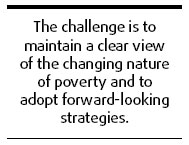
Thirty years of rapid growth have delivered a level of national prosperity and wealth that now puts China in a position to do much good for its poorest citizens. To its credit, the Chinese government has consistently placed poverty reduction high on its political agenda. The challenge moving forward is to maintain a clear view of the changing nature of poverty and to adopt forward-looking strategies that can best realize China's vision of an equitable, harmonious society.
The author is Reader in the Economy of China, University of Oxford.
(China Daily 04/08/2009 page8)