China-EU media should strike fairer balance
Media exchange between China and Europe is a century-old story. In the early 20th century, George Morrison was The Times' resident correspondent in Beijing. He told the world what was going on in China.
Now, more than 300 correspondents representing 169 media organizations from 25 European countries are based here. And they send out thousands of reports every day.
The Chinese media has also more than 100 representatives across Europe as media exchange expands significantly.
Media and news people have played their role in promoting understanding and friendship beween China and Europe. Oriana Fallaci, an Italian journalist, interviewed Deng Xiaoping in 1980 and made the world aware of China's reform and opening-up policy. The Financial Times recently interviewed Chinese Premier Wen Jiabao. A few days ago, President Hu Jintao's trip to the London G20 summit was well covered by European media. Today in China, Europe is always featured in newspapers, TV programs and on the Internet.
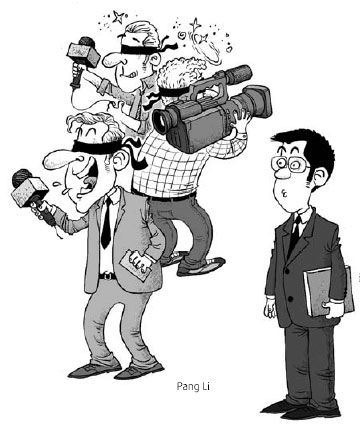
However, it is regrettable that some of the China reports from the Western media are not comprehensive, objective or fair, which lead to misunderstandings or even biased views of China. Some are even to the detriment of China-EU relations after so many years of joint efforts.
Why do the Chinese and Western media act so differently on reporting some issues concerning China? Why would such reporting stir such strong social reaction? There are many reasons.
First of all, some Europeans and some European media still lack an understanding of China. In 2008, about 6 million Europeans visited China. Only a small proportion of the population are really aware of the latest developments here. And for the 6 million who visited China, few ventured into the hinterland to explore the diversity and challenges it faces. The Europeans just don't know China well. Nor do most editors working at media headquarters. Some foreign reporters working in China have even told me their reports are often modified by editors at home to be critical of China.
Secondly, many European media report China on the basis of fixed images and assumptions. China and Europe have such different histories, culture, economic development, and social and political systems. Surely we'll have different views of and reactions to certain issues. But often the European media judges China based on European values, culture, social models and development levels.
For instance, before the Beijing Olympics, some Western media criticized Beijing for infringing the rights of residents through traffic, housing, business and urban management adjustments. But when the reporters went to Beijing and interviewed the residents in person, they were moved by the pride that people in Beijing had in hosting the Games and making sacrifices for the convenience of their guests.
Thirdly, I have to point out that one of the most important reasons is that some Western media criticize China on an unfounded basis and by using distortions.
On many issues concerning China, some Western media have nurtured a "systemic bias", persisting with patronizing comments and ill-founded criticisms. In extreme cases, they even abandon the fundamental principles of objectivity and fairness and violate professional ethics.
They patch up a piece of news using untested or even fabricated information, or sink to irrational bashing and smearing. For example, one German TV station photographed Nepalese Police arresting demonstrators and reported it as the Chinese army cracking down on Tibetans after last year's Lhasa riots.
Fourthly, the European media has not fully recognized the power of influence their reporting has on China-EU relations. Most Europeans get to know China through the European media. Therefore, the pen, the lens and the keyboard in reporters' hands carry special weight. What they produce will have a strong influence on the views of governments, enterprises, societies and the general public about China and shape public opinion on the China-EU relationship.
Today, reform and opening-up has brought China economic, social and political development. China is also actively involved in international affairs as the world benefits from its growth. But a BBC opinion survey last February showed the percentage of people regarding China as positive influence slipping from 45 to 39 percent. This result runs counter to actual development. The world has not reacted accordingly to China's growth because it is not presented with the merit it warrants.
The China-EU relationship is one of the most important bilateral relationships in the world. In the face of the global economic downturn and trade contraction, the two should more than ever broaden and deepen cooperation, so as to meet the challenges hand in hand.
I sincerely hope that the Chinese and European media will play a positive and constructive role in promoting our relations.
To make this happen, I think the following four points should be given special attention: responsibility, objectivity, credibility and communication.
Our media and correspondents shall be more aware of their responsibility for promoting China-EU relations. They have major influence on public opinion, on policy and on the future of our relations. They ought to bear in mind the responsibility and the interest of 1.8 billion Chinese and European people, look at our relationship from a long-term and strategic perspective, and make their news reporting and commentary conducive to consensus, trust and cooperation between us, rather than conflict, dispute and contradictions.
For objectivity, our media and correspondents shall stick to the basic principles of news reporting for presenting the truth to the world. Despite differences, we all cherish and follow the principle of telling the truth. The objectivity of news reporting depends on comprehensiveness of information and balanced views. One should not stand in favor of any side by using certain tricks, such as selective wording or photography with underlying statements. Chinese and European media should respect the other's theory of development, policy choice and cultural values, and the correspondents should do their job with an open mind, an open heart and a broad vision.
For better communication, our media and correspondents should cooperate more to acquire more understanding and knowledge.
The Chinese and European media should engage the local community and establish frank, in-depth and two-way communication with people from all walks of life. They should listen more attentively to how the other side responds to their impressions, judgments and conclusions.
Finally, I'd like to say a few words about China's reaction to criticisms from the Western media. The Chinese nation is modest, self-critical and eager to learn from others. We are keen to study from others, and we acknowledge the problems during the course of development and welcome constructive suggestions and well-intended criticisms. And we are ready to talk about disagreements and disputes. What we don't accept is willful imposition of views and standards or pressuring. China never yields to any pressure. Over the past 30 years, China has made tremendous achievements in economic, social, political, cultural and other fields. These achievements are the result of the reform and opening-up policy and the hard work of all Chinese people. They are by no means the result of media pressure from the West.
During his recent visit to the EU headquarters, Chinese Premier Wen Jiabao said, "I believe that the larger trend of the EU-China relationship cannot be reversed, like no one can reverse the trend of history".
And President Barroso said, "Europe, China and the international community can only benefit from intense cooperation between the EU and China".
It is a historical mission for us to push forward the China-EU strategic partnership. To fulfill it, we shall do our bit in our job and also give the other assistance and support. Together we will make our relationship beneficial to our people and the world.
The author is Chinese ambassador to the European Union. The article is an excerpt from a speech he made Wednesday (April 8) at the Chinese and European media Forum.
(China Daily 04/09/2009 page9)