Can China reduce foreign reserve risks?
The US Federal Reserve announced in March that it would purchase$300 billion worth of long-term bonds and $850 billion worth of institutional bonds in the following six months. The news soon gave rise to worries about the risks of mid- to long-term inflation and US dollar depreciation across the globe, particularly in China with its $2 trillion foreign exchange reserves.
The US government is very likely to pass its onerous debts to countries holding US dollar reserves through currency depreciation due to the central role enjoyed by the US dollar in the global monetary system. Some American officials and scholars contended that China and some other countries should be blamed for the US financial crisis due to their excessive savings.
But China and other countries do not think that way. Currently such foreign reserves are in the vicinity of $5 trillion, most of which are concentrated in East Asia. East Asian countries have increased their foreign reserves since 1990s, particularly after the 1997 Asian financial crisis to ward off speculative attacks on sovereign currencies. Their large accumulation of foreign reserves is also a result of the existing deficient international monetary system where the US faces no pressure of trade balance due to the special status of the US dollar, and the excessive consumption tendencies of both the government and individuals.
In the event that the US dollar devalues considerably, which is set to lead to depreciatory money competition among euro, pound, yen and dollar, what should holders of large foreign exchange reserves do to prevent their reserves from sinking?
Zhou Xiaochuan, governor of the People's Bank of China, advocates establishing a super-sovereign reserve currency based on the existing special drawing rights (SDR) in his published article "Reflections on reforming the international monetary system," released a week before the G20 summit in London. His suggestion to replace the US dollar with SDR has garnered support from BRIC countries, such as Brazil and Russia. However, the idea was immediately rejected by US President Barack Obama; both US Treasury Secretary Tim Geithner and Federal Reserve Chairman Ben Bernanke asserted that the US dollar remains robust and turned down the proposal for creating a "super-sovereign reserve currency". The US' stance was echoed by the European Union and other developed countries.
To set up a super-sovereign reserve currency calls for a wide consensus among major powers in the world, and history shows that it is extremely difficult to bring about any collective action. The present SDR is valued according to four types of currencies. Any additions to this list will need to meet the selection criteria. Given that the Chinese yuan has not been fully convertible so far, what institutional innovation is required before the Chinese yuan can be accepted by other countries? How should China negotiate with IMF? Or as suggested by Joseph Stigliz, the Nobel Prize winner, should a new organization be set up for overseeing the international currency?
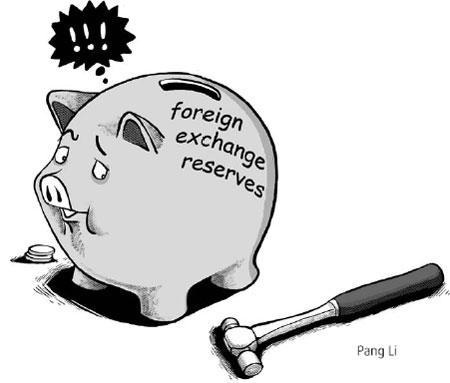
China and other countries with huge foreign reserves are more concerned about finding ways to reduce the risks of these reserves than to replace the US dollar with a super-sovereign reserve currency, which is a much more complicated issue.
There are other, more practical options to reducing the risks of foreign exchange reserves. First, G2, the Sino-American dialogue mechanism, can be utilized to achieve the goal. As a matter of fact, G2, or the like, was initially proposed by US Democratic think tanks before President Obama took office, and Secretary of State Hillary Clinton's first visit to Asia was widely regarded as the first step towards G2. Nonetheless, China's role in G2 in the context mentioned earlier does not refer to a big power status comparable to that of the US. It is that of a country with $2 trillion foreign exchange reserves, or 40 percent of the world's total foreign exchange reserves. In an article titled "China's dollar trap" published in the New York Times, Nobel laureate Paul Krugman pointed out that the super-sovereign reserve currency proposal made by Zhou Xiaochun was actually China's "admission of weakness", in view of the fact that "China had driven itself into a dollar trap", but "it can neither get itself out nor change the policies that put it in that trap in the first place". By the same token, the US, too, has fallen into that trap. Depreciation of the dollar and the passing on of debts to others will hurt not only China, but also other East Asian countries, newly emerging markets, oil exporting countries as well as some developed countries, and eventually the US itself.
To avoid such consequences, the US has to persuade China to continue using the dollar as the international reserve currency while waiting for the Chinese yuan to become freely convertible and for the Chinese economy to expand further. Other East Asian countries and newly emerging markets are likely to look to China to take the lead before they continue with their accumulation of dollar-denominated assets. By the time the Chinese yuan becomes freely convertible a new international monetary system is likely to have emerged naturally.
China's compliance with the American request, however, should not go without conditions. The US should agree not to adopt policies that may result in considerable depreciation of its dollar. The US cannot expect China to make new purchases if the risk of government bonds associated with dollar devaluation is not lowered. More specifically, can the US sell yuan-denominated panda bonds to China and make repayments with yuan on the due date? Or can the US link the bond interest rate with its inflationary rate or allow China to buy convertible bonds that entitle bond owners to convert bonds into relevant American company and/or bank shares? .
To avoid instability brought about by US dollar fluctuations, China recently conducted currency swaps with major raw material exporting countries and trade partners, such as South Korea, Russia, Malaysia, Indonesia and Argentina. The swapped amount has already captured 650 billion yuan (equivalent to $93 billion). At the same time, China is making every effort to promote cross-border trade settlements in yuan and create Hong Kong as the first offshore yuan settlement center. The efforts do not stop here. China is likely to take further measures in the future. For instance, it is likely to take full advantage of its role as the world's largest manufacturing base and resource-importing country to eventually conduct bulk resource trade with yuan settlement.
Compared with the US, which is embroiled in the dollar trap, China has more policy options and space for maneuver. To reduce the risks associated with its reserves, China needs to not only adopt a long-term international strategy, but also demonstrate the courage and skills to make full use of the possible platform of the G2.
The authors are researchers with East Asian Institute, National University of Singapore.
(China Daily 05/20/2009 page9)