An economist rises to the green challenge
When a great idea emerges, it may come with a bang - especially when a man who some regard as a conservative economist takes a radical environmental line.
Hu Angang, one of China's leading policy advisers, has long been seen by critics as being too ready to speak for the central government. Perhaps his association with an elite research group on "state of the nation" (or guoqing) of the Chinese Academy of Sciences has a lot to do with that. Hu joined the research team in 1985 before Tsinghua University co-sponsored the program in 2000. That group has prepared about 500 policy research papers.
But these days, he is leading a one-man campaign for such an ambitious plan that even his most ardent critics will admire him for his boldness. In fact, it is the most radical proposal from a member of a Beijing think tank. And Hu knows exactly what he is saying.

"Mine is going to be the most radical program," says the 56-year-old scientist turned researcher in public and environment policies in an interview with China Daily. "This is what I wanted I want to represent the most radical climate line in China."
Most people calculate, but not Hu. This is not the time to play with figures, he says. Nor is it a time for only diplomacy with no country taking the lead in sacrificing some of its immediate interest for a good cause. "It is just like China's reform and opening up." When an old development model stops working, the main task is to change it.
"You don't just do your own calculation. You don't just look at other people. Deng Xiaoping never did that," Hu says, referring to the man who began the reform and opening-up process in the late 1970s. "He (Deng) set the goal. He made people work to achieve it, irrespective of what other countries were doing."
That is what, he says, "wisdom and courage" are all about - qualities the present generation of leaders must demonstrate to make the country a leading player in the fight against global warming. If China wants to take the path to a green economy, it should set the peak of its greenhouse gas (GHG) emission at 2020, he says, in contrast to most other experts, who target 2030, 2035, or even 2050.
What 2030 should see, instead, is the falling of China's GHG emission to its 1990 level, Hu says, adding that the fall in GHG emission, or the pace of progress toward a green economy should be so drastic that by 2050 China's emission should be down by another 50 percent.
These targets, he admits, may earn him the wrath of some of his colleagues and may never be wholly accepted by the government.
Hu did his post-doctoral research in economics at Yale University after earning his PhD from the Chinese Academy of Sciences in 1985. That research resulted in his first book and brought him global recognition. Co-authored by Wang Shaoguang, the book, State Capacity of China, was translated into English and published by Oxford University Press in 1994. It deals primarily with the relationship between the central and regional governments during economic reform.
|
Hu Angang |
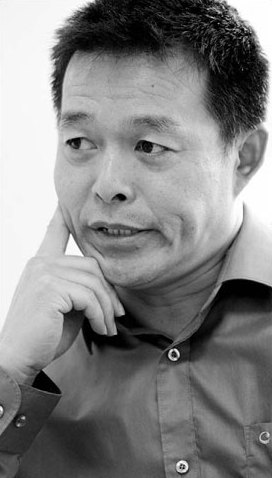
Hu has been engaged in research and development ever since, using his interdisciplinary approach. Of late, his publications and speeches show his key areas of interest are the discrepancy between China's developed and underdeveloped regions, and the environment and natural resources.
For the last couple of years, Hu has been saying that China neither has to nor should follow the path of the developed countries. It has to take the road to an eco-friendly economy by providing incentives to green consumers and green services.
Setting a goal is most important, he says, because only after that can we draw a road map and choose technical solutions. Less than three months are left for the UN climate change conference in Copenhagen, but China has not yet announced its position on how fast it will reduce its carbon footprint. Varying proposals are in circulation on how to balance the country's national interest and the fight against climate change.
The Kyoto Protocol, the global treaty on mitigating climate change, came into being in 1997 and expires in 2012. It does not require developing countries, including China, to reduce their GHG emission to a certain level. It imposes a mandatory cut on developed countries, though, many of them have either refused to ratify it (such as the US) or have failed to meet the reduction levels.
Despite that, China has been trying to cut its emission levels. For the past few years, it has set its own goals for energy efficiency and pollution control, though it falls short of a comprehensive plan.
World leaders will meet in New York (at the UN General Assembly) and Pittsburgh (for the second G20 summit this year) later this month to hopefully narrow their differences on climate change. But as an expert both in economics and the environment, Hu doubts whether the countries will achieve a breakthrough in climate change talks any time soon.
"What we have," he says, "is a community of more than 6 billion people from over 200 economies, and they are divided into two large competing camps, the developed and the developing countries."
The developing countries insist that the Kyoto Protocol has already put the onus of climate change on Annex I, or developed, countries, and describes developing nations primarily as victims of the problem. But the developed world wants to introduce concepts that go beyond the scope of the protocol and earlier international treaties by trying to impose mandatory GHG emission cuts on major developing economies such as China, India, Brazil, Russia and South Africa. This could lead to a stalemate at the Pittsburgh talks, and consequently the Copenhagen conference.
"This kind of bargaining, I'm afraid, will not help realize a fruitful deal in Copenhagen," Hu says. The truth is that global warming is a problem of the developed and the developing countries both.
After 30 years of rapid economic development, China is no longer a typical developing country. But that rapid pace of development has also made China (along with the US) the largest GHG emitter in the world. "And this is exactly where my interests as an internationalist meet my aspiration as a patriot," he says.
While appealing to the public, Hu is also trying to get some of his ideas into the country's next Five-Year Plan. There are five areas, he says, that the country should concentrate on before 2020. It should:
Continue to lower its energy intensity (measured in terms of the use of coal for every 10,000 yuan of GDP) by 20 percent every 5 years;
Continue to reduce pollution and cut the discharge of major pollutants by 10 percent every 5 years;
Conduct intensive research in green technologies and make them the economy's core competitive elements;
Increase the use of clean energy to 20 percent of the total and make the country a leading global market for alternative energy technologies and know-how; and
Make the country the world's largest afforested place by planting more trees.
None of these, he says, is just a tactic for dealing with the mounting external pressure. Green industries and green technologies are tools for China to create new opportunities.
"Our commitment must be serious," Hu says. "That should be the way for China to grow into a future world leader it should replace the bad examples of the developed countries with new workable examples for sustainable economic growth."
(China Daily 09/16/2009 page9)