Double dip unlikely, says IMF official
|
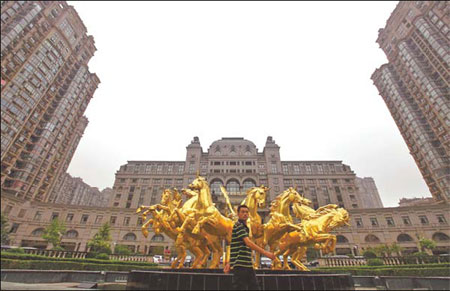
A pedestrian walks past a sculpture of horses in front of the Zhujiang Dijing residential and commercial complex in Beijing. Zhu Min, special adviser to the managing director of the International Monetary Fund, said there is no risk of a double dip in the global economy. Jason Lee / Reuters |
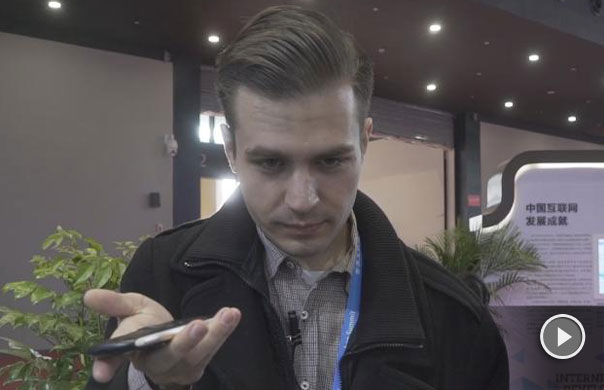
Global economy recovering despite slow growth trajectory: Zhu Min (video)
TIANJIN - The global economy does not face the risk of a double dip although it has entered a slow growth trajectory, Zhu Min, special adviser to the managing director of the International Monetary Fund (IMF), said on Tuesday.
"At this stage, we don't see the particular risk we call a double dip that everyone is talking about," Zhu told China Daily in an exclusive interview. "It (the global economy) is still recovering."
The global economy has entered a slow growth trajectory, he said. "We saw global exports slow down; so also is the case with industrial production and the purchasing managers' index."
Global governments are committed to maintaining economic stability and hence there is very little chance of another major recession in the short term, he said. "They (governments) have a lot of policies to use," said Zhu, who was deputy governor of China's central bank and Bank of China Group's executive vice-president before joining the IMF.

Advanced and emerging economies are facing severe challenges, he said. "The financial sector (of advanced economies) has stabilized but remains fragile. For example, there are still trillions of dollars of the so-called toxic assets."
The overall debt ratio of these nations, which could jump from 90 percent to 115 percent on average in the next five years, is another major challenge, he said.
For emerging economies, a special risk is the potential volatility triggered by the huge capital inflows and outflows, he said. "Capital flows into the emerging markets is good news. But it can sometimes be risky due to the volatility," he said on the sidelines of the ongoing Summer Davos Forum.
"During the past 10 years, the capital flows from the peak to the trough can be as high as 5 percent of the GDP of emerging nations. (They have) caused financial sector volatility and also exchange rate volatility."
Though the G20 mechanism has played an important role in stabilizing the global economy, it is also important for the non-G20 members to have a greater saying.
"Of course, it's impossible to get all countries included in the framework. We need proper representation, different constituencies and proper representatives for different areas and regions," said Zhu.
He also urged for faster global governance reforms. "We are in an era of globalization, without any global governance."
Talking about the yuan's exchange rate, Zhu said the IMF supports China's efforts to make the yuan more flexible. "The Chinese government is determined to move the exchange rate regime to a more market-oriented system."
China vowed to make the yuan's exchange rate more flexible on June 19. The currency has risen by about 1.3 percent since then. The yuan's central parity rate rose to 6.7378 per dollar on Tuesday, the highest level since the start of revaluation in July 2005. However, some countries, such as the United States, have criticized the slow pace of yuan appreciation and blamed it for its trade deficit.
Zhu said the exchange rate is determined by several factors as capital account conditions and not just trade alone.
High-income countries should save more, while low-income countries should increase consumption to rebalance the global economy and reduce trade frictions, he said.
China Daily
(China Daily 09/15/2010 page13)