Top News
Couples become easy prey in tube baby boom
By Cao Li and Duan Yan in Beijing (China Daily)
Updated: 2010-11-02 07:52
 |
Large Medium Small |
|
A nurse feeds a twin conceived through in vitro fertilization in Mianyang, Sichuan province, in this file photo taken in August 2010. Huang Jiaming / for China Daily |

Rising demand for IVF treatment fuels spread of unlicensed clinics. Cao Li and Duan Yan in Beijing report.
As a cold, monotone voice echoed along the whitewashed corridors, women sat or stood against the walls in silence, their faces carved with frustration. They were all waiting for their name to be called, for their chance to make a dream come true.
The line to see fertility specialists at Peking University No 3 Hospital in Beijing stretched out of the main entrance, with dozens forced to wait outside in the swirling autumn wind. Staff members said it is a common sight.
With sterility now affecting 40 million people in China, couples are increasingly turning to in vitro fertilization (IVF) in order to have children.
However, medical experts say that the commercialization of the practice in recent years has led to a spread of unlicensed clinics offering illegal services to parents and surrogacy agencies.
IVF, which involves mixing the eggs and the sperm in a laboratory before implanting them in a woman's womb, has steadily developed in China since its introduction two decades ago, with patient numbers soaring.
Records from the prestigious Peking University No 3 Hospital, where China's first "test tube baby" was born in 1988, show doctors there treated 3,500 patients in 2008 and 5,000 last year. That figure is expected to top 7,000 by the end of this year, said Qiao Jie, director of its reproductive medical center.
Patient numbers are also swelling by about 50 percent every year at the Shanghai No 1 Maternity and Children's Hospital, according to reproductive health director Teng Xiaoming.
"My husband has problems," said a 23-year-old woman who gave her name as Li Lei. She was waiting for her husband of two years to finish a checkup at Peking University No 3 Hospital.
"We have visited various hospitals and tried everything, even herbal medicines, but nothing has worked," she said.
The couple from Tangshan in Hebei province decided to try assisted reproductive technology (ART) after Li heard about a neighbor who had a baby through IVF.
"I want two babies," she said, greeting her husband as he emerged from the doctor's room with a hopeful smile. "The best thing would be to have a girl and a boy."
Exploiting loopholes
Reproductive health expert Qiao estimates that at least 10 percent of the people suffering infertility nationwide need the help of IVF treatments, which can cost up to 50,000 yuan ($7,500).
To meet such a demand, authorities have so far approved applications to start running ART services from more than 200 clinics nationwide. However, experts say the number is still far from enough, fueling a rise in illegal operations, sometimes at established hospitals.
Although no official figures exist on how many unlicensed centers are up and running nationwide, Wu Jian, a graduate from Shandong University's law school who researched the state of IVF technology in China as part of his studies, said he believes they are now widespread.
"After more than 20 years of IVF being practiced in China, it is already a mature technology that is not difficult to use," he said. "Also, the money involved helps lure unauthorized institutions into taking the risk."
Patients at unlicensed clinics are often couples sent there by surrogacy agencies, whose practices are a legal gray area in China but technically outlawed.
"You can tell how widely available illegal services are by looking at the advertisements of surrogacy agents on the Internet," said Yang Fang, a professor of medical ethics at Anhui Medical University.
"As most authorized hospitals don't provide such services, agents can only arrange patients to have IVF treatments at hospitals without the necessary license," she said.
China Surrogacy, an agency based in Beijing, offers one package for 380,000 yuan on its website.
A member of staff told China Daily by phone that the company can arrange surrogate mothers and IVF treatments "at one of the best hospitals" in the capital, although he refused to name the hospital.
Yang explained that public health departments do not have effective ways to regulate the ART industry and close down the illegal services because they "only have the right to supervise authorized hospitals".
"Many of (the illegal centers) are registered as companies instead of hospitals," she added.
Unlicensed clinics have also been a boon for families looking to have a second child without the required permit from the family planning authorities.
A 39-year-old woman who insisted on being identified by her online nickname, Zhi Zu, revealed she and her husband already have a son of 17 but now plan to exploit loopholes in the system to have a second child.
"We're not worried about money," said the mother, who hails from Northeast China's Liaoning province but explained she is receiving IVF treatment at Beijing Jia'en Hospital.
"I bought a fake birth permit and after the child is born I will buy him or her hukou (permanent residency)," she said.
Hospitals offering IVF treatments are required to check a patient's identity card, marriage certificate and birth permit, although a system to check the authenticity of birth permits is yet to be put in place.
Teng at the Shanghai maternity hospital explained that his staff member will contact family planning officials in the patient's hometown for confirmation if they are suspicious. "However, if the fake looks just like the real thing, most employees won't think to check," he said.
Zhi Zu said she is not alone in wanting a second child; a trend she says is due to fact people want bigger families when they become wealthier.
Many parents have joined in with a chat group she set up on QQ, a popular Chinese messaging service, about her situation. Other topics being discussed include the growing number of people opting for gender screening, which is illegal in China, and the possibility of having twins through IVF.
Gender screening can only be done with the latest ART equipment, which is available at only a dozen hospitals nationwide, said Teng, explaining: "It's not possible for patients to do that at a licensed clinic."
Question of control
Government bureaus responsible for supervising healthcare and industries have launched several crackdowns on illegal ART services. However, the fundamental problem, say experts, lies with the absence of any criminal or civil law that punishes owners of unlicensed practices.
Following the initial boom in IVF in the late 1990s, the Ministry of Health in 2001 released its first directives stipulating the ethics of IVF and the rules of qualification and procedure. The next year, an authorization system was established. Today, hospitals cleared to offer IVF treatments are strictly evaluated and receive regular inspections by officials.
"Unfortunately, the rules that are in place have not proved practical," said Sun Muyi, a professor of medical ethics at Southeast University in Nanjing, capital of Jiangsu province.
The numbers of hospitals that can obtain an IVF license from the ministry is strictly controlled and some in the industry say that by approving more applications, officials could take a big step toward solving the problem of illegal services.
Yet, Sun disagreed and said only a strong deterrent will work.
"This is serious," he added. "The abuse of IVF could affect our next generation. Improper operations increase the risk of birth defects in babies, while being able to choose the sex could impact the gender balance."
|
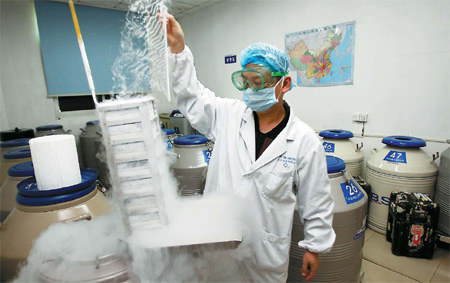
A laboratory worker checks sperm samples stored in liquid nitrogen at the reproductive health center of Xiangya Hospital in Changsha, capital of Hunan province, which offers IVF treatments. Zhang Tao / China Daily |
|
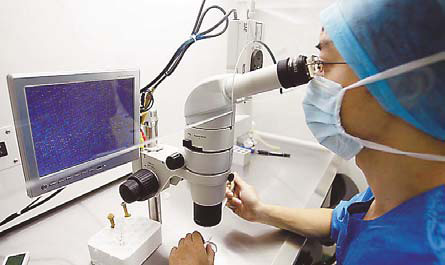
A researcher examines samples taken from a patient receiving IVF treatment at the reproductive health unit at Xiangya Hospital. Zhang Tao / China Daily |


(China Daily 11/02/2010 page1)
 主站蜘蛛池模板:
又黄又刺激又黄又舒服|
尹人香蕉久久99天天拍|
高清无码爆乳潮喷在线观看|
国产精品久久久久久久专区|
日韩精品亚洲专在线电影|
内射极品少妇xxxxxhd|
国产日韩一区二区天美麻豆|
亚洲色一色噜一噜噜噜|
中文字幕在线不卡一区二区|
成人啪精品视频网站午夜|
国产亚洲精品久久久久久久软件|
欧美激情视频一区二区三区免费
|
成全影院电视剧在线观看|
亚洲国产综合自在线另类|
久久这里只精品国产免费9|
无码精品日韩中文字幕|
国产老熟女视频一区二区|
亚洲自偷自偷在线成人网站传媒
|
久久香蕉国产线看观看怡红院妓院|
久久精品国产中文字幕|
国产精品论一区二区三区|
国产亚洲真人做受在线观看
|
久久96热在精品国产高清
|
色综合久久综合中文综合网|
国产美女久久久亚洲综合|
亚洲精品日本久久一区二区三区|
无码精品国产VA在线观看DVD|
丰满人妻被两个按摩师|
白嫩人妻精品一二三四区|
亚洲av不卡电影在线网址最新|
久久青青草原亚洲AV无码麻豆|
国产精品一在线观看|
国产综合视频一区二区三区|
在线观看中文字幕码国产|
最近中文字幕免费手机版|
女同另类激情在线三区|
秋霞人妻无码中文字幕|
久久久一本精品99久久精品66直播
|
毛片无码一区二区三区|
精品国产美女福到在线不卡|
亚洲AV日韩AV永久无码电影|
主站蜘蛛池模板:
又黄又刺激又黄又舒服|
尹人香蕉久久99天天拍|
高清无码爆乳潮喷在线观看|
国产精品久久久久久久专区|
日韩精品亚洲专在线电影|
内射极品少妇xxxxxhd|
国产日韩一区二区天美麻豆|
亚洲色一色噜一噜噜噜|
中文字幕在线不卡一区二区|
成人啪精品视频网站午夜|
国产亚洲精品久久久久久久软件|
欧美激情视频一区二区三区免费
|
成全影院电视剧在线观看|
亚洲国产综合自在线另类|
久久这里只精品国产免费9|
无码精品日韩中文字幕|
国产老熟女视频一区二区|
亚洲自偷自偷在线成人网站传媒
|
久久香蕉国产线看观看怡红院妓院|
久久精品国产中文字幕|
国产精品论一区二区三区|
国产亚洲真人做受在线观看
|
久久96热在精品国产高清
|
色综合久久综合中文综合网|
国产美女久久久亚洲综合|
亚洲精品日本久久一区二区三区|
无码精品国产VA在线观看DVD|
丰满人妻被两个按摩师|
白嫩人妻精品一二三四区|
亚洲av不卡电影在线网址最新|
久久青青草原亚洲AV无码麻豆|
国产精品一在线观看|
国产综合视频一区二区三区|
在线观看中文字幕码国产|
最近中文字幕免费手机版|
女同另类激情在线三区|
秋霞人妻无码中文字幕|
久久久一本精品99久久精品66直播
|
毛片无码一区二区三区|
精品国产美女福到在线不卡|
亚洲AV日韩AV永久无码电影|