China to be hotbed of luxury hotels
|
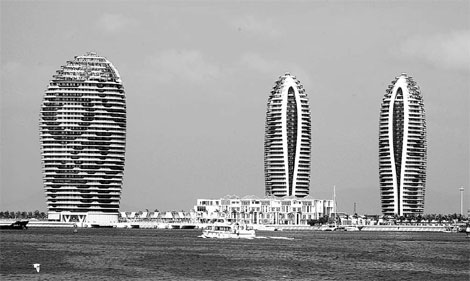
Phoenix Island, in Sanya, is one of many large-scale developments providing luxury hotels and boutique apartments. Provided to China Daily |
Sanya, the southernmost city in China, is trying to make itself into the Miami of the East as part of a plan to attract more tourists from home and abroad.
Judging by its hotels, though, Sanya may already be a step ahead of the city of pink flamingos and South Beach.
Plans now exist to complete 40 five-star hotels in five years in a 19-kilometer stretch of Haitang Bay in Sanya. According to reports, half of them will be operating before 2015, almost doubling the number of hotels in the city.
The massive construction project in the coastal city is a prime example of what's happening throughout China, as international and domestic companies move quickly to build luxury hotels.
According to Meadin.com, a web portal for the hotel industry in China, the country now has 660 five-star hotels and another 500 that are either under development or waiting for five-star recognition. Many large international hotel companies have recently announced development plans for China, not only for the largest cities but also for places that are slightly smaller.
The InterContinental Hotels Group Plc now manages 154 properties in China and has another 142 in its plans. The number of hotels under development in China, which accounts for a quarter of the company's total in the world, is the highest for any hotel group, said Keith Barr, chief executive officer of InterContinental Hotels Group Plc Greater China.
"As the first international hotel company to have entered the Chinese market, we arrived here first and we want to stay," he said.
Hilton Worldwide, meanwhile, plans to quadruple the number of hotels it has in China by 2014, bringing it to 100. The move will make China the company's second-most-important market after the United States.
Marriott International Inc also has big plans. Every month in the next three years, one hotel under the Marriott brand will be opened, said Simon Cooper, president and managing director for the Asia Pacific division of the company.
Figures from the National Bureau of Statistics in China and the United Nations World Tourism Organization indicate that China will move alongside the US to become one of the two largest hotel markets in the world by 2025, when China is expected to have 6.1 million hotel rooms, the same number the US is to have by that time.
Boston Consulting Group, a management-consulting firm, has predicted that China will surpass Japan to become the second-largest market for tourism in the world by 2013, holding an 8-percent share of the global market.
The increasing popularity of travel has been a driving force behind the construction plans. The China National Tourism Administration said domestic travelers made 2.64 billion trips last year, 13 percent more than in the previous year. The number is expected to increase to 3.3 billion by 2015. At the same time, international travelers made 57.3 million trips, 2.3 percent more than in 2010.
Another reason for hotel chains' ambitious plans is the good business results they have lately enjoyed.
InterContinental Hotel Group's annual report for 2011 showed that its revenue for each available room, or RevPAR, increased by 10.7 percent in China.
RevPAR is a gauge of the hotel industry's performance and is calculated by multiplying a daily average cost of renting a room at a hotel by its occupancy rate.
Excluding hotels in Shanghai, which greatly benefited from the 2010 World Expo, InterContinental Hotel Group's RevPAR in China increased by 17.4 percent in 2011 from the year before. In comparison, the company's 2011 global RevPAR was up by only 6.2 percent year-on-year.
Furthermore, the company's revenue in China increased by 15 percent to reach $205 million and its operating profit increased by 24 percent to reach $67 million.
Starwood Hotels and Resorts Worldwide Inc's 2011 annual report showed that 61 percent of the hotels that company has planned will be built in the Asia-Pacific region; China alone will be home to 44 percent of them.
Last year, 28 percent of the company's management fees came from the Asia-Pacific region and 33.8 percent from the US.
Hoteliers said the biggest players in their industry will continue to try to establish themselves with the use of various brands designed for different markets.
"Different sections of Shanghai require different types of hotels," said Gerd Knaust, general manager of Hilton Shanghai, the first international hotel in the city. "In commercial areas we could have Hilton or Doubletree. In a high-end area like the Bund, we could have Conrad or Waldorf Astoria. The mainstream will always go to the Hilton brand."
Another reason for the expansion has been local governments' eagerness both to make their jurisdictions more attractive and to increase property prices.
Phoenix Island, a man-made island resort in Sanya, is the construction site for a yacht marina and a hotel similar to the Burj Al Arab in Dubai, the fourth-tallest hotel in the world. The cost of the hotel property began at 18,000 yuan ($2,800) a square meter in January 2010 and is now 80,000 yuan a square meter.
Zhao Huanyan, chief knowledge officer for Hotelsolution Consulting, a Shenzhen-based company that looks at the hotel industry, says developers that are building luxury hotels aren't out solely to make a profit.
"Sometimes they build high-end hotels to increase the price of the office buildings and residences in the same project," he said. "And sometimes they are required by the local government to build those hotels to burnish the city's image. In this case, even if the hotel performs poorly, it can be compensated by profits from the sale and rental of office buildings and residences."
Local governments, which often see five-star hotels as signifying their cities' increasing international appeal, also have good reason to encourage property developers to build hotels and attract international hotel chains as operators of those properties.
At the end of 2011, InterContinental Shanghai Puxi was recognized by Chinese authorities as being a national five-star hotel. There were then 53 five-star hotels in Shanghai, the fourth-greatest concentration in China.
Chengdu, the provincial capital of Southwest China's Sichuan province, now has 12 five-star hotels and will have 35 five-star hotels in the next four years, according to CBRE Group Inc, the largest commercial real-estate services firm in the world.
Changzhou, a medium-sized city about 200 km from Shanghai, has 10 five-star hotels; another nine will be added to that total by the end of this year.
China Hotel Market Outlook 2011, a survey conducted by the hotel investment-services firm Jones Lang LaSalle Hotels, said increases in energy, operating and labor costs, rising inflation, lower occupancy rates resulting from the increasing number of hotels and frequent staff turnover are the biggest difficulties that hotels in China are faced with.
The survey looked at 266 hotels in China, almost half of which were five-star hotels and more than 34 percent of which had four stars.
Jones Lang LaSalle Hotels said the increasing prices of utilities have made operating costs the biggest subject of concern for hotels.
Hoteliers often try to cope with such pressures by trying to balance the cost increases with revenue increases. Some time usually must elapse, though, from when room rates increase to when customers accept the new prices.
The survey's results further indicated that the current concerns about occupancy rates are greater than those about room rates. If the demand for lodging does not increase along with the supply, the increasing number of hotels will lead to a decline in occupancy rates.
Cooper said hotel companies will have great trouble hiring workers in the next decade.
"The famous hotel brands can easily find good locations for their new hotels in smaller cities, rather than in big cities," he said. "But there will not be enough young people coming into the labor market. It is also hard in smaller cities to find employees who speak English, which is the language that foreign brands do business in."
Some industry observers also say China has too many hotels.
"Comparing the hotel occupancy rate in China with that of other countries shows that there is a potential oversupply of hotels rooms in China," Zhao said.
Zhao said the hotel-occupancy rate was about 75 percent in Amsterdam, Berlin, Hamburg, Munich and Paris in 2011. The occupancy in London was about 85 percent.
In comparison, the average occupancy for five-, four- and three-star hotels in China in 2011 was slightly more than 60 percent.
Wei Xiaoan, an expert in the economics of tourism with the China Tourism Academy, said at the 2011 Asia Hotel Forum that bubbles have started to appear in China's hotel industry.
"There is an oversupply of business hotels in the cities, but themed hotels, resorts and budget hotels hold good opportunities for investors," he said.
Contact the writers at yangyijun@chinadaily.com.cn and wangwen@chinadaily.com.cn
(China Daily 03/17/2012 page10)