Financial center eyes big slice of offshore renminbi cake
|
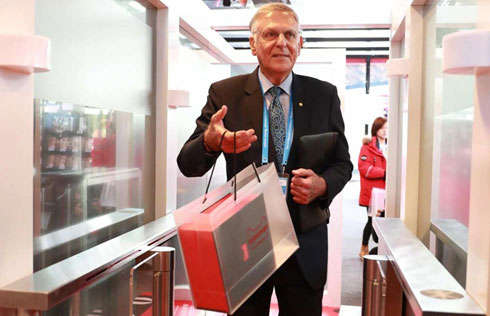
Stuart Fraser, chairman of the City of London Corporation Policy Committee. |

Unlike most of his peers in finance, Stuart Fraser believes that China's strong growth and appreciating renminbi will create a host of business opportunities for global financial centers like London.
Fraser, chairman of the City of London Corporation Policy Committee, also knows that his task of getting more Chinese investment into London is not going to be that easy.
"The Chinese government clearly wants London to be the Western hub for offshore renminbi, and that is what it's going to be," said Fraser, who in effect runs the local authority in charge of London's square-mile business district.
Financial experts believe that it is only a matter of time before the Chinese currency displaces the dollar as the global reserve currency, or at least becomes a major secondary reserve currency like the euro or the yen.
More importantly it is the prospect of the numerous business opportunities that will arise after the renminbi is internationalized that is driving cities like London, Singapore and New York to compete for the exalted status, after a similar move was made by Hong Kong in 2009.
In September Vice-Premier Wang Qishan, during his meetings with George Osborne, the British Chancellor of the Exchequer, welcomed private-sector initiatives for the development of an offshore renminbi market in London.
Since then Fraser's team has been at the forefront of the "private sector-led initiative" in devising a workable plan to make the City's grand ambition technically possible.
"The government wants a system that works, but the experts are in the private sector. So our job is to make it happen," he said.
Fraser's team has collated recommendations from the City's banks, insurance companies, pension funds and other financial institutions on developing an offshore renminbi center in London into a report, and submitted it to the government.
Fraser said that the main challenges identified by many firms were the time difference between the United Kingdom and China and the absence of a clearing and settlement system in the City for renminbi repatriation.
Despite these hurdles some progress seemed to have been made early this year when British officials and the Hong Kong Monetary Authority agreed to set up a forum to identify synergies, including clearing and settlement systems, market liquidity and development of new renminbi-denominated products.
The authority also agreed to extend the operating hours of the renminbi payment system by five hours to facilitate better offshore trading with London.
Fraser said that his team will press for a permanent solution to the time zone issue during the next round of discussions with the authority next month. He hopes the two sides will find a way for London to use Hong Kong's clearing and settlement system.
"It is very much a working visit rather than us just going over," he said, adding that he expects the meeting to be a "three-way process" involving the mainland, Hong Kong and London.
China's push to internationalize its currency started in 2008, when the global financial crisis demonstrated the danger of over-reliance on the US dollar.
During the G20 summit in November 2008, President Hu Jintao called for "a new international financial order that is fair, just, inclusive, and orderly".
Beijing soon began to encourage the use of its currency in international trade, swap arrangements among central banks, and bank deposits and bond issuances in Hong Kong.
Trade in offshore renminbi has since boomed. Increasing Chinese exports also led to a surge in demand for renminbi outside China as Chinese exporters increasingly expect to be paid in their own currency to eliminate exchange risks.
A Barclays report issued last year showed that paying Chinese retailers in renminbi could potentially increase profit margins by 7 percent.
Meanwhile, an HSBC survey of 1,300 companies in 18 Chinese cities last year showed that 78 percent of the respondents who had not yet started using renminbi to settle cross-border trade had plans to do so.
However, underneath the optimism critics have argued that London's chance of becoming the next offshore center is still stifled by the relatively small amount of offshore renminbi in the world.
While the total amount of renminbi deposits in Hong Kong doubled last year to 630 billion yuan ($100 billion), it still represents less than 1 percent of the deposits base on the mainland.
Martin Wolf, chief economic commentator for the Financial Times, said that at the moment any offshore renminbi market is bound to be "limited and distorted" because most people holding the renminbi are still in China.
Commenting on Hong Kong's decision to help London by extending its trading floor hours, Wolf said: "Right now I don't think it means much, in the very long run I assume it will mean a lot, and for that to happen, China must get rid of exchange controls."
Robin Marshall, a director at Smith and Williamson Investment Management, a UK-based financial advisory firm, said that it would take years before significant progress can be made.
"China is aiming for a soft landing, and wants to control its market. The last thing it wants is to liberalize offshore markets too quickly, and cause a sharp appreciation in its currency, contributing to a hard landing in its domestic market."
Marshall's concerns were echoed by a Bank of International Settlements report last year. "Eventually, banks will forge strong links between the offshore renminbi interbank market and its domestic counterpart, challenging monetary and credit control," Robert McCauley, a senior adviser at BIS, said in the report.
Fraser said that while he understands the Chinese government's need to control renminbi development offshore, it is also important to increase the currency's liquidity in London before trading can happen.
"We need to educate people that offshore renminbi trading is available, that they can have a renminbi account," he said, adding that the City still needs time to get used to renminbi trading because so far all other currencies commonly used in the City are convertible ones.
Despite limited liquidity for offshore renminbi, the volume of Chinese currency payments settled in London is growing, according to a recent report from the Society for Worldwide Interbank Financial Telecommunication.
For renminbi payments last year, Britain had the strongest growth. Its global share (excluding the mainland and Hong Kong) increased from 22.1 percent in the first quarter to 30 percent in the fourth quarter. In renminbi foreign exchange transactions, Britain is already the biggest player (excluding the mainland and Hong Kong) with a share of 46.4 percent.
Fraser cites these two figures as a vote of confidence in London, adding that London offers distinct advantages as an offshore renminbi hub, including its time zone, legal and regulatory framework and experience of innovation and creating liquid, efficient markets.
Noting that internationalization of the renminbi is a stated priority of the Chinese government, Fraser said financial service companies in London will benefit if the City becomes the next offshore renminbi hub. That is especially true for companies that deal with foreign exchange trading, banking, insurance and asset management, he said.
He said that London does not see other financial centers as competitors, and more will be achieved through cooperation, citing the example of retailers preferring to cluster together and creating a market rather than dispersing themselves to avoid competition.
The first time Fraser traveled to China was four years ago, and he has been amazed by its development since then. "It's quite clear that the ingredients of growth are in China," he said.
Fraser also sits on the City of London Advisory Council for China, which takes him to frequent meetings in China. The council was established in 2010 to guide the activities of the City of London's representative offices in Beijing and Shanghai.
"The last time I went to Shanghai and Beijing, the main topics we spoke about were the full convertibility of the currency. We're very excited about it."
Contact the writers at diaoying@chinadaily.com.cn and cecily.liu@chinadaily.com.cn
(China Daily 04/07/2012 page10)