Consumers turn toward imported food
|
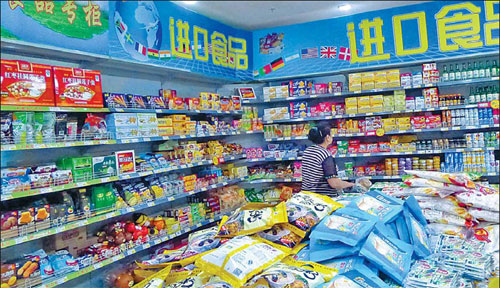
Imported foods on display in a supermarket in Qingdao, Shandong province. A survey has found that more Chinese consumers have turned to imported food and brands because of rising concern over domestic food safety in recent years. Huang Jiexian / For China Daily |
Successive safety scandals tarnish reputation of domestic products
More Chinese consumers have turned to imported food and brands due to rising concerns over food safety in recent years, according a survey by international research company Ipsos.
According to the survey, based on interviews with 2,100 respondents, 61 percent of Chinese consumers said their confidence in domestic foods has declined in the past year, and 28 percent said they will buy more imported foods or brands to replace domestic products.
Dairy products are the most purchased imported foods, at 77 percent, followed by grains and oil, at 57 percent, and children's food, at 56 percent.
The report said consumers' preferred imported foods or brands because of stricter safety controls during packaging and processing, the absence of unhealthy additives and rigorous product testing.
In 2011, the total output of China's food industry amounted to 7.8 trillion yuan ($1.2 trillion), up from 47.3 billion yuan in 1978, according to the Chinese Institute of Food Science and Technology.
"The challenges have also increased amid the food industry's robust growth. 'Lean meat powder', melamine-tainted milk, gutter oil and chemical dyed steamed buns ... all of these have drawn much attention from Chinese consumers," said Jennifer Tsai, managing director of innovation and forecasting of Ipsos Marketing in China.
Successive food safety crises have become a significant factor in influencing consumer habits and behavior, with 76 percent of respondents saying that this would make them seek an alternative product.
Meanwhile, the report said consumers tend to choose major, international and imported brands.
Gloria Gao, a 29-year-old office worker, said she stopped buying domestic milk brands two years ago.
"Due to safety concerns, I would prefer to buy imported milk, although it's much more expensive than domestic milk," said Gao, who recently purchased a box of German milk online.
"In recent years, we have seen endless scandals. Government supervision of food safety doesn't seem to work," she said.
The survey found that raw and fresh meat and seafood, grains and oil, and dairy products are the areas of greatest concern.
Online supermarket Yihaodian.com said sales of its imported products in June had increased fivefold year-on-year.
Imported dairy products, biscuits and confectionery, drinks and coffee are very popular among its customers, said a statement from Yihaodian's marketing department.
An employee at a branch of high-end supermarket chain City Shop in Shanghai said: "In the past, foreigners accounted for the majority of our customers. But now we see more and more local residents coming here."
She said that meat and vegetables were popular with local residents shopping at the supermarket, where more than 80 percent of the goods on sale are imported.
"You can buy cheaper vegetables in markets, but I really worry about safety. So I'd prefer to buy them at this supermarket at a higher cost," said a shopper.
Tim Wang, general manager of Ecolab in China, sees the issue from a positive angle.
"If Chinese companies recognize the problem and strengthen their social responsibility and improve product quality, Chinese consumers buying imported products will not be an inevitable trend."
In addition, overseas shopping is also becoming more popular, especially among China's emerging middle class, according to another survey by Beijing-based research company HorizonKey.
The survey questioned 1,059 middle-class families from the country's five biggest cities, and found that 36.6 percent of the respondents had overseas shopping experience. And more than half of the respondents said they planned to shop overseas in the near future. A total of 63 percent of respondents said they go shopping when they traveling overseas.
Tang Zhihao contributed to this story.
wanghongyi@chinadaily.com.cn
(China Daily 08/22/2012 page13)