Implementation center tackles mercury pollution nationwide
Emissions are on a downward trend, but measuring accurately remains an ongoing challenge
The Foreign Economic Cooperation Office has recently made a series of achievements in researching mercury emissions from coal-fired power plants and polyvinyl chloride production enterprises across China by conducting a pilot project.
The office, part of the Ministry of Environmental Protection, also proposed suggestions on how to reduce the presence of the toxic material in the country in the medium and long term.
The project, which started in 2013, was carried out in response to the Minamata Convention on Mercury.
China was among the first group of countries to sign the international treaty in Kumamoto, Japan, in 2013, aiming to control and reduce harmful mercury emissions globally.
It was the world's first mercury-related project to be financed by the Global Environment Facility, an independent international financial entity focusing on helping to reduce global environmental threats, and also the first cooperation between the office and the United Nations Environment Program in the mercury field.
Mercury pollution is a major threat to the environment. Exposure can cause permanent damage to the brain, kidneys and fetal development.
In China, mercury emission sources cover nearly all categories defined by the UNEP. Major sources of such pollution in the country include coal plants, PVC production, mining of nonferrous metals and mercury mines.
Power plants
The project took 2010 as the benchmark year. It showed that China consumed nearly 1.6 billion metric tons of coal for electric power generation in 2010, accounting for 45.27 percent of the country's total coal output. Each kilogram of raw coal contains 0.02 to 1.92 milligrams of mercury.
In 2010, mercury emissions from coal-fired power plants nationwide amounted to 101.3 tons in the air, 3.03 tons in water systems and 167.3 tons in solid waste.
In 2014, China consumed 1.93 billion tons of coal for power generation. Mercury emissions from the coal-fired plants amounted to 95 tons in the air and 4 tons in water systems.
The reduction of the atmospheric mercury emissions compared to 2010 was mainly attributed to the greater use of bag filters, wet flue gas desulphurization and catalytic denitrification equipment.
The office suggested establishing a regular database update mechanism in a bid to form a dynamic atmospheric mercury emission list to control the situation and evaluate the effect of the policy solutions.
It also called for taking different measurements and having different requirements for different phases based on a method that combines concentration, total emission amount and efficiency control. Monitoring standards and management also need to improve, and coal plants should pay more attention to the utilization of coal byproducts to avoid secondary pollution, according to the office.
PVC industry
In China, most PVC products are manufactured through the calcium carbide process. In 2010, 85 PVC companies used the technology in their production. Mercury used in the industry amounted to 803.8 tons that year, of which 89 percent was recycled, 0.16 percent was emitted with waste water, 0.3 percent into waste acid and 0.45 percent into solid waste.
The project proposed several suggestions to further regulate mercury emissions in the industry.
They include prohibiting new PVC production projects using mercury catalysts, raising the industry entry threshold for waste mercury catalyst recycling, and tracing the whole PVC-related process from production to trade and usage. Accelerating the research of mercury-free catalysts and technologies, and establishing a complete risk assessment methodology for mercury-related companies and polluted sites are also among the suggestions.
Local emissions
Guizhou province in Southwest China is known for its abundant reserves of mercury. It had three mercury mining companies in 2010, extracting a total of 75,000 tons of mercury ore that year.
In 2010, the province's mercury emissions in the air amounted to 10.6 tons, with the main sources being coalfired power plants, coal-fired industrial boilers and the production of cement.
Mercury emissions in solid waste amounted to 28.9 tons, with the main sources being mercury production, coalfired power plants and coalfired industrial boilers. Mercury emissions in the water amounted to 0.2 tons.
Using mercury directly in production is the largest source of mercury emissions in the province, so the project proposed to strengthen pollution controls in production procedures in a bid to reduce environmental risk. It also encouraged the application of advanced mercury pollution control technologies, and to accelerate research in efficient removal technologies and devices relating to multiple pollutants such as sulphur, saltpeter and mercury.
In Hunan, atmospheric mercury emissions amounted to 33.3 tons in 2010, with the main sources being nonferrous smelting and coal-fired industrial boilers.
Mercury emissions in solid waste form amounted to 32.9 tons, with the main sources being nonferrous smelting and waste incineration.
Other sources of mercury emissions in the province include waste incineration, and cement production, according to the investigations.
The project encouraged hazardous waste and medical waste incineration plants to use special adsorbents or wet deacidification processes to reduce the amount of mercury emissions in the air. It also suggested the province could establish a mechanism to control and prevent secondary mercury pollution.
Existing problems
Basic information relating to mercury emissions, such as the number of key sources and emission intensity, is not clear. Most of China's current standards and regulations on mercury pollution and management are out of date with the country's actual needs and developed countries' stricter controls, according to the project.
It also said that China has yet to carry out comprehensive strategic studies of mercury pollution control and lacks a management framework that is in line with the implementation of the international mercury convention.
The project proposed increasing investment in technological research and development, and further introducing and promoting advanced mercury-handling technologies. It suggested that China could expand financing channels and increase financing capabilities to ensure ample capital supply for mercury-related activities.
China's public awareness of the hazards of mercury and preventing mercury pollution also needs to be strengthened, according to the project team.
haonan@chinadaily.com.cn
|
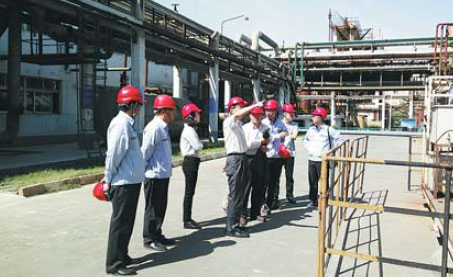
Officials from the Foreign Economic Cooperation Office at the Ministry of Environmental Protection visit a coal and chemicals company in Shaanxi province in April. Photos Provided To China Daily |

|
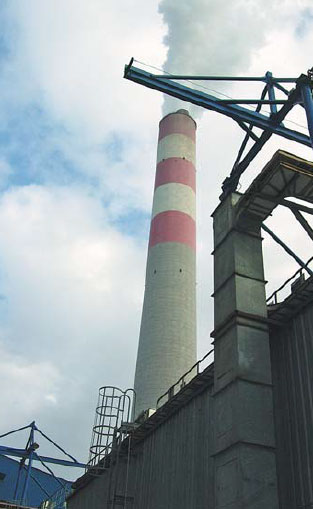
A coal-fired power plant in Zhejiang province is one of the sites the research team sources their data from. |
|
A PVC industrial park in the Xinjiang Uygur autonomous region is among the destinations the office's experts have visited for their research. |

|
Experts from the office visit a polyvinyl chloride production facility in western China in preparation for their research into mercury pollution control, of which PVC production is one of the major sources. |
|
Scholars, experts and industrialists discuss environmental issues at a symposium hosted by the office in Henan province. |

|
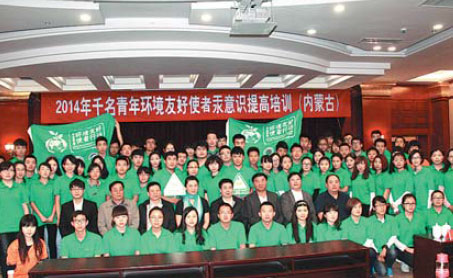
The office offers training to college students in Inner Mongolia to help to increase local people's environmental awareness. |
(China Daily 05/31/2017 page15)