|
|
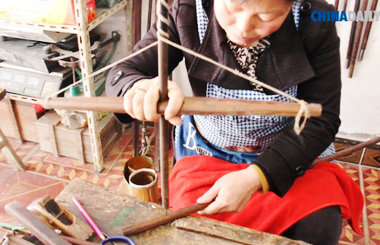
Mo Yan's 90-year-old father Guan Yifan still farms (left). Mo Yan's elder brother Guan Moxin shows a farm implement they used in childhood (middle). Nie Peng, an inheritor of Gaomi's clay sculpting tradition, hopes Mo's win will draw global attention to local folk arts. Photos by Ju Chuanjiang and Zhang Zixuan / China Daily |
 |
|
The room where Mo Yan married is dark and cramped. |
 |
|
Villagers remain low-profile around reporters and tourists (left). The local government hangs a sign celebrating Mo Yan's Nobel Prize. Mo Yan's old suitcases are still in the abandoned house he grew up in. |
The agrarian hometown of China's first Nobel laureate in literature cultivated his writing. Zhang Zixuan visits Gaomi, Shandong province.
Everyone wonders what kind of soil nurtured writer Mo Yan, who won this year's Nobel Prize in literature. He had previously achieved fame with stories that are set or actually happened in rural Gaomi - Mo's hometown in eastern Shandong province.
"My hometown and my literature are closely related," says Mo, whose birth name is Guan Moye.
"Gaomi has many folk arts, such as clay sculpting, paper-cutting, flapping-ash Lunar New Year painting and Maoqiang opera. I grew up in an environment immersed with such rich folk culture, which inevitably infiltrates my novels when I pick up a pen to write. This has definitely affected - even determined - my works' artistic style."
Those folk arts are still practiced in Gaomi, the central area of which has been urbanizing. Modern buildings have replaced the red sorghum of olden days.
But the scenery changes into a patchwork of cornfields, vegetable plots and aspen forests, just a few kilometers from downtown. Still, there's no trace of the signature red sorghum.
It had already disappeared by the time Zhang Yimou turned Mo's written work Red Sorghum into a movie in 1987. The fields seen in the film were specially planted for the shooting.
"Sorghum has little economic value today," a local farmer explains.
"Neither people nor animals eat it."
Passing cornfields and crossing the Jiaohe River leads to Ping'anzhuang village - the "Dongbei township" in which Mo sets many of his stories.
Mo's old house is still there.
The two-side rooms inside the courtyard are long gone but the main building, fashioned from mud mixed with sorghum stalks, remains in good shape.
The family has maintained it since the house was destroyed in a 1966 flood, says Mo's second elder brother Guan Moxin.
There are five interlinked rooms - a sitting room, a workshop and three bedrooms. An old radio, suitcases and farming implements remain where they've been for years.
"Mo Yan was born in there," Guan says, pointing to a room heaped with cardboard.
"And that's where he got married," he continues, pointing to another room.
At one point, 13 family members lived in the house. They didn't have electricity until 1982, Guan recalls.
But Guan says he and his siblings enjoyed a happy childhood in the dark and cramped house.
Mo was the youngest child of four.
"He was a lively boy," Guan says.
"We spent our days catching fish in the river and running through the sorghum fields."
The fields were "boundless" before the mid-1960s, he says.
Guan believes Mo's knack for writing came from his grandfather, who told them countless folktales, some of which were magical yet realistic.
Mo moved out of the house in 1988, and his parents relocated in 1991.
The house has since remained empty and unchanged. Even the worm can under the roof is still there.
Mo and his family visit the house several times a year to swap the Spring Festival door couplets.
Mo's 90-year-old father Guan Yifan still plants soybeans and carrots in the yard. He declined the gift of a villa recently offered by the businessman and philanthropist Chen Guangbiao, saying "no pains, no gains".
The local government hung a sign directing people to the house after Mo won the Nobel Prize earlier this month.
And Guan Moxin, who lives nearby, has received countless visitors since. The modest 62-year-old farmer doesn't mind taking people around and answering questions.
Dong Mengxin is a visitor from Gaomi's urban downtown. He came out of curiosity about the land that nurtured Mo. But the 30-year-old says seeing the place has led to more confusion than understanding.
"It's just an ordinary village," he says.
Guan Moxin believes that's the point.
"My family, including Mo, have always sought a normal life," he says.
Other villagers have remained low-key, too.
They haven't changed the way they live because of the visitor influx and shyly smile while refusing to be photographed.
Still, Niejia township native Nie Peng believes Gaomi's residents have a special character that Mo inherited.
"We're straightforward, humorous and attentive," he says. "We get up early and go to bed late. And we love housework."
The 22-year-old carries on Gaomi's 70-step clay sculpting tradition.
"Gaomi's clay sculptures and other folk arts will someday become known by the world like Mo is," he says.
Contact the writer at zhangzixuan@chinadaily.com.cn.
Ju Chuanjiang and Wang Qian in Gaomi contributed to the story.

|
|
|
|
|
|
|
|

Copyright 1995 - . All rights reserved. The content (including but not limited to text, photo, multimedia information, etc) published in this site belongs to China Daily Information Co (CDIC). Without written authorization from CDIC, such content shall not be republished or used in any form. Note: Browsers with 1024*768 or higher resolution are suggested for this site.
License for publishing multimedia online 0108263 Registration Number: 130349 


















 Raymond Zhou:
 Pauline D Loh:
 Hot Pot
 Eco China
 China Dream
 China Face