Terraces cultivate global recognition
|
The rice terraces Hani people have cultivated for about 1,300 years are now a World Heritage site. Provided to China Daily |

UNESCO World Heritage designation lauds world wonder's blend of culture and ecology. Zhang Zixuan reports.
The Honghe Hani Rice Terraces rise up the Ailao Mountains from the Honghe River's southern bank. They span four counties in the Honghe Hani and Yi autonomous prefecture in southeastern Yunnan province.
This man-made wonder was inducted into UNESCO's World Heritage List on Saturday at the World Heritage Committee's 37th session in Phnom Penh, Cambodia.
The nominated area and buffer zone is in Yuanyang county, which covers 461 square kilometers and displays the most concentrated and best-developed terraces in three valleys.
The 82 villages in the area house 80,000 people from the Hani and six other ethnic groups.
The more than 1,300-year-old terraces cascade from a summit 2,000 meters above sea level to the mountain's base. In some places, there are as many as 3,700 terraces flowing down the slopes. The steepest drop at 45 degrees.
"The Hani rice terraces are not just a natural splendor but also the most harmonious masterpiece of man and nature," the prefecture's deputy director Tan Ping says.
Tan explains they create a system that fuses agriculture and ecology, with forests, villages, terraces and water.
The highland forests are the lifeblood of the system to capture the water that makes irrigation possible.
"The forests are the only reservoir," says Zhang Hongzhen, nomination group leader and Hani Rice Terraces Administrative Bureau director.
The Hani traditionally believed the woodlands are home to their village god Angma, whose name translates as Village's Soul, and their land-protection deity Misong, who blesses them with peace and prosperity.
The Hani vigorously guard the sacred forests from outsiders, especially women.

The villages are built in the timberlands' lower fringes. The settlements are comprised of "mushroom houses", built of rammed earth, adobe bricks and stone with umbrella-shaped straw-thatched roofs.
The houses typically have three stories. The first is for livestock; the second is the living area and the top floor is for grain storage.
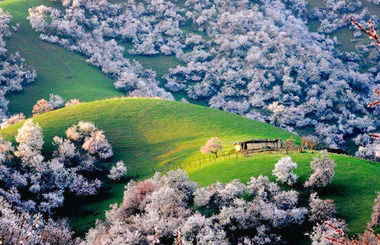
"The scenery before rice transplanting is like heaven for photographers," Yunnan's deputy governor Gao Feng says. "The terraces are full of water, which makes them appear as millions of mirrors reflecting the sun, clouds and sky."
From late April to late September, Hani people grow red rice, the terrace's dominant crop. Cattle and buffalo plow the terraces, and no chemical fertilizers are used.
Fish and ducks are also bred in the paddies, which improves fertility while providing food for people and animals.
The water from brooks, springs and rain is collected by the forests and distributed to the fields through a gravitational system of ditches, canals and bamboo pipes.
Artesian wells in the villages provide drinking water.
"The integrated four-element system plays the wetlands' role. It conserves moisture and soil, adjusts the climate and sustains biodiversity," says Xiong Zhengyi, director of the Yunnan cultural heritage bureau.
He adds that the terraces withstood the severe drought that has parched Yunnan for three years.
China began preparing the World Heritage application and domestic designations in 2000 to protect the world wonder.
In 2007, the local government and application office determined technical standards to be followed within all the villages to control development and construction.
Some abandoned terraces outside the nominated area and buffer zone have been recovered.
Improvements have been made to local living standards. For instance, livestock have been centralized, rather than dwelling in houses.
A monitoring center has been running for a year to study more than 10 ecological dimensions, such as forests and climate. The center has helped blunt the threat from alien species, such as the South American crayfish, which invaded the fields three years ago.
Red rice contains up to 18 amino acids and is being sold outside the Ailao Mountains. More than 90 trademarks have been registered to protect intellectual property rights.
The local government is working with Tsinghua University's School of Architecture to develop guidelines for construction that maintain the mushroom houses' extrinsic characteristics with improved interior functions.
In accordance with local people's wishes, the government will subsidize the houses' construction but allow residents to build them according to the guidelines. Three houses have been built in this way, and more are planned.
This May, the State Council designated the property as a State Priority Protected Site.
From October, only electric vehicles will be allowed to drive in the area.
"The Honghe Hani Rice Terraces' protection must receive all stakeholders' support," says State Administration of Cultural Heritage deputy director Tong Mingkang.
The government will offer farmers subsidies to encourage them to continue cultivating the paddies. Otherwise, it is feared nearly all locals might abandon them to work in the tourism industry.
More detailed and sustainable eco-tourism strategies are being developed to alleviate increased tourism's pressure.
Farmer Li Yousheng, from Yuanyang county's Dayutang village, says he now understands better than ever why protecting the terraces is important.
"The World Cultural Heritage designation shows the magnitude of our guardianship of the Hani lifeblood," the 53-year-old says.
|
|
|