Exceptional and ethereal
Modern visitors to the ancient town of Zhengding discover Longxing's Big Buddha is an exceptional figure — but ultimately an idiosyncratic entity that dwells in a settlement packed with peculiarities. Erik Nilsson explores the temple in Shijiazhuang.
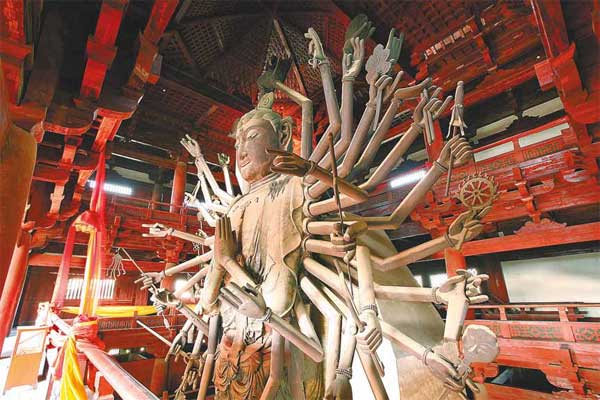
What has nine heads, 42 arms and is 21 meters tall?
The answer isn't the punch line to a lame joke but rather the incredible statue that gives the Longxing Monastery its other appellation — the Big Buddha Temple.
 |
|
The Thousand Hands, Thousand Eyes Buddha is the biggest draw at Longxing Monastery in Shijiazhuang. Photos provided to china daily |
The country's largest bronze Buddha is also known as the Thousand Hands, Thousand Eyes Buddha — a misnomer by virtue of exaggeration but a namesake that nonetheless hails its uniqueness. The Song Dynasty (AD 971) statue's bronze arms were destroyed in 1780 but later restored by believers.
Yet the sculpture is only one of myriad religious rarities housed by the holy site in Hebei province's ancient Zhengding city (then the province's capital), about 15 km outside the provincial capital Shijiazhuang.
Longxing ranks among the country's best-preserved temples because it was a stopover for emperors undertaking pilgrimages to the Wutai Mountains, giving the compound yet another title — the First Temple South of Beijing.
That's perhaps the reason it hosts so many sacred peculiarities.
An amazing trove of artifacts survived from Longxing's construction in the Sui Dynasty (AD 581-618), especially those from after the Song revamped the compound. One of the oldest surviving artifacts is the Longcang Temple Stele, hailed as "the First Stele of the Sui Dynasty". It's actually China's oldest.
An especially striking specimen from the period immediately following the reconstruction is a 10.8-meter octagonal rotating sutra bookshelf that's 7 meters in diameter. It's the oldest and largest of a handful that remains and offers insight into Song technology.
A 1,000-year-old 7.4-meter-tall Buddha carved from a single tree is unique in that it's exceptionally slender and stands rather than sits.
Another celebrated sculpture is unparalleled in that it depicts "China's most beautiful Guanyin" at her "most casual". The Goddess of Mercy reclines whimsically in stark contrast to her otherwise rigid depictions in the only known such rendering in dynastic history.
But there's a potentially unnerving dimension of Guanyin's laidback side — her gaze seems to follow you as you walk. Some consider her wandering eyes playful. Others call them creepy.
Three stacked domes of 1,072 Buddhas — a Ming (1368-1644) emperor's gift to dear old Ma — are celebrated as some of the best bronze work from the era, mostly because of their surfaces' smoothness.
The buildings that house Longxing's rare relics are also exceptional in themselves.
Experts nominate Mahamuni Hall as the apex of ancient Chinese architecture.
The nine stairs — nine is a homonym for longevity in Chinese — exiting the hall containing the 500-year-old two-faced Buddha altar are a millennium old and haven't been restored. They're intact but slick — polished glossy by 1,000 years of ever-trickier tromping. Trees planted at about the time the stairs were carved shade them.
Also, the temple's swooping eves are meant to resemble a lion's claw from a bird's-eye view.
The town in which Longxing was constructed is also unique in that it preserves an architectural timeline of the country's development.
Zhengding is a jumble of buildings from every period following the Sui's founding, including modern constructions. It's the kind of place where a structure finished yesterday could exist beside one constructed 1,600 years ago and be surrounded by edifices raised in various centuries between.
The town's development was largely propelled by its prominence as a stopover for emperors' pilgrimages, especially in the Qing Dynasty (1644-1911). Many rulers, including Qing emperor Kangxi (1654-1722), left their mark and chiseled the town's legacy in stone with their inscribed calligraphic works.
While these writings contributed to Zhengding's acclaim, Zhengding's acclaim contributed to writing, as such seminal authors as Lu Xun penned its praises.
History has left behind a mishmash of artifacts from figurines to cannonballs.
Many Ming Dynasty (1368-1644) walls survive, having weathered offensives during the War of Resistance against Japanese Aggression (1937-45) and other assaults.
Nature dissolved some of Longxing's buildings during the Republic of China (1912-49).
Several town walls were refurbished by replacing the insides to ensure structural integrity, while leaving the original exteriors. Bricks were confiscated to build houses during the "cultural revolution" (1966-76).
Homeowners later returned many of these, and they were often restored in their original locations.
An exceptional number of Zhengding's Song era-statues, murals and steles survived tumults.
The west and north gates are the oldest. Zhengding's main gate bifurcates into one stairway and horse-path that has been restored and another that crumbles in its original state.
Four Tang Dynasty (AD 618-907) stupas still tower above the ancient town.
They're equated to the legendary Four Beauties.
Zhang Yu contributed to the story.