3. Will the property market collapse next year?
Wang Haifeng, director of the International Cooperation Center affiliated with the National Development and Reform Commission
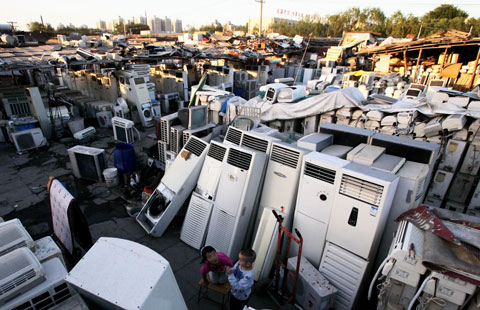
If the word "collapse" refers to the bankruptcy of some property developers, I believe such a correction should be allowed in regions that have seen too much price growth and speculation over the past few years. Such a collapse is necessary and healthy for the long-term development of China's property sector and the overall economy. If the government doesn't address the excessively high property prices right now, it will become more problematic to the economy in the long run.
Meanwhile, the government's tightened measures regarding real estate should remain until prices fall to a reasonable level. An annual growth rate of 7.5 to 8.5 percent is acceptable for such an active adjustment. And the government should let the market play a bigger role in this round of adjustment.
Wang Tao, head of China economic research at UBS Securities Co Ltd
I don't think so. The weakness in the property market has been largely driven by the government's tightening measures, including purchase restrictions, higher mortgage down payment requirements and price restrictions.
We have been surprised that sales and prices have held up so well after more than a year of policy tightening. We had expected them to decline by 10 percent in 2011.
As the government continues its current property tightening policies, we expect to see sales decline in the coming months while prices may finally start to drop.
We expect the private (commodity) housing market to weaken as the government continues the tightening policy, but we do not expect a collapse in that market.
Meanwhile, we think social housing will support overall construction in the next 12 to 15 months. The government has set an ambitious target of starting the construction of 10 million units in both 2011 and 2012.
4. Will China suffer a trade deficit in 2012?
Wei Jianguo, former vice-minister of commerce
The ongoing European debt crisis will hurt China's economic growth and the nation's exports. China's exports are expected to slow down to single-digit figures in 2012 from the double digits we have been seeing. We cannot exclude the possibility that China will see a trade deficit next year.
Although the European nations are striving to rescue the economy, I am still pessimistic about the prospects. The suspension of European debt will lead to decreasing demand for China's goods and drag down China's exports, probably causing a trade deficit for 2012.
We noticed orders from the European Union shrank during the 110th Canton Fair (China's largest foreign trade fair) held in October. Chinese exporters need to transfer their focus onto emerging markets rather than just betting on developed nations.
China needn't intentionally seek a trade balance. The top priority for China is to maintain its economic growth. China's stable economic growth will be a big contribution to the worldwide economy.
Huo Jianguo, director of the Chinese Academy of International Trade and Economic Cooperation affiliated to the Ministry of Commerce
I don't think there is any possibility that China will see a trade deficit in 2012, or even for a few years.
Although the year-on-year growth for China's exports has been on the decline during the past few months and the trend is expected to continue, we should not be too pessimistic about the prospects for China's exports.
Demand from developed nations including the United States and European Union is still there, although the growth is not robust. And China has been diversifying its markets for exports, with shipments to countries including Brazil, Russia and South Africa rising fast during the past year.
On the other hand, China's imports are not as strong as expected as the nation's economy slows down.
I expect double-digit exports growth for China will be sustained in 2012 and the nation's surplus will narrow to around $120 billion next year.
5. Will China's currency become more internationalized?
Shen Jianguang, chief economist for China with Mizuho Securities
The internationalization of the yuan can help China adjust the US dollar-based and passive accumulation of foreign exchange reserves. It can also greatly enhance China's role in international trade and investment.
Meanwhile, the lift to the yuan's global profile will help upgrade China's exports and make it easy for China to adopt balanced measures to reduce trade surpluses and increase imports. The anticipation of the yuan's appreciation will help boost China's purchasing power of energy and raw material products and strengthen national and corporate competitiveness.
The internationalization of the yuan will also help boost domestic demand and help shift the growth model from being export-driven to consumption-driven.
Huang Yiping, chief economist for emerging Asia with Barclays Capital
It is the international markets rather than China itself that can determine whether the yuan is a true international currency. Overseas investors want to hold the yuan but they are unwilling to pay in yuan.
Given the very limited investment channels for the Chinese currency, the only motivation for foreigners to hold the currency is the expectation of the yuan's further appreciation. But once the yuan loses the potential to appreciate, the international demand for the yuan may drop significantly.
Using administrative measures to push for a wider use of the yuan is not going to bring real benefits to China. The focus of China's currency reform should still be on the reform of the exchange rate system, the gradual opening of the capital account and the development of yuan-denominated assets.


Copyright 1995 - . All rights reserved. The content (including but not limited to text, photo, multimedia information, etc) published in this site belongs to China Daily Information Co (CDIC). Without written authorization from CDIC, such content shall not be republished or used in any form. Note: Browsers with 1024*768 or higher resolution are suggested for this site.
License for publishing multimedia online 0108263 Registration Number: 130349