Project established in the aftermath of the Sichuan quake has given children from the province a chance to travel and learn, Jaime Koh reports from Singapore.
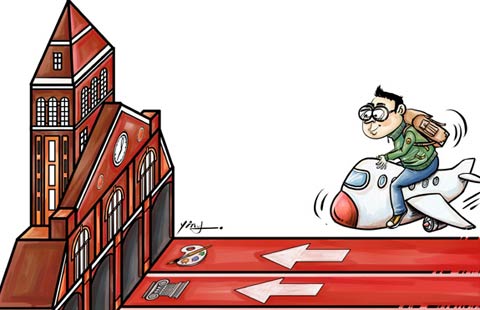
It took Gengga Lianger a whole day to travel by bus from his home in Hongyuan county, the Ngawa Tibetan and Qiang autonomous prefecture, to Chengdu, the capital of Sichuan province. From there, the 11-year-old boy embarked on a five-and-a-half-hour flight to Singapore via Hong Kong.
Tiring as the journey was, the young boy was overjoyed. It was the first time he had traveled outside China and it was also his maiden flight. "It was thrilling to be on the plane," he said. "Very exciting."
Despite the long journey, he had little chance to rest. The day after he arrived in Singapore, he launched straight into a full schedule, meeting students in a school and attending classes with them. He also introduced his culture to them by performing a traditional Tibetan dance.
Gengga Lianger was among the 30 students from 15 schools in Sichuan on a nine-day exchange trip. The children were all recipients of World Learner Student Exchange Scholarships, a program inaugurated by Lim Swee Say, Singapore's minister in the prime minister's office, .
The scholarship was launched in 2010 in Singapore as a continuation of the Sichuan Earthquake Charity Show, a 2008 event intended to fund the rebuilding of seven schools destroyed by the Sichuan earthquake that year.
About 80 students have benefited from the scholarship program, which is now in its third year. The top two students from each of the participating schools in Sichuan are nominated for the exchange.
Saris and sarongs
In their first two days at Pei Chun Public School, the Sichuan students had a full schedule, attending classes in English, music, art, computer and physical education alongside their Singaporean counterparts. They also learned how to wear the sarong and the sari, the traditional clothes of Malay men and Indian women.
 |
|
Learning how to wear the sari, a traditional Indian dress. Provided to China Daily |
The Sichuan boys played a basketball match with some of the Singaporean schoolgirls to boot. "We lost terribly. It's so embarrassing," they sighed as they buried their faces in their hands, much to the delight of their female classmates.
Following the two-day immersion, the visitors spent three days at Yang Zheng Primary School, attending classes and performing community services.
Despite the packed schedule, they found the experience enriching and relished the chance to participate in all the activities.
"I like attending the classes. They are much more fun and interactive than the classes we have at home," Gengga Lianger said.
His companion Zhao Yuzhi nodded in agreement. "Back home, we just sit at our desks, take notes and listen to the teacher. We don't have anything else to do," said the 11-year-old, adding that he loved the interaction between students and teachers.
The Sichuan children radiated energy. They were constantly smiling, laughing and teasing each other. It was hard to imagine that they, mere kids when the 2008 earthquake struck, were affected by the natural disaster.
"Seeing the smiles on your faces and your positive attitude warms my heart," Lim told them, to great applause. "We cannot forget the past, but we can treasure the present and rebuild the future."
For many of the Sichuan students, it was their first overseas trip. For many, it was a once in a lifetime opportunity to explore the outside world, but the impact was greatest on the four children from the remote counties in the Ngawa Tibetan and Qiang autonomous prefecture and Garze Tibetan autonomous prefecture.
"Some of the students from Garze county, for example, are very timid because they rarely leave their villages," said Feng Limin, one of the teachers that accompanied the Chinese students. "Most of them are from agricultural families, and some (of the families) are very conservative. They are often unwilling to let their children leave the village."
Bustle and beauty
Ganzi county is one of the 18 subdivisions of the Garze Tibetan autonomous prefecture and one of poorest regions in Sichuan, said Feng.
The all-expenses-paid trip was an eye-opener for the students, who were impressed by the bustle, cleanliness and beauty of Singapore. Even simple meals such as fried chicken wings, a common snack for children in Singapore, was a treat to be savored and relished.
 |
|
Sichuan boys make a dash to prevent their Singaporean competitors from scoring. Provided to China Daily |
The air-conditioned classrooms and computer rooms were a far cry from Sichuan where, according to Feng, the schools often lack facilities.
"After the earthquake, most of the funds went into rebuilding the disaster-hit areas. In the poorer areas, there hasn't really been much improvement. Many of the buildings are still derelict, and may be torn down at any time. They don't even have the most basic facilities," she said.
"Most schools have only a small (playground), even the table tennis facilities have to be put together by the teacher, sometimes using cement. There are no basketball hoops, few exercise facilities. They don't have musical instruments or computers."
Children in China must attend school for at least nine years and most are able to graduate from secondary schools (as part of the country's compulsory education system).
"But in the poorer regions, if the families cannot support their children through further studies, they (the children) will go out to work or farm," said Feng. "The World Learner Program has helped the students step out of Sichuan and into the world. It has not only expanded their horizons and helped them increase their knowledge, it has also helped them make new friends."


Copyright 1995 - . All rights reserved. The content (including but not limited to text, photo, multimedia information, etc) published in this site belongs to China Daily Information Co (CDIC). Without written authorization from CDIC, such content shall not be republished or used in any form. Note: Browsers with 1024*768 or higher resolution are suggested for this site.
License for publishing multimedia online 0108263 Registration Number: 130349