Editor's note: History is, by definition, about past events, and while nothing can be done to change those events, forgetting them may lead to wrong roads being taken in the future. During the coming months, China Daily will present a series of regular reports about ordinary lives during World War II and the continuing impact of the conflict on the present and the future. This is the sixth report in the series.
 |
|
Wang Jianxue, vice-chairman of the China Association of Historians Studying Modern Chinese Materials, talks about the role of Mukden POW camp during World War II. PHOTOS BY ZOU HONG / CHINA DAILY |
During World War II, the Japanese army held thousands of Allied POWs in northeastern China at a camp where brutality was commonplace, as Gao Anming, He Na and Wu Yong report from Shenyang.
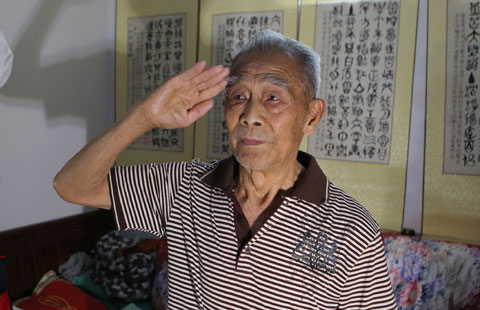
Li Lishui, 90, from Shenyang, Liaoning province, has three possession he values more than his life: A letter written in English; an old photo of a foreign soldier; and a certificate awarded to him by the United States government in appreciation of the encouragement and help he gave Allied prisoners of the Japanese during World War II.
The story of how Li met and befriended the Allied POWs more than 70 years ago is told at a museum in the Dadong district of Shenyang, the capital of Liaoning province, which commemorates the Camp for Allied Forces Prisoners of War in Mukden, as Shenyang was known in English at the time.
Statistics published by the National Museum of the United States Army show that the Japanese held 2,018 POWs from six countries in the camp for three and a half years. The average age of the prisoners was 26.
Surrender
The Pacific War started after Japan attacked Pearl Harbor on Dec 7, 1941. The Imperial Japanese army and air force began heavy assaults on Allied forces in Southeast Asia.
"Within five months, the Japanese army was sweeping forward from victory to victory throughout Southeast Asia as the Allied forces lost their ability to fight because of a lack of supplies and the spread of disease," said Professor Wang Jianxue, vice-chairman of the China Association of Historians Studying Modern Chinese Materials.
To minimize the number of casualties, Major General Jonathan Wainwright, Allied commander in the Philippines, surrendered the island of Corregidor in March 1942, and a short while later, the rest of the Allied forces also laid down their arms. The Japanese, who hadn't expected to capture so many soldiers, dealt with about 200,000 POWs from 12 countries by establishing 115 camps across Asia from 1942 to 1945.
Mukden, which held the most senior Allied officers, is one of the best-preserved former camps. Of the soldiers held there, 523 held the rank of major or higher, and 76 were brigadier generals and above. Some were world-famous, including Wainwright, Major General George Moore, the former commander of the Philippine military harbor defenses, and Brigadier Duncan Maxwell, the commander of the Australian Army's 27th Brigade during the invasion of Malaya.
"These high-level POWs were important bargaining chips in the late Pacific War because Japan was heading for defeat," Wang said.
Mukden was a familiar place to the Japanese, according to Liu Changjiang, director of the Mukden camp memorial.
"The Manchukuo puppet regime continuously expanded and established military industries. Mukden had been the Japanese military's industrial center, and included many US arms manufacturers before the Pacific War," he said.
"But when the Pacific War broke out, Japan faced great shortages, both of labor and the resources needed to fight in China and Southeast Asia," Liu added. "To solve the crisis, the Japanese appropriated money and valuables, labor, food and other resources from the countries it occupied. As a result, Japan decided to set up a camp in Mukden for POWs with specialist mechanical skills. "
Liu pointed to the irony of US POWs using US technology and machines to produce arms for the Japanese to fight the US.
Life in the camp was brutal. Wainwright was the highest-ranking POW, but even he was treated extremely poorly. "Many times during my long rot in captivity, I wondered how the Japanese were capable of their gross inhumanities," he wrote in his memoirs, General Wainwright's Story.


Copyright 1995 - . All rights reserved. The content (including but not limited to text, photo, multimedia information, etc) published in this site belongs to China Daily Information Co (CDIC). Without written authorization from CDIC, such content shall not be republished or used in any form. Note: Browsers with 1024*768 or higher resolution are suggested for this site.
License for publishing multimedia online 0108263 Registration Number: 130349