|
|
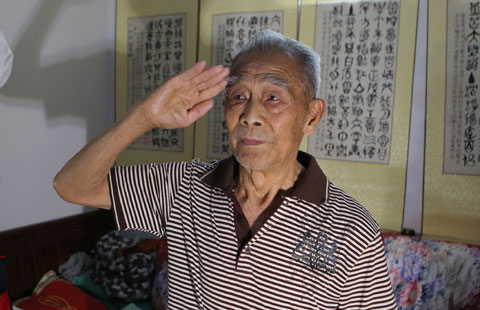
Zhao Sujuan, 81, a retired staff member of Jilin Provincial Archives, discusses the Japanese occupation of China. [Photo by Song Wei/China Daily] |
Sex slaves
|
 |
| Special coverage: Details of the Japanese files |
|
 |
| Japanese atrocities documented in new book |
|
 |
| Cruel life of miners under Japanese subjugation |
A record of a phone call describes how the acting manager of the branch of the regime's central bank in Anshan, Liaoning province, and the bank's Foreign Capital Division of Fund Department granted permission for the dispersal of more than 200,000 yen ($1,950) for the purchase of comfort women.
Japan is the only country whose military has enforced comprehensive sexual slavery, according to Su Zhiliang, a professor at Shanghai Normal University, who specializes in studies related to the issue.
"We should distinguish these women from prostitutes. The 'comfort women' were slaves. They were forced, not paid, and had no personal freedom. Numerous women were affected across Asia," he said.
Unit 731
The archives also shed light on how the Japanese army conducted bacteriological tests on prisoners of war. Although Unit 731, the detachment that conducted the tests, remains almost unknown outside China and Japan, the documents show that spies and those suspected of actively resisting the occupation were handed over to the unit.
Records kept by the Kwantung Kempeitai show that 277 people were transferred to Unit 731, including Chinese, Russians and Koreans. The name of Lee Jisua, a 28-year-old Korean national, is one of many etched into the fabric of a museum in the Pingfang district of Harbin, the capital of Heilongjiang province. The walls of a long corridor used as a secret conduit through which those selected to undergo testing were herded bear 2,995 names written closely together
"We have a lot of documents and audio interviews with former members of Unit 731 that document the cruel testing procedure. We also have testimony from laborers who were forced to build the site. Japan's genocide and crimes against humanity didn't just harm the immediate victims, but also undermined society's moral values," said Wang Xiliang, a researcher at the Institute of Japanese History at the Heilongjiang Provincial Academy of Social Sciences.
"The archives related to the laborers enslaved by the Japanese military tell of strict management and the cruel suppression of those who had been enslaved, most of whom were Chinese or Allied POWs," said Mu of the Jilin archives.
Conditions were tough for the Chinese laborers. One archive describes how 10,000 men were forced to work on the construction of a military project. When a large number of workers attempted to escape, they were captured and thrown into a pit. Water cannons were used to stop them from climbing out of the pit, where they either drowned or were buried alive.
Obstacles
According to the Jilin Provincial Archives, the 89 files constitute just a tiny fragment of the records. The archive plans to release more files to help the general public gain a better understanding of the history of the occupation.
Since Shinzo Abe came to power in December 2012, the Japanese prime minister has allowed cabinet members to visit the Yasukuni Shrine in Tokyo, which commemorates Japan's war dead, including 14 Class-A convicted war criminals, and is seen by many as a symbol of Japan's militaristic history.
"The frequent visits to the shrine and Japan's attitude toward its wartime history are major obstacles to the process of mending relations between Japan and its neighbors," Professor Wang Jianxue said.
Contact the writers at hena@chinadaily.com.cn and dongfangyu@chinadaily.com.cn
Han Junhong contributed to this story.


Copyright 1995 - . All rights reserved. The content (including but not limited to text, photo, multimedia information, etc) published in this site belongs to China Daily Information Co (CDIC). Without written authorization from CDIC, such content shall not be republished or used in any form. Note: Browsers with 1024*768 or higher resolution are suggested for this site.
License for publishing multimedia online 0108263 Registration Number: 130349