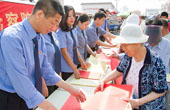
US scientists have denounced a 2008 nutrition research project that allegedly fed genetically modified rice to a group of Chinese primary school students.
The study involving 68 Chinese children aged 6 to 8 has generated public anxiety about potential harm to the children and controversy over ethics and rules.
The study's lead author Tang Guangwen of Tufts University in Boston, Massachusetts, published a report on Aug 1 in the American Journal of Clinical Nutrition showing that 100 to 150 grams of so-called golden rice could provide 60 percent of the daily intake of vitamin A.
However, the three listed authors from the university's Chinese partners, Hu Yuming, Yin Shi'an and Wang Yin, all denied the use of golden rice in the study in Hengyang, Hunan province.
Dave R. Schubert, professor and laboratory head of the Salk Institute for Biological Studies in San Diego, California, said the test was done among Chinese children "most likely because they could not pass the review process required for doing this type of clinical trial in the US".
Schubert was among the 22 scientists from all over the world who wrote an open letter to caution Tufts' research on golden rice in 2009. He said this kind of experiment "should not have been done unless there was extensive safety testing of the rice".
According to a report commissioned by nonprofit organization Foodwatch in Germany, a sample of the golden rice grains was sent to Germany in 2001 for a feeding trial with mice. But when the grains were tested for carotenoid content, the scientists were "surprised to find it contained less than 1 percent of the amount expected". After the rice was cooked, this was reduced another 50 percent, so the trial was abandoned.
Schubert also said there was clearly "potential for harm in the children" when feeding them the rice. "Since there has been no animal or human safety testing of the golden rice, I believe that it was exceptionally foolish to feed this golden rice to children."
"Their brains are still developing and it is well known that molecules related to those made by golden rice can be harmful," Schubert said.
"There should have been some good safety testing before doing the experiment, but as far as I know, there was not," he added.
The 2009 letter also expressed concerns that such testing is against the Nuremberg Code a set of research ethics for human experimentation set as a result of the Subsequent Nuremberg Trials at the end of World War II. The code states that children under 10 are not legally capable of giving consent to participate in experiments.
Marion Nestle, professor of nutrition, food studies and public health at New York University, thinks getting beta carotene from the rice is "unnecessary".
"Plenty of sources of beta carotene are available in fruits and vegetables without having to go to genetically modified rice," Nestle said.
Nestle added that research rules in the US require human subjects to give informed consent to being experimented on.
Neither Tang nor a spokesperson from Tufts University could be reached for comments.
Last week, Greenpeace issued a statement in response to the report's findings. Fang Lifeng, sustainable agriculture campaigner at Greenpeace East Asia, said it is "incredibly disturbing to think that an American research body used Chinese children as guinea pigs for genetically engineered food, despite a clear directive against this very experiment issued by Chinese authorities in 2008".
Greenpeace East Asia first heard of this experiment in 2008 and immediately informed the Chinese Ministry of Agriculture.
"Research and development of a new generation of GM crops like golden rice, which can function to improve consumers' nutrition, is now a global trend in agriculture," said Huang Dafang, a member of the biosafety committee in charge of agricultural GM organisms, which is affiliated with the Ministry of Agriculture.
But he also expressed confusion about regulations and procedures of such a trial in Hengyang if it indeed involved GM golden rice.
It might be a regulatory loophole for such GM crops to enter the nation in the name of a scientific research, he said.
Contact the writers at yuweizhang@chinadailyusa.com


Copyright 1995 - . All rights reserved. The content (including but not limited to text, photo, multimedia information, etc) published in this site belongs to China Daily Information Co (CDIC). Without written authorization from CDIC, such content shall not be republished or used in any form. Note: Browsers with 1024*768 or higher resolution are suggested for this site.
License for publishing multimedia online 0108263 Registration Number: 130349