Law firms are seeing more business as African contracts become more complex
As Chinese companies become more deeply involved in Africa and hire more local subcontractors and workers, they are starting to seek out legal advice more often on their projects, legal experts say.
"In the last few years we're receiving more and more requests for advice from Chinese companies. And we are seeing other law firms representing more Chinese companies as well," says Pascal Agboyibor, a partner specializing in energy and infrastructure with Orrick, Herrington & Sutcliffe LLP, a global law firm with a focus on the technology, energy and financial sectors.
|
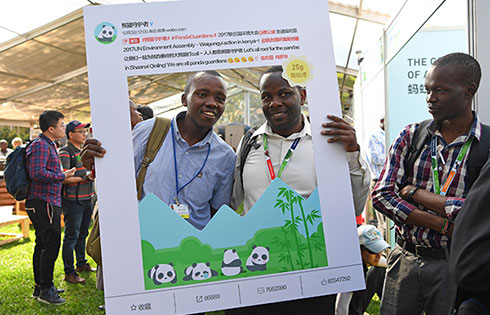
African businessmen attend the China-Africa Investment Forum held in Beijing in July. Business exchanges between China and Africa are growing more frequent. Photos provided to China Daily |
|
A crewmember of China Petrochemical Corporation in Sudan talks with local employees. As Chinese investments grow quickly in Africa, they need more legal services to regulate their business there. |
Orrick opened its first affiliated office in Africa just three months ago in Abidjan, economic center of Cote d'Ivoire. It has 25 other offices in Asia, Europe and North America.
The firm has had a busy Africa practice for some time, and has lawyers in Paris and London who have been working on cases related to Africa for more than 10 years, says James L. Stengel, a partner specializing in mass torts and product liability with Orrick.
About two years ago, they started to see more Chinese clients in their Africa practice as Chinese investments in the continent grew quickly.
"We decided that probably the size of practice and the sum of money handled by the practice in the African continent suggested that we needed to be physically present in Africa," he says. "In terms of our expectations for growth, the Africa practice involving China is obviously great."
Orrick has served primarily the African Development Bank, other such entities or organizations in Africa, or private companies from Europe or the United States doing business there, Stengel says. At the beginning, Chinese companies were not part of their business, and that clientele has developed only in the past few years.
"I think there's a change in how China is investing or acting in Africa, which means there will be more demand for lawyers like us," he says.

"If you go back 10 years, even five years or so, the Chinese model in Africa was sort of unitary," Stengel says. If an African country wanted a hydroelectric project, they approached China and maybe would get help with financing by China, engineers from China, and the workers would be from China. The Chinese team would fly to the location, build the housing, complete the project and go back to China.
Using that model, African countries would get the exact product they wanted, but it didn't bring with it much development for the local government and the local people, in terms of local contracts, giving workers more skills, or all the other development that flows out of the central project.
"The Chinese model was very efficient in terms of putting infrastructure into place, but didn't have this second-tier development effect the way that now the non-Chinese or European or United States model would," Stengel says.
Now more Chinese companies, especially big companies with a major presence in Africa, are beginning to run development projects in a way that is more consistent. They bring over expertise, manage the project, are involved in financing, and also use local contractors and engineers, so there's much more variety in how the deals are structured and the deals become more complicated.
Although business from Chinese companies is growing, that doesn't mean Chinese companies are seeking out legal advice as often as their Western counterparts, experts say. However, they're doing so more than they did a few years ago.
Apart from serving big Chinese companies, Orrick's new practice also targets a large number of smaller or less sophisticated Chinese state entities or private entities, Stengel says.
Because there's a lot of excitement about doing business in Africa, some Chinese companies may ignore or downplay the fact that their legal situation will be totally different in Africa and they need guidance in this different world, he says.
"Legal risks can be found in any major investment. The project may not work, expenses may be more than they expected, there may be failures in another party's transaction," he says.
There also are political risks. Stengel says that legal systems in place in African countries aren't necessarily fully developed, and they may not have the tools they need to support these business activities. He says he thinks that will change over time, but there may be huge gaps between the legal system of the host country and the specifics when transactions are being done.
Because Africa includes 56 different countries, and every country has a different legal system, and some speak different languages, one of the things law firms can bring to clients is to pass on details about what is happening in each of those countries.
"Africa is a continent that has countries that will greatly develop, and it has some in the midst of wars, and the legal systems and commercial systems of these countries are equally variable," Stengel says.
"What we have been doing now is to make Africa simpler for non-African investors and businesses to understand, to say, here is the legal situation," he says.
It's essential to have a deep understanding of the nation in question, he says, meaning they have to be there, to do business with local people, and to stay constantly in touch, because there are so many changes. In Africa, many changes are quick and unpredictable legal systems change, the environment changes, and there are some political and security problems, Stengel says.
As with any area, Africa poses a few unique challenges to foreign investors. One challenge Chinese companies face in Africa is that there is a lower threshold for government intervention than one typically finds in Europe or North America, says Agboyibor, who is also in charge of the African office.
In Europe, regulators often voice opinions on projects, particularly in high-profile industrial sectors, but often don't have a legal basis for intervening. In Africa, government intervention can impact projects at any stage, regardless of the project's size or the industrial sector at issue.
"Any company doing business in this environment, Chinese or otherwise, can benefit from legal and financial advisers and representatives who have a deep understanding of the environment, the local institutions and the best practices in African jurisdictions," Agboyibor says.
Orrick's African practice involves some 60 to 70 lawyers, primary in Paris and London. Their office in Africa has three lawyers at the moment, all of whom are local people. Two had practiced extensively in Paris before returning.
The firm sees the search for talent as the biggest challenge to the firm's growth in Africa. They need lawyers who understand both local systems and cultures but also have experience practicing with international firms, says Christopher Vejnoska, also a partner specializing in mass torts and product liability at Orrick.
"As the first to arrive in Abidjan, we have the best lawyers there who can be part of an international firm. If there are 15 firms, the talent in town may not be growing so fast, and it may not be easy to find people on the ground in Africa," he says.
chenyingqun@chinadaily.com.cn
( China Daily Africa Weekly 01/30/2015 page19)
Copyright 1995 - . All rights reserved. The content (including but not limited to text, photo, multimedia information, etc) published in this site belongs to China Daily Information Co (CDIC). Without written authorization from CDIC, such content shall not be republished or used in any form. Note: Browsers with 1024*768 or higher resolution are suggested for this site.
License for publishing multimedia online 0108263 Registration Number: 130349