Shenzhen, another municipality?
( 2003-11-07 10:06) (China Daily HK Edition)
If Shenzhen were to become a municipality under the direct supervision of the central government, it would be the fifth city granted such status, after Beijing, Shanghai, Tianjin and Chongqing.
Those who keep a close eye on the city's evolution are hotly debating the wisdom of such a move. However, an official with the municipal government recently issued a flat denial: "The city government has never expressed something of this nature. What we are concerned with is greater innovation within the system."

A special place
But this has not stopped rampant conjecture about the city's future. To release Shenzhen from the dilemma of being sandwiched between Hong Kong and Guangzhou, the argument goes, it has to find its own identity. And what could be better than to make it a zhixiashi (a municipality directly under the central government)?
According to a research report by the China Development Institute, a Shenzhen-based think-tank, Shenzhen and Hong Kong are both restricted by certain limitations, but combined they form an economic dynamo, with a total GDP of HK$1,700 billion that accounts for 17 per cent of the mainland's overall GDP. This would put the twin cities on the map with Western metropolitan areas.
An integrated Hong Kong-Shenzhen would cover 3,000 square kilometres, doubling Hong Kong's existing acreage. That would help alleviate Hong Kong's high unemployment and high cost of living woes. But to construct a unified market with a free flow of people, goods and capital, Shenzhen must rise in status, the report proposes. The elevation of its economic standing should be matched by a similar high level of jurisdiction. Hence, the zhixiashi solution.
Wei Dazhi, a professor at Shenzhen University, has studied zhixiashi and lists the following as the strongest arguments in its, and Shenzhen's, favour:

The Shenzhen Stock Exchange. Supporters of the zhixiashi idea think the elevation of Shenzhen's economic standing should be matched by a similar high level of jurisdiction. [newsphoto.com.cn] |
China's existing zhixiashis are evenly spread, geographically speaking. The north has Beijing and Tianjin, with Shanghai in the east and Chongqing in the west. Another zhixiashi in South China would create perfect symmetry.
In terms of economic output, Shenzhen has led all other cities in foreign trade for the past 10 years. Its industrial output is second only to Shanghai's. It ranks third in the country for financial revenue and fourth in GDP.
Seceding from Guangdong would not leave too much of a dent in the province, which contributes one-ninth of the nation's GDP, one-seventh of the tax revenue, one-fourth of the foreign capital and one-third of the foreign trade volume.
Shenzhen, at present, does not have the political clout of Beijing, the economic bulk of Shanghai, or Guangzhou's co-operation mechanism for dealing with Hong Kong. The city needs a stature boost to fully integrate with its southern neighbour.
Giving a newly developed city zhixiashi status would not wreak havoc with the existing administrative partitioning. In that sense, Dalian in the northeast, Qingdao in Shandong Province, Suzhou in Jiangsu Province and Ningbo in Zhejiang Province are all ideal candidates for zhixiashi.
Furthermore, in terms of administrative costs, it is cheaper to grant zhixiashi status to a city that is not a provincial capital. Chongqing was selected over Chengdu a few years ago for that very reason.
Compared with Wenzhou and Ningbo in Zhejiang Province, which fall one level below municipal status, Shenzhen does not have as big a "backyard". Therefore, neighbouring cities, such as Heyuan, which are the designated recipients of financial aid from Shenzhen, should be incorporated into the city.
Given the prospect that national tax and local tax may be combined, Shenzhen as a zhixiashi would make it easier for the central government to co-ordinate taxation, as it would take into account both the local economy and the balance of tax revenue at the central government level.
Surface or substance?
Chongqing, the latest entrant to the zhixiashi pantheon, is a case in point. Ever since receiving the coveted title in 1997, the changes it has undergone have been nothing short of stunning. The city skyline has been renewed every year, and economic output rose 50 per cent in the last five years.
Yet not everyone is convinced that the benefits associated with a zhixiashi will deliver as promised.
"Shenzhen is nothing like Chongqing," writes one netizen. "The problem with Shenzhen is it's so 'special' that goods and people face several roadblocks going in and out... Everyone, both foreign nationals and Chinese from other parts of the country, would need a special permit to get in. So much for 'seamless integration'."
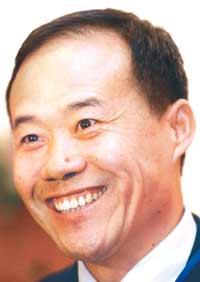
Wang Shi, chairman of real-estate company Vanke, said that zhixiashi would be extremely bad for Shenzhen's economic integration with neighbouring regions. [newsphoto.com.cn] |
Wang Shi, chairman of Vanke, one of the biggest real-estate firms in Shenzhen, remarked recently that it is really a lousy idea to push the city up a notch into the zhixiashi realm. "The local media people are enthusiastic about it because they are all government controlled and they will move up the ladder in status. But it is extremely bad for economic integration."
Others question the claims of economic growth said to be brought about by the title. If zhixiashi is such a miracle cure, why not bestow it on lots of cities that desperately need a shot in the economic arm? Still others feel that it is not equitable to disproportionately assign resources to one particular place. "A market economy is supposed to be about fair competition, and zhixiashi goes against that principle," states another netizen.
"Zhixiashi is good for the local economy, but Shenzhen should not be one yet," argues Huang Shiding, director of the Urban Management Institute at the Guangzhou Academy of Social Sciences. According to Huang, a zhixiashi enjoys several benefits - it does not need to pay provincial tax, and it has greater leeway in approving big investment projects, not to mention that all civil servants in the municipality would automatically move up the bureaucratic ladder.
But Huang contends that Shenzhen is a very special city. "It is the bridge through which Hong Kong goods, capital and personnel flow into the mainland. And it is a role model for the rest of the country in economic innovation. It would be weird for Shenzhen to become a zhixiashi because that would further complicate an already complicated situation.
"Shenzhen will never rival Hong Kong in international stature," Huang continues. "The two places have different political and legal systems. It is not just Shenzhen, but the whole Pearl River Delta, that functions as Hong Kong's backyard, so to speak. Therefore, it should be an integrated Delta to be on a par with Hong Kong."
The bigger picture
"The issue of Shenzhen as another zhixiashi must be examined in the context of the nation's administrative partitioning," says Huang Shiding. "It is not an isolated case. The way government is structured, layer upon layer, is the fundamental reason why some cities are better as zhixiashi and some are not."
Huang explains that five levels of government hierarchy currently exist in China. Aside from the central government, the other, more local levels include province, region (diqu) or city, county, and town. Zhixiashi comprises one level more than what is stipulated in the constitution.
Bai Gang, director of the Public Policy Institute at the China Academy of Social Sciences, points out that the current administrative demarcation is not even, as some localities are very large and heavily populated. A big county may have 2 million residents while a smaller province may have less than 3 million. "City" is the most chaotic designation, Bai says, as it has multiple levels of its own.
Zhixiashi carries repercussions of a negative nature, according to experts Bai Gang and Huang Shiding. More levels of government incur more administrative expense. Multiple levels also mean less efficiency and more bureaucracy. In order to push a project through the lengthy hierarchical pipeline, a great deal of co-ordination is needed, which raises costs even more.

Opponents of the zhixiashi idea believe Shenzhen would always act as a bridge between Hong Kong and the rest of mainland. A zhixiashi would simply complicate matters. [newsphoto.com.cn] |
Lin Yifu, a Beijing-based economist, emphasizes that the massive population relocation from rural and inland regions to urban and coastal areas is not being accounted for in the existing administrative system. Some counties experience such a precipitous drop in population and tax revenue that they should be phased out, says Lin.
"The hierarchy should be flatter to save on government costs and speed things up," argues Huang Shiding. When asked why some Western countries seem to have disproportionately demarcated jurisdictions, as in Texas and Delaware in the US, Huang explains that in a free market economic movements are not affected by administrative boundaries. People do not need special permits to work in a neighbouring city, and goods simply flow to where the market demand exists. But China has not achieved that standard yet. The way in which a place of administrative jurisdiction is mapped out may have a huge impact on economic behaviours.
In the 1980s, most counties were turned into cities following the rationale that a city would act as an economic engine and pull the whole county along with its growth. This has proved true for cities like Changzhou and Wuxi in Jiangsu Province, says Professor Zhou Zhenhe of Fudan University in Shanghai. But Yangzhou, just north of the Yangtze River, is another matter. There was no way the economically weaker city could adequately serve as the "dragonhead" for eight or nine of its surrounding counties.
In an ideal scenario, local governments would take care of administrative services, leaving economic decisions to the market, according to both Professor Zhou and Huang Shiding. But that is not likely to happen soon. Therefore, some new thinking is necessary for administrative repartitioning.
One suggestion is to create smaller provinces in which provincial governments manage counties directly, thus bypassing the troublesome "city" level. According to Zhou Zhenhe, Zhejiang is phasing out the regional (diqu) level because it has fewer counties and a more convenient transportation system. The provincial government can easily macro-manage all of its counties and leave local decisions to the county governments. The same is true of Hainan Province.
But Sichuan Province, for instance, was too spread out and had a huge population, which was why Chongqing took a big chunk out of it, Professor Zhou explains.
So where does that leave Shenzhen? "It depends on what kind of city it wants to become, not what kind of title it has," Huang Shiding stresses. The ripple effects of its economy and culture will ultimately determine the magnitude of its importance.
Tang Jie, secretary general of the Shenzhen municipal government, clarifies that the city does not claim to be the "dragonhead" of the Pearl River Delta. Nor does it propose itself as a "central city". The goal is, rather, to become "an international city". According to Tang, "Shenzhen has never thought about breaking away from the Delta."
|




