|
Home>News Center>China | |
|
|
|
|
|
|
|
|
|
|
|||||||||||||||||||||||||||||||||||||||||||||||||||||||||||||||||||||||||||||||||||||||||||||||||||
|
|
It's spring, and jobs are in the air
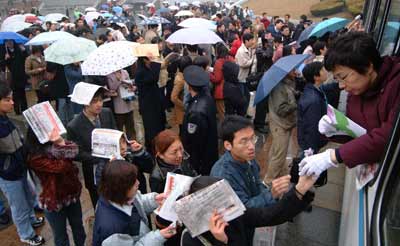
Recruitment booths mobbed by job hunters, resumes flying, questions asked, explanations offered, job leads swapped ... It's spring, and the time job fairs are organized every year for college graduates in Beijing and other cities across the country. At the first large employment fair staged this year in the nation's capital on February 7, more than 50,000 employment seekers swarmed the venue and only 5,700 went home with an offer in hand. Hot on its heels, four more fairs followed in mid-February, attracting 200,000 people (not just college graduates). More are in the pipeline.
Job fairs constitute a key avenue for university graduates to find employment in the market economy unlike in the planned-economy period that spanned the 1950s, 1960s and 1970s when jobs were arbitrarily assigned. This year, 2.8 million will graduate, 680,000 more than last year, a direct outcome of college enrollment expansion several years in a row since 1999. The figure of job-seekers is smaller, taking into account a significant portion of university graduates who will continue their academic pursuits in postgraduate schools. But there's another job-hunting contingent on the scene - those who have just finished their three-year postgraduate programmes. All this is against the backdrop of a tight labour market. This year, for example, 24 million people will enter the job market. Among them are 14 million laid-off workers to be re-employed and 10 million young people coming of age and needing a job, including college graduates, according to labour and social security authorities. The country's rapid economic growth means demand for a much larger workforce in the long term, especially for college graduates. But in the short term, the growth does not necessarily translate into sufficient employment opportunities for all people in all fields of knowledge. Market rules Employment is the outcome of interaction between the job hunter and the employer, with the relationship between demand and supply looming in the background. What do the graduates want? Jobs that promise good prospects, offer a decent pay and are in big cities. The three factors are the most important for college graduates, no matter what they have majored in. There are, of course, other important factors that also count when it comes to choosing a job but they do not weigh so heavily in the minds of the job hunters as the "Big Three." "Who wants a job that has no use for your specialized expertise and promises no future?" asks Song Jian, a finance major from Renmin University of China, adding that a sense of accomplishment and being important counts most. According to a survey conducted last year by Beijing Normal University among college graduates in 14 provinces and autonomous regions, 29 percent of the graduates found jobs in foreign-funded firms, 19 per cent in government organizations, 14 percent in high-tech enterprises, 13 per cent in State-owned enterprises, 11 percent in schools, 7 percent in scientific research institutions, 1 percent in township-run enterprises and the remaining 5 percent in various unspecified sectors. How much do they expect to be paid? It varies with each person and speciality. In general, students majoring in information technology, business management and finance expect higher pay. But they no longer ask for 10,000 yuan (US$1,200) or so per month as their predecessors did a few years ago when IT professionals were in short supply as the country's information industry moved into top gear; and when everything related to business and finance was pursued eagerly. Now that there is a glut of IT professionals on the market with an abundant supply of students of computer science, telecommunications and electronic engineering as a result of the "IT rush" in university enrollment; and with the information industry entering a phase of consolidation, the "IT elite" are giving up high wage expectations. But they still want more than their peers in other fields. It is roughly true of the business- or finance-related students. What do the graduates actually get monthly? A survey conducted by Peking University shows that, on a national average, 40.9 percent of newly-employed graduates, including postgraduate students, get less than 1,000 yuan (US$120); 45.5 percent 1,000-2,000 yuan; 9.5 percent 2,000-3,000 yuan;and only 4.1 percent more than 3,000 yuan. It also reveals that the pay varies significantly with different regions. In Beijing, for example, the bottom-line pay for newly-hired university students averages 2,161 yuan (US$250). Postgraduates' fate Postgraduates are more generously paid - averaging 3,000-4,000 yuan (US$361-481) in Beijing, for instance. But they want more - 5,000-6,000 yuan (US$602-722). They think they are well justified in asking for more, taking into account that they have invested three years in postgraduate programmes. There were many responses to a post put up on an online forum run by Tsinghua University on August 15, 2003 by a postgraduate, saying that he or she had earned 29,160 yuan (US$3,350) in seven months, or 4,167 yuan (US$480) a month in average. The person deplored: "It (postgraduate schooling) doesn't pay!" One of the responses was typically blunt: "That's a good wage. Be thankful. What else can you expect from the labor market today?" Big-city lure Then there is the geographic location of the employer, one of the "Big Three" factors. Many choose to settle in the already-crowded big cities, those in eastern coastal areas in particular - Beijing, Shanghai, Guangzhou, Dalian. The bottom line for many is provincial capitals. Why this hankering after big cities? "I like the sense of being near the centre of action. Besides, living and working in a big city offer you many things, tangible or intangible - cultural appeal, better amenities, access to a vast reservoir of information, a convenient avenue to the outside world and many more," says Zhang Chi, a graduate from the prestigious Tsinghua University. "Being in a small city in a remote area gives you a feeling of being buried deep." Handan, a medium-sized city in Hebei Province, not far from Beijing and sitting on the country's rail artery Beijing-Guangzhou line, finds it difficult to attract university graduates and postgraduates, except for those who choose to return to their hometown. "We badly need professionals specializing in computer science, law and business management. But some workplaces in our city are unable to lure graduates from prestigious universities," says Wang Qiang, director of the University Graduates Employment Section under the Handan Personnel Bureau. "To my knowledge, 58 graduate students with master's degrees came to work here a few years ago. But now, most of them have gone away. What can we do?" he asks resignedly. By the way, Handan is not a town in the backwoods. Demanding requirements While potential employees are particular about future jobs, employers, too, set their own terms, which are sometimes hard to meet - a prestigious university, a master's degree or above, two years of working experience. Some of the employment requisites border on absurdity - a run-down garage requires job applicants to be college graduates or above; a retail chain store demands that potential employees have a level-4 command of English or above. Besides, "two years of working experience" poses not just a baffling threshold but an insurmountable barrier for students newly out of college. These unreasonable demands coupled with graduates' sometimes unrealistically-high expectations, fan employment difficulties, among other things. Although many recruiters refrained from openly demanding high academic credentials at this year's job fairs, what they really want remains to be seen. A paradoxical situation thus arises: Jobs are hard to get on the one hand, and jobs go unwanted on the other. To redress the situation, college graduates should first of all lower their expectations, says Wei Zuping, vice-director of the Personnel Centre in Hangzhou, capital of East China's Zhejiang Province. "Against the background of a market economy, it is society, and, in turn, enterprises, that make the choice when it comes to employment matters. Only meeting the demands of society in the first place, can one have one's personal value realized." When they really tune down their expectations and be realistic, thousands upon thousands of jobs created by the nation's fast economic growth are just theirs for the picking, in his view. "Of course, some jobs sound not so good, some pay less, but they are jobs," he says. Some educators are encouraging the notion that is spreading on the campus: "Get a job first, choose a career second." To begin with, one's got to land a job to support oneself, then, biding one's time, choose a better job when opportunity knocks. Put into practice, the notion would help take some pressure away from the labour market, many believe. In the long term, it is inaccurate to state that there is a graduate glut or that supply of university students far outstrips demand, according to He Xian, director of the National Centre for Personnel Exchange. Holders of the college-level academic credentials or above, for example, make up only 5 percent of the employed people nationwide, the director says, citing the latest available survey conducted in 1998. This is in sharp contrast to 26 percent in developed nations. "The employment bottlenecks lie in big cities, hotly-pursued professions and eagerly-sought workplaces such as government departments, State-owned enterprises and foreign-funded firms. Beyond that, qualified professionals are still in short supply," he says. In view of this, the government is encouraging college graduates to go westward to pick up jobs in the vast hinterland areas; seek employment in grassroots units; or set up their own businesses, no matter how small they are in the initial stage. A series of preferential policies have been formulated to facilitate this. They include: Those who have worked in remote and poor areas for two years or more shall be, when they apply for employment in Party and government organizations and State enterprises, given preference in case their qualifications are on a par with other applicants. The principle applies to postgraduate enrollment, too. College graduates who set up their own businesses shall have registration and government management fees waived in the first year. The hiring of civil servants by government departments, organizations and agencies should be geared to accommodate college graduates' job needs, the policies state. This applies to State enterprises, too, when they need new technicians and managerial personnel. Policy support and graduates re-adjusting their employment outlook may help ease some pressure on the job market. |
|
|
|
|
||||||||||||||||||||||||||||||||||||||||||||||||||||||||||||||||||||||||||||||||||||||||||||||||
|
|
|
|
|||||||||||||||||||||||||||||||||||||||||||||||||||||||||||||||||||||||||||||||||||||||||||||||||||