|
Home>News Center>Life | |
|
|
|
|
|
|
|
|
|
|
||||||||||||||||||||||||||||||||||||||||||||||||||
|
|
Be it ever so expensive...
Forty-five year old Xu Liqiu used to live in a small shack near the Suzhou River in Shanghai. It was only 20 square metres in area, but had to accommodate a dozen people in total, because Xu's family is a really big one.
Xu's problem was that because he lived in a shack with three generations of his family, no one would marry him. Xu was thus caught in a "catch-22" situation. Xu's factory was also in a difficult situation, because with the limited nominal rents it collected, it was impossible for the factory to provide enough housing for all its workers. In the early 1980s, the housing shortage became increasingly acute in almost all Chinese cities. Families of two or even three generations sleeping in the same room, like Xu's family, were not exceptional. Things began to change gradually in the mid-1980s, when the housing reform was kicked off across the country, along with the reform and opening up of the economy. The two-decades long and still on-going reform, with "housing for the needy" as its slogan, has greatly improved the housing conditions of Chinese people. Individual stories Xu's situation, which embodies the story of countless similar ordinary Chinese families, is now recorded in "House," a 10-part documentary shot by China Central Television (CCTV), the largest TV station in China.
Housing has always been a hot topic in China, because it involves everyone. But different from other documentaries which usually take a macroscopic view of their subject, "House" chooses a different angle. Each episode focuses on the personal story of one ordinary Chinese, such as Xu Liqiu. The 10-part documentary tells 10 typical Chinese stories, thus presenting a panoramic view of housing conditions of Chinese people over the past decades. "In each city, we selected a typical area after consulting local scholars. Then we visited hundreds of households in those areas one by one, hoping to find the most typical story that we felt was interesting enough to include in the documentary," said Li Wenju, one of the two directors of "House." They began the work in May when China was in the centre of the SARS (severe acute respiratory syndrome) outbreak and the panic it brought. But even SARS did not stop their work. "We were not sure whether we could find what we were looking for, but fortunately things came together as we had hoped. Finding the target people was a quite strenuous and tiring task, even more difficult than the shooting process itself. It took more than two months, and only in July, were we able to start shooting," Li said. A foreigner might find it difficult to understand how much the issue of housing means to the Chinese. In the past in Chinese cities, housing was a fringe benefit for staff members of government institutions and industrial workers. Housing was distributed according to official rank or job seniority and rents were nominal.
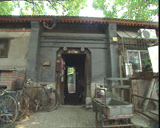
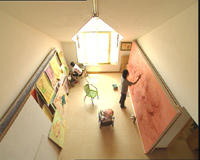
In order to make maximum use of the limited space they did have, Xu's father built a small attic 1.2 metres in height in their shack. That was where Xu slept from the time he was born. The legs of his bed had to be cut short to fit into the attic. Even so, he could never straighten up sitting on the bed, or he would bump his head against the roof. Their housing problem meant that Xu missed several chances of marriage. He had a number of girl friends over the years, but when marriage was broached, things came to an end. It sounds miserable enough. But when you consider that Xu's experience was quite common in the early 1980s in Shanghai, the biggest commercial city in China, the misery is magnified many time over. In Xu's neighbourhood along the Suzhou River, which used to be one of Shanghai's most imporerished residential areas, there were tens of thousands of families living in small shacks. Statistics reveal that in 1980, the city's urban population had an average living area of only 3 square metres per person. Fortune finally smiled on Xu in the 1990s when the Shanghai municipal government decided to rebuild the slum areas to improve people's living conditions. In 1998, Xu's family moved into a new, much more spacious flat measuring more than 100 square metres in Taopu Xincun, a new residential area built to accommodate former slum residents. And now Xu is planning to get married before he hits 50. Different angles Even for a Chinese, the issue of housing is too comprehensive to be fully understood. "Shooting the documentary helped me get a further understanding of the changes in housing conditions in China over the past two decades," said Xiao Wei, the other director of "House." Like Xu Liqiu's story, the other nine stories Xiao and his colleagues have chosen to tell in their documentary are all very typical. The protagonist in the first episode is 95-year-old Fu Zhicheng, who has been living in a small siheyuan, or courtyard compound (a kind of traditional housing in Beijing), in the Qianmen area for more than half a century. Fu's neighbourhood, next to Tian'anmen Square, is where the most typical traditional housing in the city is preserved. Normally 10, or even 20, households share one compound, each household having only very limited space. In the fourth episode, Yang Lixin, a renowned actor in Beijing, recalled the years he has been living in a tongzilou (long low-rise apartment buildings with long central corridors with communal toilets and washing facilities at either end), typical in the 1980s in China. The eighth episode tells the story of Leng Zhihua, a laid-off worker in Suzhou, in East China's Jiangsu Province, who moved into a new apartment with the help of the "low-rent housing scheme," an important part of the housing reform. Another episode is about Yang Xihong, who 12 years ago took out a mortgage to buy her own apartment, making her the first person in China to use a mortgage to buy an apartment. Today, taking out mortgages to buy apartments is the chosen route of millions of young people. Today, China's urban population enjoys an average housing space of 22 square metres per person, up from a mere 3.6 square metres back in the early 1980s. "The theme word of CCTV's documentary 'Witness' is 'change.' It is our aim to show our viewers the changes that have been taking place in Chinese society over the past decades," said Li Wenju. With this theme as their guide, Li said, they plan to pay more attention to modern China and make more documentaries focusing on the changes Chinese society is going through. |
|
|
|
|
|||||||||||||||||||||||||||||||||||||||||||||||
|
|
|
|
||||||||||||||||||||||||||||||||||||||||||||||||||