
|
Home>News Center>Life | |
|
|
|
|
|
|
|
|
|
|
||||||||||||||||||||||||||||||||||||||||||||||||||||
|
|
Stodgy response to writing prodigies
There are no signs in front of publishing houses saying, "Adults only, children not allowed."
Eileen Chang (Zhang Ailing), one of the most creative and original female writers in 20th-century China, who achieved literary fame in her early 20s, once remarked: "If you want to become famous, the earlier you get started, the better." Now it seems quite a large number of Chinese teenagers of literary bent are using the motto to spur themselves on, and indeed exhibiting a more impressive and precocious sophistication and aggressiveness than their famous inspirer. For example, Jiang Fangzhou, a 14-year-old girl with five books published already, is now working on the sixth, while at the same time writing separate columns for two different newspapers. According to the Chinese Junior Writers' Association, which was established in November last year, in less than four months it has recruited more than 1,000 members, all under the age of 18, many of them published authors.
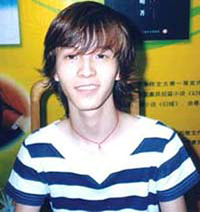
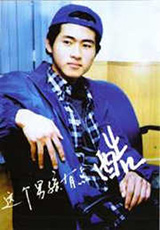
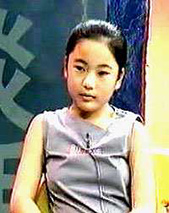
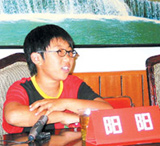
Initiated by Mengya (Sprout) Magazine, and co-sponsored by 10 top-notch universities, the competition offers an important channel for teenagers with literary talent to get public attention. For example, both of the top two best-selling juvenile writers, Han Han and Guo Jingming, are two-time winners of the competition. The trend includes even the incredibly young. Gu Liqun, not yet 13 years old, got her first fantasy novel, "Legend of the Sorcerer" (Mofashi Chuanqi), published last year. Yang Yang, now 10, published his debut book at 9 years of age, also a fantasy novel, "Time's Magic Zither" (Shiguang Moqin). Zhang Mengmeng, now 12, started her publishing career at age 9 with a collection of essays: "Let Me Tell You, I'm Not Stupid" (Gaosu Ni, Wo Bu Ben). When 9-year-old Jiang Fangzhou released her first book "Open the Skylight" (Dakai Tianchuang), people were startled. But the record was soon broken by Dou Kou, who published at 6 a collection of tales based on his own real-life experiences, "The Drifting Life of Dou Kou" (Dou Kou Liulang Ji). Jiang Fangzhou, whose works are marked by their strikingly precocious worldly wisdom, once remarked, "Apples that ripen fast sell more readily." Not surprisingly, the market is enthusiastically in favour of these precocious young authors. Han Han's first two books, "The Third Way" (San Chong Men) and "One Degree below Zero" (Lingxia Yidu), have each sold more than one million copies, while the majority of creative writers in China would deem themselves lucky if their books had a print-run of 50,000 copies. At last year's Beijing Book Fair, the country's largest annual book-sellers' event, one of the top-three best-sellers in the category of social sciences and humanities, was Guo Jingming's "The Visionary City" (Huancheng), written in 2002, when he was still a third-year senior high school student. Inviting criticism? Young teenage writers tend to portray the world in a very different way than adult writers do.
In some of the books written by teenage authors, adults as a whole are presented as a host of dogmatic, unsympathetic antagonists who find fault with whatever the young do. In a way, they are correct, because their fame comes accompanied with criticism. One of the most frequently heard depreciations is that they are the prey of market-oriented publishers. "The prevalence of young writers is not a literary phenomenon, but a commercial one," said Feng Jicai, a famous writer. "They are curiosities carefully packaged by publishers to attract consumers. Their youth guarantees them a place in the market," said critic Zhu Dake. Then there is always the doubting discussion and uninvited concern with their atypical lifestyles. When 11-year-old Gu Liqun dropped out of primary school in Chengdu, in Southwest China's Sichuan Province, in 2002, with the ambition of "becoming China's youngest professional writer," the incident not only aroused many disapproving voices, but almost brought her mother into a lawsuit. The local department of education and the primary school where Gu formerly studied threatened to take her mother to court under the country's Compulsory Education Law. They believed she had broken the law requiring all parents to see that their children complete their compulsory nine years of education. But Gu's mother said that she had no other course than to allow her daughter to drop out, because the girl insisted on it. "I like to have the freedom to arrange my time," said Gu, who stubbornly refused to go to school. She now spends most of her time at home in front of her computer, dividing her day between writing, playing computer games, reading and a bit of physical exercise. She has so far published two fantasy novels and one about life at school.
"Like most of the work by her young counterparts, Gu's three published novels are either directly based on school life she has experienced, or have at least been influenced by the ideas and information shared among children in school. "If she cuts off her relationship with school life, she will lose the source of inspiration for her work. I don't think books and the Internet can sustain creative writing," said Ran Yunfei, a well-known writer. "The most valuable thing about the stories written by children is that they are true records of life. If there is no life, how can they continue to write?" said Zhou Xuefeng, an official working with the Education Bureau of Sichuan Province. Heavy fame Wang Meng, famous writer and vice-chairman of the Chinese Writers' Association, said in a speech given during the closing ceremony of the sixth session of the "New Concept Writing Competition:"
Wang's words represent an attitude shared by a great many adults from critical circles. While they are impressed by the language and literary abilities exhibited by young writers, still they feel there is something disquieting about this trend that makes them reluctant to encourage it. "Early fame is too great a burden for children to handle. It may prevent them from establishing natural relationships with the world around them, from knowing themselves in any true sense, and from building a healthy and balanced personality," said Zheng Mingming, a professor in the Education Department of Beijing Normal University. What happened to Dou Kou less than two years ago is a typical case that demonstrates the unwholesome influence that early celebrity can have on a young child's mind and personality. Before Dou Kou was 6 years old he had been to more than 30 cities in China with his parents, who are sales representatives constantly travelling, and he was educated at home by his father. After "The Drifting Life of Dou Kou" brought him fame as a child prodigy, he was admitted by a private primary school in Nanjing, in East China's Jiangsu Province. Although he was only 6 years old, Dou was placed in the fifth grade from the very start. However, he dropped out before completing the year. According to a story written by www.qianlong.com's reporter Song Xiaoli, the biggest problem Dou Kou had in the school was that he did not know how to communicate with his schoolmates. He seemed frightened by the new environment, and unwilling to mix with his classmates, who, several years older than him, treated him with unfriendly curiosity and superiority. "They are jealous of me. I have no friends in the school," Dou Kou reportedly said to the press. According to Song, because Dou Kou's parents had to work, for some time after he had dropped out of school, they had to leave their young son locked in at home every day, where he spent most of his time reading and writing. The child was allowed to go outside to play for two hours every week, but he seemed more inclined to stay at home, seldom taking the time to go outside.
"I don't think childhood can be happy if there is no sunshine, laughter and little playmates, only loneliness and an excess of praise," said Liu Na, a primary school teacher. Lu Xun (1881-1936), one of the greatest 20th-century modern Chinese writers, once said that there were two ways to kill genius one was excessive praise, the other, excessive criticism. The remark is constantly quoted in articles about today's teenage writers. It seems the adult world has reached unanimous agreement that the right thing to do is to create a benevolent, protective environment for the healthy growth of these atypical children. But how? Obviously it has something to do with our education system. Almost all the teenage writers who have experienced trouble in their lives have had some sort of clash with the education system. When Dou Kou studied in the private primary school in Nanjing, he had no problem catching up in his Chinese course, but had a lot of trouble with mathematics and English. When Gu Liqun dropped out, she said she was "bored by the primary school routines, which she found tedious. She had a feeling what was taught in the classroom was "useless" to her. Han Han dropped out of senior high school after he failed to pass all his exams, with the exception of Chinese. Perhaps the teenager who has stirred the greatest controversy in China, Han makes China's education system the target of criticism and scorn in his first novel, "The Third Way," which was written when he was a 17-year-old senior high school student. Since 1977, the national entrance exams held each summer are the only path leading to universities. As a result, in order to pass the exams, all the students are asked to read and memorize the same textbooks and indiscriminately cram into their heads the same knowledge.
"The main problem is that it is hard to evaluate creative writing" - this is the excuse Peking University gave in 2000 when Han Han was refused admission. Later, Fudan University, in Shanghai, told the press that it would allow Han to sit in on classes as an auditor, but when Han heard the news, he spurned the offer. |
|
|
|
|
|||||||||||||||||||||||||||||||||||||||||||||||||
|
|
|
|
||||||||||||||||||||||||||||||||||||||||||||||||||||

 Exceptions have been made for students who exhibit
extraordinary talent in the sciences, arts, or sports. These students can be
given bonus scores in the entrance exams, or even exempted from them and
admitted directly into universities. But to date little has been done to
accommodate students who show a talent for creative writing.
Exceptions have been made for students who exhibit
extraordinary talent in the sciences, arts, or sports. These students can be
given bonus scores in the entrance exams, or even exempted from them and
admitted directly into universities. But to date little has been done to
accommodate students who show a talent for creative writing.


