|
Home>News Center>Life | |
|
|
|
|
|
|
|
|
|
|
||||||||||||||||||||||||||||||||||||||||||||||||||||||||||||||||||||||||||||||||||||||||||||||||||||
|
|
Intimate moments with a great man
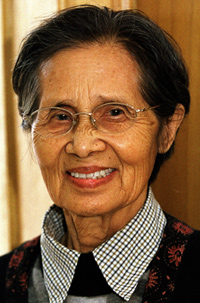
There seems to be nothing outstanding about this slim and diminutive elderly lady. At 80, she quietly lives in a three-room apartment with her husband in northeast Beijing.
Despite her advanced years, Hou will head to London for an exhibition of her photos scheduled to open on April 7 at the famous Photograph Gallery. The photos on display are all of the late Chinese leader Mao Zedong (1893-1976). All were taken by her, Hou Bo, one of the first generation of women photojournalists in China. Charismatic photos All this began at the moment when Hou Bo pressed the shutter, capturing Mao proclaiming the founding of the People's Republic of China on Beijing's Tian'anmen Rostrum on October 1, 1949. "The Founding Ceremony" may not be a great picture from a professional point of view, but no one can miss its historical significance, observes Zeng Huang, a senior photojournalist and member of the Chinese Photographers Association. "It signals the start of a new era in China and has thus become symbolic."
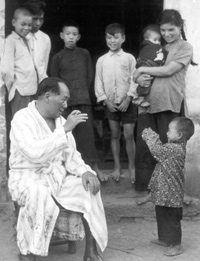
And it was a great moment for Hou as well. That impressive photo led the modest peasant girl into Mao Zedong's inner circle, living and working in Zhongnanhai, the nerve centre of the new government, documenting Mao's public and private life until 1961. Almost all of the well-known images of the Chinese leader from those years were taken by Hou Bo. Among them are Mao in a dark overcoat standing on the beach, Mao wearing a straw hat in a wheat plot, Mao surrounded by children in his hometown, Mao shaking hands with people of ethnic minorities, and Mao meeting foreign guests. Those pictures enhanced Mao's image as a leader, a teacher and a helmsman. But they are only a small part of Hou's pictures of Mao. Most of the other pictures surfaced only years after Mao passed away in September 1976. "In those days, only those photos that presented State leaders in their best light were be published," recalls Hou. One of the photos which was withheld for "being too private or intimate" shows Mao teasing a country boy. This most engaging picture captured Mao's grandfatherly affection towards children. Here he is an ordinary old man: draped in a loose bathrobe, dirt-stained legs uncovered, smoking while playing with the boy, apparently taken into the boy's innocent world. Hou vividly recalls the scene in 1958 as though it took place yesterday. "The Chairman had just had a swim in the Xiangjiang River in his hometown and spontaneously strolled into a farmer's courtyard nearby," she says. "Seeing the stranger coming, a few villagers, including that boy, rushed into their houses. Mao followed the boy who was eating snacks, and teased him: 'What are you eating? Can you share it with me?' The boy hid the snacks behind him and said: 'Guess what it is. I bet you can't. "The Chairman was really amused. And I got the picture," Hou says proudly. There other similar moments, although Hou might not be there to catch it. Take for example, the photo catching Mao swimming in the mighty Yangtze River in Wuhan, the capital city of Central China's Hubei Province, in late May 1956. Hou says she was simply impressed by Mao's guts and swimming skills. "He was 63 years old then, and few Chinese could go swimming in the Yangtze at this age back then," she says. "The Chairman was such an excellent swimmer that he could even smoke while doing the backstroke, acting as relaxed as he would when taking a leisurely walk." Her only regret is that she failed to capture that moment. Hou was on a fishing boat following Mao. She remembers that day the Chairman swam for 40 minutes and "he was overjoyed." Mao was known for his passion for swimming. "But he seldom swam in the swimming pool built for him in Zhongnaihai," she says. "To him the pool was merely a bath tub. He preferred to swim in rivers, lakes or oceans." Zeng Huang agrees that Hou's pictures reveal her own reverence towards Mao. "But her reverence was pure and innocent," he says. "There is nothing wrong for a photojournalist to be full of pure respect for his or her object. History should be grateful for her innocence which drove her to capture so many colourful images of Mao. That's a good historical record." Hou strongly feels that Mao was the saviour of both herself and of China. "Without him, I'm sure I would have been long dead of starvation or killed by the Japanese," she says. Photographer's devotion Fleeing the invading Japanese troops, who killed her family in North China's Shanxi Province, Hou with her schoolmates joined the guerrillas in the Zhongtiao Mountains. She joined the Communist Party of China at the age of 14. However, she recalls, she did not truly understand the meaning of her life until the early 1940s, when she encountered Mao for the first time in Yan'an, the centre of China's revolution. She was a student of Yan'an University and Mao came to give lectures. She described Mao's tone as "dulcet" and his talks about communism and China's liberation as "clear and interesting." Mao's lectures broadened Hou's horizons. "I suddenly felt things were changed, and a brand new world would appear as long as we follow Chairman Mao." To her, every day was a new day in Yan'an. It was there she met her future husband Xu Xiaobing, eight years her senior. Before coming to Yan'an, Xu worked as a camera assistant for noted film director Wu Yinxian in Shanghai. Xu taught Hou all he knew about photography. If Mao had taught Hou her way of thinking, Xu had given her a method to understand the leader through the lens. After she moved out of Zhongnanhai in 1961, Hou continued to work as a photojournalist with the Xinhua News Agency. When she left Zhongnanhai, all of her photos of Mao were kept in Zhongnanhai as part of the central archives. Despite her glorious past, Hou was not spared from persecution during the "cultural revolution" (1966-76). At the order of Jiang Qing, Hou was sent to a work camp in the Zhongtiao Mountains, where she had joined revolutionaries some 30 years earlier. "I don't remember that I did anything offensive to Jiang Qing. The only thing I can think of is that I refused to take pictures for her a couple of times. I didn't like her. But the Chairman asked me to forgive her if I cared for him," Hou says. Years after Mao passed away, Hou Bo could still feel his lingering impact. In 1985, she made a visit to Hotan of northwestern Xinjiang Uygur Autonomous Region. She was delighted and surprised to find in almost every household there hang a picture she took of Chairman Mao meeting an old Uygur farmer named Kurban. "When the local people learned that I was the photographer, they all wanted me to take a picture for them. But they got mad at me when I told them Chairman was not a god and he made mistakes. Some even tried to beat me." Nevertheless, Hou loves that experience. "There would not be New China without Mao. And the Chinese people would not have been able to liberate themselves," says Hou, from the bottom of her heart. Spiritually, she and her husband still live in the reality of the past, or in Mao's era. "We cannot forget Chairman Mao. He is the man who decided China's destiny and mine as well," says Hou Bo. |
|
|
|
|
|||||||||||||||||||||||||||||||||||||||||||||||||||||||||||||||||||||||||||||||||||||||||||||||||
|
|
|
|
||||||||||||||||||||||||||||||||||||||||||||||||||||||||||||||||||||||||||||||||||||||||||||||||||||