|
Home>News Center>Life | |
|
|
|
|
|
|
|
|
|
|
|||||||||||||||||||||||||||||||||||||||||||||||||
|
|
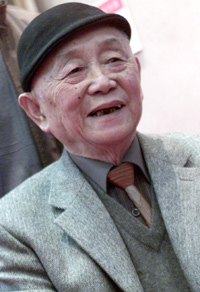
Energetic artist winks at life
Artist Huang Yongyu has much to expect from the spring.
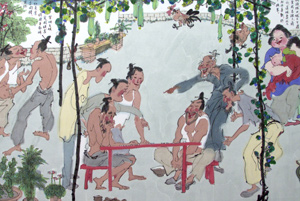
Huang, 80, lives a quiet life at his home in Beijing's eastern suburb, which he calls his "Hall of Ten Thousand Lotuses" (Wanhetang). Huang, whose work "Painting of Old Plum Trees" (Laomei Tu) sold for 570,000 yuan (US$69,000) late last month at an auction held by the China Sungari International Auction Company in Beijing, is one of several respected master artists who are reaping fame and money after decades of wandering and creation. Unorthodox artist A retrospective exhibition of his traditional Chinese paintings and calligraphic works is running at the National Museum of China until Thursday to celebrate his 80th birthday.
Viewers share in both the visual joy of the paintings and the cheerfulness of the clever, humorous old man, when viewing Huang's works, which are characterized by simple lines and bold colours. The visitors can also understand why some of the orthodox have criticized the master's traditional Chinese paintings as being "not very Chinese." Huang, smoking a pipe, with a black felt hat and checked shirt, sees himself as "a cultural vagrant." "I am not an expert in aesthetics or art history. I am just a craftsman," he says. Unlike most other artists of traditional Chinese paintings, Huang never formally followed any teachers. His first "artwork" was completed at the age of 4 on the wooden wall of the newly built house where Huang's large intellectual family had lived for generations in Fenghuang County, in Central China's Hunan Province. "Give me a brush and ink," the 4-year-old ordered his younger brother. He drew a painted mask of a local opera character and wrote beside it 10 characters saying: "We are at home, and we are doing something." The mask brought him a scolding, not a reward. Though faded, the ink work is still there on the wall, and Huang couldn't help touching it up every time he returned home from his wandering. "My hometown is just so wonderful," he was quoted as saying by his friend Li Hui, who accompanied him on a trip to Hunan. To Huang, his hometown was where he played in narrow alleys paved with stone slabs, where he watched craftsmen make kites and carve statues of Buddha, where he enjoyed folk operas, dragon-boat races and lion dances. "The place and people there have changed. Sometimes they are not as simple as he remembersthem to be, but nothing can change the perfect image of his hometown in his heart. It was his source of inspiration in his wandering years," said Li. Huang went more than 600 kilometres away from his home for his high school education, in Xiamen, in East China's Fujian Province, when he was 11. "I thought the urban kids there were childish. At 11 they still played games, while back home we hunted birds and animals in the mountains," he said. He was notorious for playing truant and hiding himself all day in the school library. Not having noticed the short, thin child, the librarian often locked him in when leaving for lunch. After two years of schooling, he carried a large pack of books on his back when he ran from the Japanese invaders when they invaded Xiamen during the War of Resistance against Japan (1937-45). But he had to drop the books one by one as they were too heavy for him to carry. "Huang read about everything - philosophy, geography, military weapons - as well as novels. One night he stayed in a small town, where he could find nothing to read, so he read the telephone book at the local hotel," said Li Dalun, a friend from Huang's hometown. "There were many interesting things in the telephone book, such as which fertilizer to use for flowers, and how to bathe cats and dogs," explained the artist. While running to save his life, Huang met several artists and became a member of the Southeast China Wood-cut Society. From 15 he began to live on the money paid by newspapers and magazines that published his wood-block prints. "At 20 I was doing illustrations for some popular poets' books, and often boasted about my acquaintanceships with poets. But I was extremely poor and often had to choose between having a haircut and buying a wood block print," he recalled. He is grateful to his wife Zhang Meixi, also an artist. It was on an occasion when she insisted on his having a haircut and at the same time bought him a wood block print that they first fell in love. Starting in 1947, Huang began to travel between Shanghai, Taiwan and Hong Kong to work for various small magazines. After holding four solo shows in Hong Kong, he was employed by Hong Kong-based Ta Kung Po as an art editor. In the 1950s he became the youngest teacher at the Central Academy of Fine Arts in Beijing. By the time of the "cultural revolution" (1966-76) Huang was one of the leading print and ink artists in the country. He did little in the way of art during that 10 years of turmoil. But his ink and wash painting, titled "Owl" (Maotouying), which portrays an owl with one eye closed, was criticized as an attack on socialism, as it portrays public officials turning a blind eye to wrong doings. Since 1977 he has held solo shows in the National Art Museum of China in Beijing and the Metropolitan Museum in New York, as well as in other important art venues in Hong Kong, Rome, Auberhaussen, Bonn, Stuttgart, Melbourne and Taipei. A merry life Known to his fellow villagers as "the old painter," Huang said writing ranks first in his heart, sculpting second, printmaking third, and then painting. "But life is too hard as a writer, sculptor or print-maker. Only as a painter can I support my other three passions," he said. He has published several books of prose, most recently "Old Men Older Than Me" (Bi Wo Lao De Laotou'er), which describes the lives of scholars and artists he has known, including Shen Congwen (1902-88), Qian Zhongshu (1910-98) and Zhang Leping (1910-92). It is said that the members of his family often hear him break into laughter when he "writes something marvelous," according to Li Dalun. Among the flowering trees and beside the pond in Huang's garden, one can see his sculptures, mostly cute, funny images that greet viewers with hearty smiles. "I have never known anyone like him," remarked cartoonist Ding Cong. "He is so energetic. He paints, writes, sculpts and builds houses. He built one big house after another, and we all think he is addicted to building houses," said Ding's wife Shen Jun. Huang has designed and built four houses - in Beijing, Florence, Hong Kong and his hometown Fenghuang. Although his homes would suit reclusion, he receives many guests. "One can be naive in his own life, but has to be sophisticated in social life," he said. In one of his books, the "old man" (laotou'er) is pictured silently smoking a pipe, but in another he is jumping high in the air, twisting his body. A reader asked Ying Hong, the book's editor, which of the two was truer of Huang. "Boxing and car racing are his favourite sports, so what do you think?" Ying replied. |
|
|
|
|
||||||||||||||||||||||||||||||||||||||||||||||
|
|
|
|
|||||||||||||||||||||||||||||||||||||||||||||||||