|
Home>News Center>Life | |
|
|
|
|
|
|
|
|
|
|
||||||||||||||||||||||||||||||||||||||||||||||||||||||||||||||||||||||||||||||||||||||||||||||||||||||||||||||
|
|
Migrant workers: Urban underclass
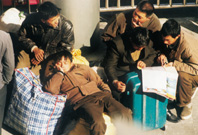
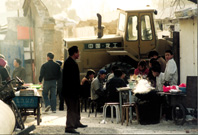
According to official statistics, there are now 130 million (equivalent to one-half the American population) migrant workers in Chinese cities. This means that China has more migrant than urban workers, and that they constitute the main Chinese industrial workforce.
To those familiar with China, this phenomenon is an important signal for social change. The term "farmer" carries quite different connotations in China from what it does in the West, where farming is a profession taken up by well-educated people and involves large-scale mechanical production. Also known as agricultural industrial workers, farmers have a social status equal to that of urban dwellers. In China, being a farmer is synonymous with low social status. Chinese farmers have a comparatively poor education and live on a small patch of farmland (per capita farmland is less than 1 mu, or 1/15 hectare). Some farmers work in non-agricultural industries, or go to cities as migrant workers, but do not enjoy the same political rights and social guarantees as their urban counterparts. Migrant workers thus have a raw deal, despite providing cheap labor for China's ongoing economic development. Their huge numbers also challenge the system of domicile registration and legal and social guarantee systems that have been in force since the establishment of New China. Making One's Fortune
Li is content with his current life: "Having stayed here for four years, I am reluctant to leave. I earn 500 yuan per month. As my food and lodging are part of my salary, I can save 400 yuan each month. Farming in my hometown is not easy these days because of floods, drought, and pest infestations. Even after a good harvest we are not optimistic because grain prices frequently drop, but the price of diesel oil, fertilizer and pesticide remain stable. Mechanization of agriculture has created surplus laborers." Most of Li's contemporaries have left their hometowns for the provincial capital, county seat, Beijing, or Yangtze and Pearl River Deltas. Li comes from Henan, China's No 1 labor exporting province, and is one representative of its large army of migrant workers. Statistics from 2003 show that 13 million farmers lived away from Henan for more than six months, accounting for one-third of the province's rural labor force. In Anhui, the second-largest labor exporting province, seven million of its total 27 million rural laborers worked away in 2003. China's 1.3 billion population includes 900 million rural dwellers, within which there is a 500 million labor force. Out of this, 100 million engage in agricultural production, and scores of millions work at township enterprises. This leaves a 300-400 million surplus. The current figure of 130 million migrant workers in urban areas is, therefore, just the tip of the iceberg. According to experts, a massive shift of rural labor into non-agricultural industries, as occurred during England's industrial revolution, is an inevitable outcome of accelerated industrialization and urbanization. Migrant workers contribute greatly to rural economy. In 2003, migrant workers from Henan Province remitted 52.8 billion yuan to their hometowns, and Anhui's seven million migrant workers contributed an amount equal to the annual provincial GDP. They remit 30 billion yuan annually, an amount higher than the entire provincial revenue. These funds are used to improve farmers' living standards, build houses and roads, establish schools and help boost rural economic development. Many migrant workers return home to run their own business, bringing with them new concepts that help boost local economic development.
According to a survey conducted by the labor and social security department, within 2,600 enterprises in 26 Chinese cities, including Beijing, Tianjin and Shenzhen, migrant workers earn an average 660 yuan per month. This is lower by about 300 yuan than that earned by urban industrial workers. Living on the Edge In a survey conducted by the China Urban Labor Employment and Labor Flow research team, 50 percent of the floating rural population wanted to stay in the city, and less than 10 percent expressed a desire to return home. Could they permanently stay and work in cities? Not yet, because as far as urban dwellers are concerned, no matter how prosperous life for migrant workers in the city may be, they do not belong there. Li Cheng is still stung by urban dwellers' derogatory remarks about his background. "We can never enjoy the same rights as urban citizens. The word 'farmer' is used to mean a poorly educated person with outdated concepts and low hygiene awareness," says Li. Migrant workers take on the heavy, dirty work disdained by their urban counterparts, and even when there are rural and urban workers on the same job, they do not reap the same benefits. Rural workers get no insurance, subsidies or social security, and have to pay a high entrance fee when sending their children to school. The worst aspect of their situation is the unfair treatment they are subjected to, like working overtime with no pay, and being chosen to do dangerous work with no protective clothing or equipment. If they fall ill, or get injured to the extent of disablement, they are simply fired. Legal experts say that the present system makes it difficult for migrant workers to enjoy their civil rights in cities, as urban social organizational systems are not open to them and they are constrained by discriminatory local laws and regulations. "I like the skyscrapers, shopping malls, and hustle and bustle of city life," says 26-year-old Yan'er from Guangxi Zhuang Autonomous Region. Having worked in Shenzhen for eight years, she is reluctant to leave. "In my home village the road is muddy after a fall of rain, and power failures are a part of daily life, which is generally monotonous." Yan'er nevertheless finds city life hard. She has a job, but fierce competition dictates that 18-25 is the most desirable age group for employment, outside of which there are few opportunities. Marriage is also a headache. Urban citizens are not willing to marry migrant workers, and Yan'er herself has no interest in marrying a migrant worker on a low salary, and would not even consider farm laborers in her hometown. A considerable number of migrant workers are reluctant to return to their home provinces, but few gain a foothold in the city due to a lack of professional skills. One worker who has succeeded in establishing a place in the city for himself and his family is Sun Yongqiang. In the past seven years, he has delivered goods, made steamed buns, and worked as waiter in a restaurant, until eventually being promoted to general manager of the Hefenglou, a medium-sized restaurant in Beijing. Although he earns 40,000 yuan annually, a medium salary in Beijing, his rural roots preclude him from the right to a housing subsidy fund or house loan. He lives in a 10-square-meter makeshift house with his wife and two-year-old son. An apartment in Beijing costs anything from several hundred thousand to one million yuan, and the 1,500 yuan left over after paying rent and other living expenses is not enough for a mortgage on an apartment. "Being a big boss is the only way to a well-off life," says Sun, but he has no idea when that will be. Policies to Safeguard Migrant Workers' Rights Long Yongtu, secretary-general of the Boao Forum for Asia, and William Ding Lei, China's richest man and founder of Internet portal NetEase.com, won the title China Economics Personality of 2003, along with Xiong Deming, a woman from Longquan Village, Renhe Town, Yunyang County, Chongqing Municipality. Her personal circumstances, as regards education and personal wealth, do not compare with her illustrious fellow prizewinners. Xiong Deming was awarded this prize because in 2003 when Premier Wen Jiabao was on an inspection of her hometown she complained to him about a 2,300 yuan wage payment default suffered by her husband.
Marginalized by city life, the main threat that migrant workers face is being refused payment of earnings after working hard for the whole year. As there is a dearth of laws safeguarding migrant workers' rights, wage payment defaults are an ongoing and common problem. According to well-known sociologist Li Qiang, in the year 2002 one in every four migrant workers experienced defaults in wage payment. Gui Yanchao, a 43-year-old farmer from Daxin Town, Dawu County, Hubei Province, is one example. Ten years ago, he went to Shenyang with 25 fellow villagers and contracted for the plastering of a construction project. He signed a formal contract with the first party, who later refused to pay him. Ashamed to face his village, Cui has stayed on in Shenyang working as a trishaw driver and pressed for payment of the money owed to him. He has not once seen his wife and children in the past ten years. Xiong Deming's honest disclosure of a local employer's defaulted payment of her husband's wages brought the passing of an act that helps migrant workers obtain their rightful earnings. Governments at all levels have since been urged to help migrant workers, and companies in default are severely punished. Beijing municipal government has announced that any building enterprise failing to pay migrant workers' wages will be driven out of the Beijing market. But this is not merely a matter of employment ethics; it is an economic problem stemming from migrant workers' low status. Urban citizens can demand a government guarantee of their rights and interests, but migrant workers cannot. The solution to the problem is abolishment of discriminatory regulations formulated during the planned economy that restrict farmers from staying in cities. Since adoption of the reform and opening-up policy and China's transition into a market economy, farmers have flocked to cities to find work, but appropriate measures to accommodate them have not yet been perfected. Recent media concern for migrant workers has raised the issues of improving their status, relaxing restrictions on them, and bestowing on them the same rights as those enjoyed by urban dwellers. The Chinese government's passing of acts that show solicitude for and protect migrant workers was sparked off by Xiong Deming's honest disclosure. In developed provinces like Jiangsu, where differentiation of rural and urban domicile registration has been abolished, urban and rural residents enjoy the same treatment. In big cities like Beijing, Shanghai, and Shenzhen, a considerable number of schools for migrant workers' children have opened. Migrant workers in some areas also have the legal right to a pension and industrial injury insurance. Recently, the State Development and Reform Commission and the Ministry of Finance announced that migrant workers would no longer be required to pay sundry fees. "We firmly believe that deeper reforms and social advancement will eliminate the pejorative connotations of being a migrant worker," was the optimistic comment carried by Chinese mainstream newspaper the Worker's Daily in its article "An Important Signal for Social Change." |
|
|
|
|
|||||||||||||||||||||||||||||||||||||||||||||||||||||||||||||||||||||||||||||||||||||||||||||||||||||||||||
|
|
|
|
||||||||||||||||||||||||||||||||||||||||||||||||||||||||||||||||||||||||||||||||||||||||||||||||||||||||||||||