|
Home>News Center>Life | |
|
|
|
|
|
|
|
|
|
|
|||||||||||||||||||||||||||||||||||||||||||||||||
|
|
Early educational mission
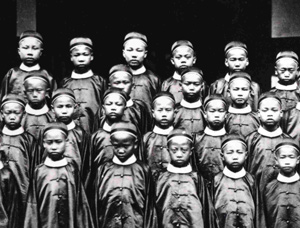
A group of boys aged between 9 and 15 set off for the United States on August 11, 1872, from Shanghai.
Funded by a project called the Chinese Educational Mission, they were the first group of Chinese students to be officially sent abroad by the government. However, for more than a century, their stories have remained obscure. But now, who they were and what happened to them is being recorded in a five-part television documentary by a crew from China Central Television, the national TV network. Entitled "Boy Students" (You Tong), the series is scheduled to air between May 1 and 5 on CCTV's News Channel, and between May 3 and May 10 on its International Channel. Surprising findings
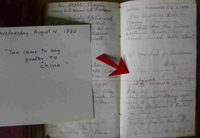
According to Hu Jincao, general director of the documentary, the mission was founded by Yung Wing, the first Chinese person to graduate from a US university. A Yale University graduate in 1854, Yung valued his academic experience in the United States so much that he felt compelled to try to help other Chinese students to follow in his footsteps. He believed that after acquiring Western technical education, the students would use that knowledge to modernize China and help the country defend itself in wartime. After years of cajoling, Yung finally got the Qing court to agree to finance the project. Between 1872 and 1875, a total of 120 students, with an average age of 12, were chosen by the mission and were lucky enough to see with their own eyes the world outside China. They were respectively placed with local families in about 40 towns in the Connecticut River Valley. Like Jackie Chan following imperial orders, "at first they were required to wear their long Chinese gowns and plaited cues," E. La Fargue, assistant professor of History and Politics at the State College of Washington, writes in his 1948 book, "China's First Hundred." "It made them look like girls, and their fellow American students took great delight in teasing them and calling them Chinese girls," Fargue wrote. But the students overcame language barriers soon and did well in their academic studies. Meanwhile, they rapidly adjusted themselves to the US culture and soon took off their long gowns and were often seen on sports fields. It had been scheduled that they would stay in the United States for 15 years before returning home. However, in 1881, the Qing court discontinued the mission on the grounds that students were losing touch with their Chinese culture and heritage, fearing that they would be "completely Westernized." On the pictures the students sent home, their gowns and plaited braids were gone, replaced with top hats and stiff collars. Some students even claimed to have become Christians. By the time the programme ended, more than 60 of these boys had attended colleges, universities, or ordinary technical schools. There were 20 students at Yale, eight at MIT, one at Harvard, and three at Columbia. Sadly, many had just started their schooling. A US group led by renowned writer Mark Twain appealed to Ulysses S. Grant, then President of the United States, to help stop the departure of the Chinese students. Their efforts only succeeded in delaying the departure for about six months, according to Hu Jincao. After getting back home, the young students became precursors in many businesses and other fields, especially in technical professions such as the mining industry and railway transportation. These students also infused a new spirit into what was still antiquated China, bringing home modern ideas. Among them were Tang Guo'an, the first president of Tsinghua University and Cai Shaoji, first president of Tianjin University as well as Tang Shaoyi, first Cabinet Prime Minister of the Republican of China (1912-1949). But digging into the lives of these students was slow and time-consuming. "Stories of the young students sent to the United States are fragments of porcelain, scattered over the United States and China, lost for more than a century," said Hu Jincao. According to Hu, the notion of shooting "Boy Students" came to Qian Gang, the general adviser of the documentary, quite coincidentally. In the summer of 2002, Qian casually mentioned the Chinese Educational Mission to Patricia M. Thornton, an assistant professor at Trinity College in Connecticut. Thornton said she had learned much about it, as Hartford, the site of her college, was one of the settlements where the Chinese students lived. At Thornton's invitation, Qian made a visit to Hartford soon thereafter. As a senior producer, Qian had been thinking of shooting a documentary on the students. But it was only then that he felt the proper time had finally come. In an effort to look for traces of these students, the television crew travelled to 10 towns in the United States, as well as to Hong Kong, Macao and many other Chinese cities. They filmed buildings that existed during the late 19th century and interviewed many descendants of the original Chinese students. Hu said she and her crew were surprised to find that despite the short period they stayed, the Chinese students had made a distinct influence on the local society in the US towns where they had stayed. The traces were left in the high schools and universities they used to attend. According to Hu, historical societies and public libraries in most host cities of the students' still preserve many precious historical relics - letters, diaries, clothes, and press clippings that help to patch together a bygone period in the history of Sino-US exchanges more than a century ago. In some ways, the students are still living in the memory of many local US people in the towns they used to stay in. In Colebrook, Connecticut, the crew met Robert L. Grigg, a retired cartographer. Grigg told the crew that as a child he attended the local two-room schoolhouse, where the students were taught about a Chinese man by the name of Yew Fun Tan. During his years gaining an American education, Tan became closely associated with a local family, the Carringtons, where he was accepted as a member of the family. Tan died of pulmonary disease in 1883, and was buried in the local cemetery in Colebrook. Tan's tombstone has English posies on one side, and Chinese on the other. Today his tomb is still frequently visited by local people as well as dignitaries from both China and the United States. "The townspeople felt honoured to have had him as part of our history, and as a result, viewed China and its people on a more personal basis than the general population," Grigg said. "The history of the boy students is a history of the friendship between people of the two countries," Hu said. Ties continue today The friendship continues today, as Hu could feel during the shooting of her documentary. Julie Felt, one of the US members of the crew, said as a native of San Francisco, California, she had heard many stories about the great contributions that were made by the immigrants from China to the development of the West. "We will continue to be able to learn much from each other's cultures for the betterment of all," Felt said. Ben Tivey, another crew member, is also a native of San Francisco. He grew up among many third and fourth generation Chinese in the United States. "The work the filmmakers have done creating 'Boy Students' will now add another fascinating piece to the picture of the complex and ever-evolving relationship between the Chinese and the US people," Tivey said. Hu said the history of the students illustrates the challenges of China's early efforts to modernize, as well as the vicissitudes of time. Richard Yung, whose grandfather Yung Kwai participated in the Chinese Educational Mission and was one of the 120 children, said when he was young, his parents never told him about his Chinese background. Yung Kwai, who graduated from Yale College in 1884, gave rise to a dynasty of Yale graduates, including Yung's father, Yung's uncle and his brother Dana Yung. Unlike his parents, Richard Yung is willing to tell his juniors about the unique family background. His granddaughter once even wrote in a composition the story of her distant ancestor Yung Kwai. "Today, we are all proud of the Chinese blood in our veins," Yung said. |
|
|
|
|
||||||||||||||||||||||||||||||||||||||||||||||
|
|
|
|
|||||||||||||||||||||||||||||||||||||||||||||||||