|
Home>News Center>China | |
|
|
|
|
|
|
|
|
|
|
||||||||||||||||||||||||||||||||||||||||||||||||||||||||||||||||||||||||||||||||||||||||||||||||||||||||||||
|
|
NPC rules out HK general elections in 2007, 2008
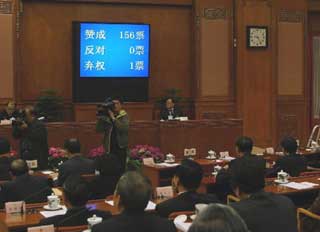
The Standing Committee of the National People's Congress (NPC) adopted a decision Monday, which favors modification of the existing methods for selecting the Hong Kong's chief executive in 2007 and forming the Legislative Council in 2008, but rules out the possibility of universal suffrage for the upcoming elections.
"The method of universal suffrage shall not apply to "the election of the Third Chief Executive of the HKSAR in 2007, nor to the election of all members of the Fourth Legislative Council of the HKSAR in 2008, the Decision said. The half by half ratio for members of the Council from functional groups and from constituency election shall remain unchanged, the Decision said, adding that the procedures for voting on bills and motions in the Legislative Council shall remain unchanged. However, the Decision said that specific methods for selecting the Chief Executive in 2007 and forming the Legislative Council in 2008 could be "appropriately modified" in the principle of gradual and orderly progress and in accordance with the Basic Law, the Decision said. The NPC Standing Committee explained in the decision that HongKong's history for democratic election is not long, and it has been for no more than seven years that Hong Kong residents have exercised the democratic rights of participating in selecting the HKSAR Chief Executive.
Moreover, various social circles in Hong Kong currently still have considerable differences about methods for selecting the Chief Executive and for forming the Legislative Council after 2007, and no broad consensus has been reached yet, it noted. Under such circumstances, conditions do not satisfy the general election of the Chief Executive and the general election of all Legislative Council members, the Decision said. The NPC Standing Committee said, "it is the consistent stance of the Central Authorities" to develop democracy in Hong Kong inthe principle of gradual and orderly progress and in the light ofspecific conditions of the region, in accordance with the BasicLaw of Hong Kong. The final goal will surely be reached as provided for by the Basic Law that the Chief Executive will be elected through universal suffrage after nomination by a nomination committee with broad representation through democratic procedures, and all the members of the Legislative Council be elected through universal suffrage, the Decision said. Full Text of the NPC decision
NPC Standing Committee decision on issues concerning methods for selecting HK Chief Executive and forming Legco The following is a Xinhua translation of the decision on issues concerning methods for selecting HK Chief Executive in 2007 and forming the Legislative Council in 2008, approved by the Standing Committee of the National People's Congress Monday: Decision by the Standing Committee of the National People's Congress on relevant issues concerning methods for selecting HKSAR Chief Executive in 2007 and for forming Legislative Council in2008 The ninth meeting of the 10th National People's Congress (NPC)Standing Committee deliberated the report submitted by Chief Executive Tung Chee Hwa of the Hong Kong Special Administrative Region (HKSAR) on April 15 2004 on whether the methods for selecting the Chief Executive of the HKSAR in 2007 and for forming the Legislative Council in 2008 need to be amended. The NPC Standing Committee has also heeded opinions of NPC deputies from Hong Kong, members of the National Committee of the Chinese People's Political Consultative Conference from Hong Kong, various circles in the Hong Kong society, Hong Kong representatives in the HKSAR Basic Law Committee, the HKSAR task force on constitutional development and the Hong Kong and Macao Affairs Office of the State Council. The NPC Standing Committee in its deliberation fully noticed the recent attention paid by the Hong Kong society to methods for selecting the Chief Executive in 2007 and for forming the Legislative Council in 2008, as well as opinions of some groups and persons who hope that the Chief Executive in 2007 and all member of the Legislative Council in 2008 would be elected through universal suffrage. This Meeting holds that Clause 45 and 68 of the HKSAR Basic Lawof the People's Republic of China have made it clear that methodsfor selecting the Chief Executive and for forming the Legislative Council should proceed in the light of the actual conditions ofthe HKSAR and in the principle of gradual and orderly progress, with the final goal of selecting the Chief Executive through general election after nomination by a nomination committee with broad representation through democratic procedures, as well as the final goal of selecting all the Legislative Council members through general election. The methods for selecting the Chief Executive and for forming the Legislative Council should comply with the above principles and provisions of the Hong Kong BasicLaw. Any change concerning the methods for selecting the Chief Executive and for forming the Legislative Council should accord with Hong Kong's social, economic and political development, and conduce to the balanced participation of various social strata, circles and parties, efficient operation of the executive-ledmechanism, and the maintenance of Hong Kong's long-term prosperity and stability. This Meeting holds that Hong Kong residents have enjoyed unprecedented democratic rights since the establishment of the HKSAR. The Chief Executive for the first term of office was elected by a 400-member election committee, and the Chief Executive for the second term of office was elected by a 800-member election committee. In the First Legislative Council, 20 out of 60 members were directly elected in their electoral district, in the Second Legislative Council, the number of directly-elected members increased to 24, and in the Third Legislative Council to be formed in September 2004, the number will rise to 30. Hong Kong's history for democratic election is not long, and it has been for no more than seven years that Hong Kong residents have exercised the democratic rights of participating in selecting the HKSAR Chief Executive. Since Hong Kong's return to the motherland, the number of directly-electedmembers in the Legislative Council has been increased remarkably. After half of the members are directly elected in constituency andhalf are elected by functional groups, the influence of the directly-elected members upon Hong Kong society's general operation, especially the influence upon the executive-led mechanism, remains to be tested by practice. Moreover, various social circles in Hong Kong currently still have considerable differences about methods for selecting the Chief Executive and for forming the Legislative Council after 2007, and no broad consensus has been reached yet. Under such circumstances, conditions do not satisfy the general election of the Chief Executive after nomination of a nomination committee with broad representation through democratic procedures as defined in Clause 45 of the Hong Kong Basic Law, and the general election of allLegislative Council members as defined in Clause 68 of the HongKong Basic Law. In this case, in accordance with relevant provisions and "Interpretations on the Clause 7 of Annex I and the Clause 3 of Annex II of the Basic Law of the Hong Kong Special Administrative Region of the People's Republic of China by the Standing Committeeof the National People's Congress", the NPC Standing Committee has hereby made This Decision on methods for selecting the Chief Executive of the Hong Kong Special Administrative Region in 2007and for forming the Legislative Council in 2008, as follows: I. To the election of the Third Chief Executive of the Hong Kong Special Administrative Region in 2007, the method of universal suffrage shall not be applied. In the election of the Fourth Legislative Council of the Hong Kong Special AdministrativeRegion in 2008, the method of universal suffrage shall not apply to the election of all members of the Legislative Council. The half by half ratio for members of the Council from functionalgroups and from constituency election shall remain unchanged. The procedures for voting on bills and motions in the Legislative Council shall remain unchanged. II. Under the premise that the First Clause of the This Decision are not violated, specific methods for selecting the Chief Executive of the Hong Kong Special Administrative Region in 2007 and forming the Fourth Legislative Council of the Hong Kong Special Administrative Region in 2008 could be appropriately modified in the principle of gradual and orderly progress and in accordance with provisions in Clause 45 and 68, and the Clause 7 of Annex I and the Clause 3 of Annex II of the Basic Law of the Hong Kong Special Administrative Region. This Meeting holds that it is the consistent stance of the Central Authorities to develop democracy in the Hong Kong Special Administrative Region in the principle of gradual and orderly progress and in the light of specific conditions of the Hong Kong Special Administrative Region, in accordance with the provisions of the Basic Law of Hong Kong. Along with the development and progress of all social sectors in Hong Kong and through joint efforts by the Hong Kong Special Administrative Region government and residents of Hong Kong, the democratic system in the Hong Kong Special Administrative Region will surely advance forward ceaselessly, and the final goal will surely be reached as provided for by the Hong Kong Basic Law that the Chief Executive will be elected through universal suffrage after nomination by anomination committee with broad representation through democratic procedures, and all the members of the Legislative Council beelected through universal suffrage. |
|
|
|
|
|||||||||||||||||||||||||||||||||||||||||||||||||||||||||||||||||||||||||||||||||||||||||||||||||||||||||
|
|
|
|
||||||||||||||||||||||||||||||||||||||||||||||||||||||||||||||||||||||||||||||||||||||||||||||||||||||||||||