|
Home>News Center>China | |
|
|
|
|
|
|
|
|
|
|
|||||||||||||||||||||||||||||||||||||||||||||||||
|
|
Pilot health scheme for urban poor
"It is the health project that has given me a second life," says He Honglin, a middle-aged laid-off worker in Tiexi District of Shenyang, capital city of Northeast China's Liaoning Province.
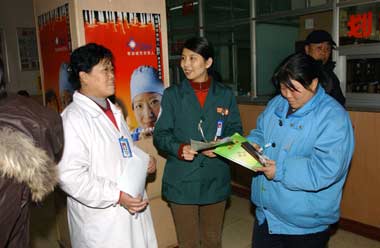
He could not afford the thousands of yuan needed for medical treatment, so he had no choice but to wait for death. "He was skin and bones when I saw him in the middle of last month. What's worse, he had a high fever," said Zhou Zhaohui, an official from Tiexi Health Bureau. He is now in charge of the Sino-UK urban health pilot project in Tiexi District. He Honglin was luckily covered by the project and immediately sent to the local TB control centre for treatment. "He needs to pay only less than half of the treatment cost. Furthermore, he has the chance to receive further aid if he still cannot afford the sum," says Zhou. Now He's disease is under control. The Urban Health and Poverty Project (UHPP) is a national project co-funded by the Chinese Government and the UK Department for International Development (DFID). The project focuses on urban health reform and poverty alleviation and is also the country's largest ongoing community health and medical aid programme. It is currently being piloted in four cities - Shenyang, Chengdu in Southwest China's Sichuan Province, Xining in Northwest China's Qinghai Province and Yinchuan in Northwest China's Ningxia Hui Autonomous Region. Two districts in Shenyang - Heping and Tiexi - have been chosen for the experimental project. He Honglin is not the only one who has benefited from this project. About 2,000-plus people in Tiexi District had received the medical aid from the pilot project by the end of this March, according to Zhou. "As the nation's traditional industrial base, Shenyang suffered a great economic downturn in the past decade. There are many laid-off workers whose health requires special attention," says Li Weiran, an officer with Heping District Health Bureau. There are over 20,000 residents in Heping District alone now living on the government's minimum allowance. The number of Tiexi residents currently living on the minimum living allowance is 26,942 - much higher than in the other three experimental districts in Shenyang and Chengdu. Since last August they have been covered by the project and enjoy a ceiling subsidy of 2,000 yuan (US$241) for inpatient care. And those disadvantaged and elderly residents over the age of 70 can receive another annual payment of 60 yuan (US$7) for outpatient services. The significance of UHPP An Ni, PhD, National Project Manager of the UHPP, reveals the project now covers 2.56 million in Shenyang and Chengdu. Around 76,800 in the two cities have benefited or will benefit from this project.
"When I see people who benefit from our project and are able to live a healthy life, I feel very happy, as what I have done is of great significance," said An. In fact, the ultimate aim of the project goes beyond just helping low-income people with their medical treatment. It is aimed at exploring and setting up a new urban health system model for China. "Since the very beginning, we have set our aim high. It is not just about the distribution of medical aid, but the exploration of a new healthcare model," says An. Of course, the ambitious goal requires An and her colleagues to make ever greater efforts to fulfil their objective. An told China Daily they have designed four different sets of experimental projects in the four pilot cities. Exploring urban health system Take Shenyang and Chengdu for example. Because the problem of laid-off workers is very serious in Shenyang, the project in the city mainly covers local laid-off workers living on the minimum allowance. Meanwhile, as migrant workers make up a great part of Chengdu's total population, the project there concentrates on the migrant group. "Only in this way can we provide different models for government policy-makers. So even if some of the models ultimately fail, we may still have successful ones," An told China Daily. The scientific attitude has prompted An to pay great attention to each step of the project. "We must make the budget as exact as possible before implementation; otherwise, we cannot say the project is accomplishing its goal even though it may help many people," she says. To ensure the success of the project, a series of co-operative activities have been organized to help improve the community healthcare level. In Heping District, doctors and nurses from community health service stations have been organized to take part in formal medical training at China Medical University, according to Li Weiran. Another training programme has also been started for project managers at the national, municipal and district levels. Last year, 21 project managers were sent to Britain to take related training courses. These moves are all significant measures to improve the social security system and ensure medical rights for people trapped in financial hardship, says Zhao Wu, deputy director of the Shenyang Municipal Health Bureau. "This is not only about money input. The more important point is that it offers us a new urban health system model and brings up a group of professional personnel,"says Zhao. The UHPP has been aiming to explore and set up a Chinese-style urban health system which will improve the public health service in cities, says Professor Meng Qingyue of the Health Management and Policy Research Centre at Shandong University. As a result of continuous efforts from An and her colleagues, the project has made great progress since its start in 2001. "Before the central government decided to take measures, An had already engaged in practice. When we make policy, she can provide us with experience," says Wang Hui, a senior official with the Civil Affairs Ministry. She notes that she was greatly moved by grassroots health workers as well as officials from the Civil Affairs Ministry. |
|
|
|
|
||||||||||||||||||||||||||||||||||||||||||||||
|
|
|
|
|||||||||||||||||||||||||||||||||||||||||||||||||