|
Home>News Center>China | |
|
|
|
|
|
|
|
|
|
|
|||||||||||||||||||||||||||||||||||||||||||||||||
|
|
Corruption's long and winding road
A spate of corruption cases has focused the national spotlight on officials in charge of building express highways.
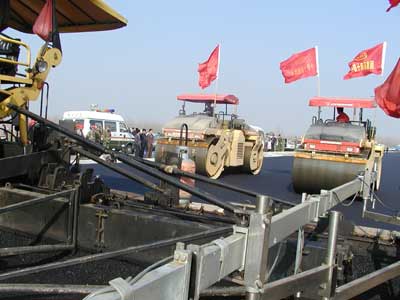
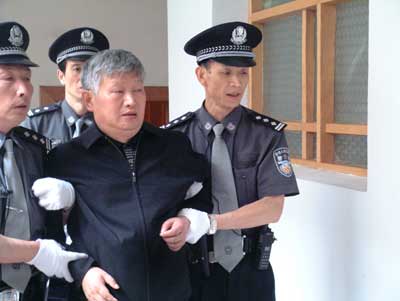
In Central China's Henan Province, three consecutive directors of the provincial Transportation Bureau, which oversees the building of the province's expressways, have been "dethroned." The latest, Tong Yanbai, vanished in early January when the Xuluo Expressway, built under his watchful eye, was being investigated for serious quality problems. He was found to have left for Australia with an illegally-obtained passport. "I heard he has changed his name, and by now probably has already got his green card," says one of his former colleagues. In southern China's Guangdong Province, 32 officials were charged in 2001 with taking bribes worth tens of millions of yuan. Since 1990, all three of the general managers of Guangdong Expressway Construction Company, a unit under the provincial transportation bureau, were found guilty. In Sichuan Province, Liu Zhongshan and Zheng Daofang, director and deputy director of the provincial transportation bureau, were sentenced to death penalty reprieve and death, respectively, for embezzling public funds and taking bribes of "extremely large amounts." Their counterparts in Hunan, Guangxi and other provinces and autonomous regions were fired. The Beijing-based Outlook weekly reports there have been a dozen prosecutions against people in these positions. According to experts, it's time to shift the focus from individual greed to rooting out the mechanism that sprouts this type of corruption. Wang Zehe, who worked with two of the three deposed Henan transportation bureau chiefs before becoming deputy mayor of Xuchang, says the scandals have not only derailed the professional lives of these people, but tarnished the reputation of the entire transportation system. Boom and bribery An expressway is probably the second most expensive mode of transportation in terms of construction cost, next to a subway. The current cost in China ranges from 11 million yuan (US$1.3 million) per kilometre on the recently completed Guwang Expressway in Ningxia to 115 million yuan (US$13.8 million) per kilometre on the one leading from downtown Guangzhou to the city's new airport. Cost varies from 42.49 million yuan (US$5.11 million) per kilometre on average in Guangdong to 29 million yuan (US$3.49 million) in Fujian.
There was no modern expressway in the Chinese mainland 20 years ago. The first one - an 18.5-kilometre stretch in a Shanghai suburb - was completed in 1988. But since then there has been a construction craze. In 2003 alone,4,639 kilometres were added. China now has the world's second longest network of expressways, which was 29,800 kilometres at the end of 2003. The plan is to extend it to 70,000 kilometres by 2010. When you multiply the per-kilometre cost with the length, you get the magnitude of the industry and the money involved. One jailed former official is very descriptive: "There were so many bribers around me that they stung me like locusts. Then people drove me into jail as if herding a duck into the pen." When Zeng Jincheng assumed leadership at the Henan Transportation Bureau in the aftermath of his predecessor's disgrace, he pledged he would never take a single penny in bribe. One year later, he was found to have taken 40 bribes, totaling 300,000 yuan (US$36,000). Zhang Kuntong, Zeng's successor, vowed that "the expressways will be paved with clean governance," which was his slogan. Before the echoes abated, he had embezzled 100,000 yuan (US$12,000) and accepted 680,000 yuan (US$81,000) and US$40,000 in "sweeteners." Meanwhile, construction flaws were so widespread and serious that new roads often required immediate and constant repair. The Zhengzhou-Xuchang section and the Xinxiang-Anyang section were filled with so many potholes that huge amount of extra investment was needed to turn them back into working condition. The Luoyang-Sanmenxia section had to be blasted away before it was completed because what was built was totally substandard. The Zhengzhou Yellow River Bridge, which links several expressways, was designed to last 30 years. It opened in 1992. Between 1995 and 1996, it underwent 9 major repairs, 8 medium ones and 9 small ones, costing a total of 64 million yuan (US$7.7 million). The original price tag for the bridge was only slightly more, at 75.54 million yuan (US$9.1 million). Province-wide capital spending on expressways in 2001 doubled that of the previous year, but the number of new roads did not. The reason was much of the money - or 4 billion yuan (US$481 million) to be exact - was spent on maintenance. As a result, the expressway network in the province, which should have been highly profitable, has been unable to break even in the past couple of years. Epicentre of power The Henan Transportation Bureau collects 4 billion yuan (US$483 million) of various fees annually. On top of that, it gets 10 billion yuan (US$1.2 billion) in loans. Putting these together, plus some other revenues, it handles about 15 billion yuan (US$1.8 billion) a year. The bureau acts as both the investor and the manager. It determines which contractor gets what job. None of these multi-million-yuan contracts is valid unless signed by the bureau chief. With so much power concentrated in one hand, says Wang Zehe, the deputy mayor who used to work in this agency, it can be terrible or terrific, depending on the ethics of the person in that seat. If he can hold the line, he can create something that will benefit many generations. If not, it's a disaster waiting to happen. Inside sources reveal that the poor quality is the result of work-shortening processes and cost-cutting on materials. For example, contractors may use 4-ton wheel dozers when they are supposed to use 8-ton dozers; they may bulldoze for two days when the work is supposed to last three days. An engineer points out that because the density of paving does not meet quality standards the road will sink under heavily loaded vehicles and may crack after rain or sleet, eventually causing the concrete wires to break. "It is actually quite easy to spot," says the source, "but inspectors who have taken kickbacks tend to overlook these places. Many inspections are just a formality." Another secret is that daily maintenance is something officials are not enthusiastic about because the money comes from the smaller pool of maintenance fees. If you wait till the small cracks turn into giant potholes, you'll need special funds, which are much larger. And the more money one has at his disposal, the more gravy he can skim from contractors, explains the engineer, who insists on anonymity. Contractors complain they were often forced by the agency to buy building materials from designated suppliers at inflated prices. For example, when cement cost 198 yuan (US$24) a ton, one builder was asked to buy from an agency-picked cement maker at 260 yuan (US$31) a ton. And this applies to almost all materials. Sometimes a contractor would even be coerced to parcel out a significant part of the job won in bidding to someone else who did not even participate in the bidding process. Due to its strategic location in the middle of the country, Henan has 1,400 kilometres in the 11-year history of expressway construction. As much as 60 per cent of the traffic on these roads comes from out of the province. Henan Expressway Development Corp Ltd, a spinoff of the transportation bureau's expressway management office, has fixed assets in the amount of 23 billion yuan (US$2.77 billion), making it the largest State-owned enterprise in the province. Tong Yanbai, the official who fled to Australia, was acting as chairman of the board. As is customary in China, the government agency and the business corporation are actually one entity with two identities. People called him "Chief Tong" instead "Chairman Tong." And Chief Tong made sure that only he had the final say in approving large spending. Remedy The Tong Yanbai case is still under investigation, and Jin Daomin, head of the discipline team from the Ministry of Communications, vows to get to the bottom of it. In late 2003, Henan Province stipulated that all expressway projects be supervised by personnel from the discipline department. Experts argue that the crux of the matter is lack of check and balance procedures in the capital spending process. All power is in the hands of the government, which, in turn, gives it to one department and ends up concentrated in a few individuals. The solution, they say, lies in the separation of government and business, or the creation of a truly independent business unit that can shoulder responsibilities in terms of cost control and quality control. The law on bidding, which went into effect in 2000, laid down the rules. But some local agencies have found ingenious ways to bypass them either out of local protectionism or personal interest. The 2001 regulation on whistle-blowing concerning major infrastructure projects has also led to a series of prosecutions. Wang Zehe suggests the building and maintenance of provincial-level highways be managed professionally, with cost-benefit analysis and financial responsibility. Surplus personnel should be let go and cost be brought down. Those who take investment risks should be allowed to reap profits. The government, while giving more power to the business community, should at the same time enhance its supervision. Experts further suggest laws be passed to oversee economic activities with a check-and-balance mechanism by outside elements to insure that investment be protected from corruption. Also, projects, capital and market should be handled by separate organizations. In Henan, new regulations specify all investment in excess of 500,000 yuan (US$60,240) be open to public bidding. Those projects worth 30 million yuan (US$3.6 million) or more must be open on a provincial-level market to national and international bidders. Those below that amount should be handled on a city-level market. While new measures are being created to halt the onslaught of corruptors, a giant billboard with a public service ad has been erected along an expressway in suburban Beijing, urging people to fight corruption. The fight, it seems, is starting in an industry very close to it. |
|
|
|
|
||||||||||||||||||||||||||||||||||||||||||||||
|
|
|
|
|||||||||||||||||||||||||||||||||||||||||||||||||