|
Home>News Center>Life | |
|
|
|
|
|
|
|
|
|
|
|||||||||||||||||||||||||||||||||||||||||||||||||
|
|
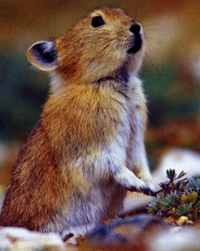
Pika wrongly accused
Last week, one day before he stepped on the Qinghai-Tibet Plateau yet again, something he has been doing regularly for the past two decades, Andrew Smith delivered a speech to the top biology students in Peking University, who were fascinated by the tale of plateau pikas on the vast and mysterious plateau.
"At first, Chinese pikas caught my attention simply because they live in the meadows," said Smith, a professor in the School of Life Sciences at Arizona State University. He specializes in conservation biology and is a member of the Biodiversity Working Group of the China Council on International Co-operation in Environment and Development. Twenty years ago, intending to observe how habitat changes the ecology of pika behaviour, Smith came all the way to Northwest China's Qinghai Province from North America, where pikas only live in rocks. However, over the past two decades of research on the plateau, Smith has been putting more effort into conservation issues and has paid less attention to basic ecological behaviour questions. Now he has developed a new perspective towards the plateau pika, which he believes acts as the keystone species for the biodiversity of the plateau. One of the dominant species in the alpine meadow ecosystem, the burrowing plateau pika lives in family groups and falls into the category of lagomorpha, rather than rodent. So far, two facts have actually been shown to be true. The plateau pika's burrows provide a habitat for a wide variety of species of animals. The pika also serves as a main source of food for most predators.
Also, most of the predatory animals living on the plateau rely heavily on the pika for their diet. Pikas are not only the most abundant source of food for predators during the summer, but almost their sole source of food during winter, as they do not hibernate. When pikas are exterminated, this important source of food disappears, leading to starvation of predators and a serious blow to the local biodiversity. In Yeniugou of the Qilian Mountains in northern Qinghai Province, the researchers have seen four brown bears and all of them were chasing pikas. One of the most impressive pictures remaining in Smith's mind is the scene of the cumbersome bears digging up the pika burrows. In a similar study conducted on the Changtang Wildlife Reserve in Tibet Autonomous Region in 1998, George Schaller, a well-known American zoologist, found that the pika constituted almost 60 per cent of the diet of brown bears. The consequence of poisoning pikas was seen most clearly when researchers compared poisoned and non-poisoned sites where many other species rely on pika burrows for nest sites and cover. "If you drive down the highway in Qinghai, you can tell whether an area has been poisoned or not by looking at the sky," said Smith. "When you see the black-eared kites, the area probably has not been poisoned. Contrarily, if there is nothing in the sky, you can tell the pikas are not there any more," said Smith. Smith and his graduate students chose 13 sites covering most parts of Qinghai Province, to count birds all day along. Their findings were disturbing. No Hume's ground jays and very few snowfinchs were sighted in areas that have been poisoned. "You poison the pikas, and all the beautiful birds will disappear," said Smith. Good for plants Smith also put forward a hypothesis that the pikas increase plant species and some properties of the ecosystem on the plateau. Although not yet tested in China, the theory has already been proven true among other pika species that live on the Mongolian steppe. This summer, Smith will focus on nutrient cycling, erosion control and plant species richness. In the region close to Xining which Smith believes was the first area to undergo pika poisoning in the late 1950s, the animal is seldom seen any more. Smith and his students will study the soil nutrients, the diversity of flowers and plants, as well as looking at the effects on water runoff in areas poisoned 40 years ago, 30 years ago, and 20 years ago. Smith believes that the burrowing of the plateau pika leads to higher plant species richness, though this theory still needs more research to prove it. All big rivers in China, such as the Yangtze and the Yellow, start on the Qinghai-Tibet Plateau. Smith believes that the pika burrows reduce water erosion, thereby minimizing downstream river flooding. When the big rains come, the water is held by the burrows like a sponge and then the soil gives out the water more slowly. "It is going to be difficult to test this theory, but it is very much worth doing," said Smith. Does poisoning work? In spite of the contributions of the plateau pika to the plateau ecosystem, the species has been targeted for control. Poisoning the pikas began in 1958 and continues today. In Qinghai Province alone, 208,000 square kilometres, a rather huge part of the province, has been controlled. Some areas have been poisoned two or three times. Smith argues that simply poisoning the pikas will not restore the meadow and that the severe overgrazing of livestock is responsible for the grassland degradation over the past 40 years. When areas are overgrazed, the pikas multiply faster because they favour the short grass and can see the predators better. "Pikas are really the indicator of degradation rather than its cause," said Smith. Many people believe that the more pikas there are the more grass they will eat. However, Smith argues that no comprehensive biological research has been conducted to support this hypothesis. Even if it is proved, this hypothesis still can't justify the massive scale of the poisoning. "If a part of plateau is already degraded and many pikas live there, simply poisoning the pikas can only solve half the problem," Smith said. "Only when you get rid of overgrazing can you finally bring that area of meadow back to productivity. If you still allow cattle to graze there, it is not going to recover." The pikas are also blamed for causing "black sands," small depressed areas with steep edges and larger barren areas basically devoid of vegetation. But Smith explained that the pikas actually like the black centre area because it is more open and they can see predators better. When the black sands areas occur, the pikas move in in higher density. So people see pikas there and say they are the cause of black sands. The pikas like to eat the roots of plants at the edges of the black sands, so they may be causing some of the expansion of black sands. "As far as I know, no one has actually studied why and how these black sands come into being. So they really remain an open question," said Smith, who is going to address the issue this summer. Smith has discussed the pika issue with people living on the plateau, who have set up NGOs such as the Snowland and Great Rivers Environmental Protection Association to run education campaigns against poisoning the pika. "They understand the ecological situation and want to protect the biodiversity," said Smith. According to Wang Song, a research fellow with the Institute of Zoology with the Chinese Academy of Sciences, Chinese scientists have had heated discussions on whether the plateau pikas are a pest or a keystone species. Though there are still disagreements, undoubtedly, the plateau pika has already won its biological status in the academic world. "The original fragile ecosystem in Qinghai Province has been largely degraded by overgrazing activities. People should not simply put their eyes on the grass-eating side of the plateau pika. There should be a comprehensive solution for the restoration of Tibet's rangelands," said Wang. As a biological conservationist, Smith has found himself inseparably tied to the plateau, home to the world's most unique ecosystem. "I don't know how many more years I will be able to keep doing my present work. I am crazy about it, so I keep going," he said. |
|
|
|
|
||||||||||||||||||||||||||||||||||||||||||||||
|
|
|
|
|||||||||||||||||||||||||||||||||||||||||||||||||