
|
Home>News Center>Life | |
|
|
|
|
|
|
|
|
|
|
||||||||||||||||||||||||||||||||||||||||||||||||||||||||||||||||||||||||||||||||||
|
|
Finery brightens austere Tibet
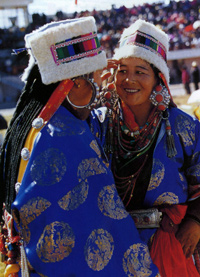
The Tibetan people always take great pride in their dress and the accessories they wear. This is evident in the heavy and well-preserved dresses passed down across generations and still shining on happy Tibetans, as well as the devotion of tailors and pedlars to their traditional dress.
The summer months, the best season on the plateau, are packed with horse races and trade fairs. Young local women start to dress themselves up days before the races and fairs start. As they never cut their hair, they have the luxury of braiding their long thick hair into dozens of thin plaits. After that, they affix many colourful amber and turquoise stones, and coral and silver ornaments among the plaits. When their hair is done, they spend time selecting their best headwear, best and most beautiful necklaces, and gold and silver accessories. Their robes are also decorated with patches of fine fur. A full costume often weighs several dozen kilograms. But such a weight is bearable for the sake of beauty. As contemporary fashion has not reached the plateau, there has been little change in the way the young women dress. The costumes and ornaments are passed down from one generation to another, bearing the honour, pride and wealth that the women have inherited from their ancestors. Fashion store without a name The costumes on the plateau are worn for generations, but there are ample reasons for the local Tibetans in Lhasa to change their dress.
Dawa runs a small shop on Barkhor Street in Lhasa. With a floor space of only 20-odd square metres, the shop does not even have a name. Listening to a radio, Dawa patiently waits for customers. The best items in his stock are hats and caps, which are indispensable to local Tibetans during festivities. And his collection is all hand-made. "A steady return of old customers ensures a good business," Dawa says. "Customers remember my face. "There is no need to have a name for the store." Dawa is not alone. A lot of stores on Barkhor Street don't have names. Most of the Tibetans involved in the garment business like Dawa get their merchandise from India. Dawa's wife goes to India several times a year and brings back cotton cloth and, especially, satin. The kind of satin Dawa and his wife import is of bright colour interwoven with gold thread. It is good for making scarves or festival robes. The Tibetans began to bring in satin more than half a century ago and import volumes have increased dramatically. Tibetan costumes have not changed in design but have changed in the use of colours and materials. Lhasa residents like colours that are neither too bright nor too dull. Dawa must be very careful in selecting the right colours for his materials, since they govern how much money he can earn each year. The most expensive costume Tibetan costumes vary from one place to another. In Lhasa, women's dresses in the traditional Tibetan style are made with various materials for the four different seasons. Because the dresses hang down almost to the ground, some young Tibetan women prefer to wear casual pants. But Dawa is not happy with that - he often asks his own women folk to dress in traditional costumes. "Don't you think Tibetan women look the most beautiful when they wear Tibetan dresses?" he says. He takes solace in the fact that Tibetan dress not only has maintained its popularity among local women but also appeals to an increasing number of tourists. As his business thrives, Dawa has opened a garment workshop of his own, in the hope that it will turn out the finest of dresses made from the most beautiful materials. Bianba, of Kham origin, whose ancestors passed down their tailoring skills to him, shares the same hope as Dawa. He often goes to Dawa's shop for the right materials, especially satin from India. Bianba has a lot of orders to fill. The Kham people who work in Lhasa or come on pilgrimage always go to him to get their dresses and robes made. Bianba said he has seen a full costume with ornaments that was valued at around 1 million yuan (US$121,000). The most expensive costume Bianba ever made cost 70,000 yuan (US$8,454). The average price tag for a tailor-made traditional Tibetan costume ranges between 40,000 and 50,000 yuan (US$4,830-6,038). A Tibetan costume shows more than beauty and splendour. Few would think it a waste of money to have an expensive costume made, because they are a testimony to a person's stature, position, prosperity and ancestry. Bianba has a deep understanding of the meaning behind each costume, so he takes great care while making them. Few actually know the exact traditional process of making a full Tibetan costume. So Bianba takes great pride in his traditional skills, which he has inherited and which now are embedded in the depths of his soul. |
|
|
|
|
|||||||||||||||||||||||||||||||||||||||||||||||||||||||||||||||||||||||||||||||
|
|
|
|
||||||||||||||||||||||||||||||||||||||||||||||||||||||||||||||||||||||||||||||||||
 Women on the prairie of northern Tibet look the most beautiful in
summer when the flowers are in full bloom.
Women on the prairie of northern Tibet look the most beautiful in
summer when the flowers are in full bloom.
 The capricious nature of a metropolis breeds a desire for novelty.



