|
Home>News Center>China | |
|
|
|
|
|
|
|
|
|
|
|||||||||||||||||||||||||||||||||||||||||||||||||
|
|
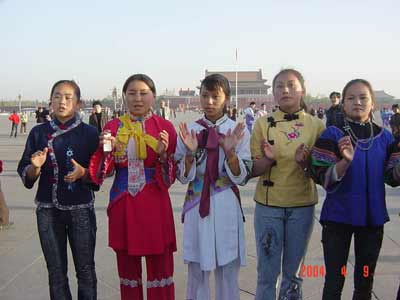
Education brings hope for rural girls
Bao Guoxia, 18, uses computers deftly in a trading company in Beijing where she works as a secretary. A year ago, however, the computer was something she had heard about only on the radio. "I would never have seen one if I had not attended the Rural Women's Practical Training School," she says.
The girl's hometown is a poverty-stricken village in Zhangxian County in Northwest China's Gansu Province. Bao's family used to live on the income of her father, a local teacher. But a traffic accident five years ago that took her father away changed everything. The 300-yuan (US$36) annual income from their farm was far from enough to send the girl and her brother to school. So she dropped out and found a job in a nearby town as a dishwasher, which paid her 60 yuan (US$7.20) a month. The turning point in her life came in 2003 when the village head asked her if she was willing to attend a free training course offered by the Rural Women's Practical Training School in Beijing. "I felt like a blind person suddenly opening her eyes," she recalls. During the one-year programme of studies, Bao Guoxia not only took basic courses like Chinese, mathematics and English, but also mastered the operation of computers. After her training, Bao was recommended to her current company. Her salary now is 400 yuan (US$48) a month, not much in a metropolis like Beijing. But she has changed in more subtle ways. "I used to be so shy that I cringed before strangers," she says. "Now, I communicate with customers every day, over the telephone or face to face. I'm more confident." According to the National Bureau of Statistics, by the end of 2003, the total number of peasants living below the official poverty line - 637 yuan (US$76) a year - in China stood at 29 million. In addition, another 56 million peasants have annual incomes of only 637-882 yuan. These poverty-stricken peasants account for 10.5 per cent of China's total rural population of 768 million people. These peasants live mostly in provinces in west China like Gansu, Bao's hometown, where farming is still the way the bulk of people earn their livelihood. Bao Guoxia sheds tears when she thinks of her mother, who gets up at three o'clock in the morning, long before the sun rises, to cut firewood, collect herbs or sometimes trudge along mountain paths for three hours to transplant seedlings for others, breaking from her work when she is hungry only long enough to eat a couple of dry, hard buns.
According to Xie Lihua, deputy editor of China Women's News and one of the founders of the training school, "If not given a chance, girls like Bao will likely follow their mothers' footsteps, marrying young, giving birth to several children and struggling in poverty for the rest of their lives." Xie's concern for peasant women dates back to 1992 when she was assigned the job of directing the publication of a new magazine - Rural Women. For over a decade, the magazine, like a bridge, has tied her with peasant women, some of whom even write to her for help. From the letters she received, she got to know the hard life these young women lead. "I am a peasant woman from Henan. My husband, the backbone of the family, is suffering from necrosis. Our debt is too heavy. What shall I do?" asks one woman. "My mother sells her blood to pay school tuition for my elder brother. And I have another two younger brothers. Where is the end for her suffering? How could I bear to attend school at the cost of my mother's blood," asks another. Xie feels obliged to do something for the women in rural areas. A bold idea began taking shape in her mind in 1995. Three years later, she founded the Rural Women's Practical Training School. With funding from foundations, corporations and individuals, the school offers a variety of training courses, including restaurant service, hairdressing, housekeeping and computer skills, for rural girls from the most impoverished regions of China, all free of charge. These girls also receive general education and physiological education at the school. To date, 3,082 rural girls have finished courses of their choice at the school. Operating on a shoestring budget, the school hires just 10 regular teaching and administrative staff. Most teachers are volunteers without salary. Guo Xianghe is one of them. A graduate of Beijing Normal University with a Master's degree, Guo, 32, has a decent job in an institute affiliated with the Ministry of Education. But she sometimes feels that her job does not allow her to utilize the things she learned in school. Guo got to know the school by chance when she was surfing online. Curious and interested, she established contact with persons in charge there and got a job as a tutor and counsellor in psychology. Her first task at the school was to help two handicapped girls find jobs. Guo mobilized many of her relatives and friends to help in the search, and finally she was able to win over the owner of a restaurant. The two girls now work there and are very grateful to her. This has given Guo "a sense of accomplishment." Despite receiving no pay, Guo works hard in her job. "I'm glad to have lent them a hand when they most needed it," she says. "The small effort we make can mean a great deal to them." Indeed, a small effort is enough to change the life of rural girls like Ni Zhihui, a 17-year-old orphan from a village in Linshui County in Southwest China's Sichuan Province. Talking about her life, the quiet girl was suddenly overwhelmed by her emotions and couldn't hold back her tears. After her parents' death, the girl lived in the homes of her relatives, working for them, and moving on every three or four months when they had had enough of her. "To them, I am a freeloader," says the girl, wiping her eyes. "Even my relatives are mean and indifferent to me, not to mention the others. I was disappointed with the world at that time." She was told about the school by the head of her village at the beginning of this year. According to the school's enrollment criteria, girls of five kinds - orphans, single-parent children, children with several siblings, those with sick parents and those with old parents - are eligible for enrollment in the programme. She didn't believe it at first until the ticket to Beijing arrived. Talking about her teachers, Ni stopped crying. "They are just like my mother," she said. One of her roommates added, "I have never been scolded by the teachers. They are always patient and encouraging." According to a study of the educational status of girls in western China by Zang Jian, a professor at Beijing University, about 70 per cent of the girls in impoverished regions get less than two years of schooling. They are almost certainly destined to become the main group of illiterates in China. Inadequate education is a major cause of women's early marriage and the birth of too many children, according Zang's research. "Through informal education like this, girls from rural areas not only get a chance to return to school, but also to become a part of mainstream society," Zang says. The All-China Women's Federation founded more than 100,000 training schools for rural girls during the 1999-2003 period, according to Cui Yu, head of the federation's development department, but they are far from enough, she says. "We are happy to see that individuals have been involved in this undertaking and that poverty alleviation is no longer seen as the responsibility solely of the government," she says. Xie Lihua, the founder of the school, who always appears optimistic and cheerful in front of her students, has her troubles. "We need more staff who are both professionally qualified for, and emotionally dedicated to, the undertaking. But because the pay is low and the work is demanding, not enough college graduates are willing to join us," she says. And Ni Zhihui, the new orphan student, also has her worries. "I'm not sure whether I will be able to use the computer proficiently after only one year's study, as I had never seen or touched one before." In fact this fear used to bother Bao Guoxia a year ago. "But in the end I made it," says Bao. Bao Guoxia feels her whole life has been changed by this experience, and she dares to speak openly of her dream for the first time, which even her mother doesn't know. "After I have earned enough money, I will attend college to study music and become a music teacher," she says. |
|
|
|
|
||||||||||||||||||||||||||||||||||||||||||||||
|
|
|
|
|||||||||||||||||||||||||||||||||||||||||||||||||