|
Home>News Center>China | |
|
|
|
|
|
|
|
|
|
|
||||||||||||||||||||||||||||||||||||||||||||||||
|
|
Artists fight for land use rights
The Art Village on Xiaoguwei Island in Guangzhou is famous for its 165 carefully designed and colorfully styled villas built by artists. But now the municipal government is ordering the demolition of the village to pave the way for the construction of a college development. Jia Hepeng investigates how the artists are trying hard to protect their legitimate interests
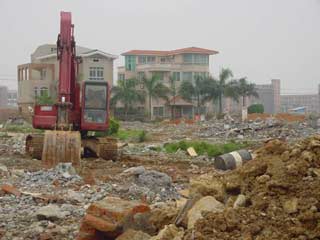
"Even If I knew my house would be demolished tomorrow, I would still take good care of it today, because it is like my child and I have to be good to it," said Liang Guoyin, 73, a famous painter and professor with the Guangzhou Institute of Art. He was referring to his villa in suburban Guangzhou, which, together with 100 other villas, is under threat of being bulldozed to make way for a new college development. Twenty-odd artists including Liang bought the land use rights of about one mu (667 square metres) of land in 1994 from a local developer to build their villas in Xiaoguwei, an island on the Zhujiang River about 17 kilometres south of Guangzhou, capital city of South China's Guangdong Province. In China, all non-agricultural land belongs to the State, but a citizen may have 70-year land use rights for their properties on the land. The artists became the first residents of the suburban villa zone, now known as the Art Village and consisting of 165 unique villas which are mainly home to painters, sculptors, horticulturists, architects and photographers. But the dreams of these artists to maintain a creative paradise did not last long. In 2002, the Guangzhou municipal government launched the construction project of a college development in Xiaoguwei Island. The Guangzhou College Town, with an area of 43.3 square kilometres, plans to accommodate 10 colleges with 350,000 students and a number of faculties. In April and August of last year, the municipal government decided to take back the land use rights of all three sections of the Art Village, despite the fact that the property rights of all villa owners had been authorized by the Guangdong provincial government in 2002. Municipal government circulars stipulate that all villa owners in Xiaoguwei must move out of their properties by the end of April 2004. They will be compensated in accordance with the standards set by the government. By the end of June 6, more than 60 villas had been torn down but other villa owners, mainly artists, refuse to move out. They said the relocation order will demolish their years of artistic labours and their private property rights. 甅DNM?subhead> Exquisite art villas 甅DNM?bodytxt>Due to its poor traffic conditions, Xiaoguwei Island became a natural resort in contrast to heavily industrialized Guangzhou. Its land prices were deemed worthwhile for many artists. The land deal cost Liang and his wife all their life savings of about 300,000 yuan (US$36,230). They had to wait for three years to make enough money to start building their three-storey villa. At the end of 1998 when the construction was completed, Liang had to stop for another three years to raise money for the interior decoration. The whole project was finished only in 2002. "The lengthy construction time gave me chances to repeatedly refine the construction plans, the design, and all the interior decoration," Liang told China Daily. The villa was carefully built, with a specially designed irregular layout, unique lighting and an elegant garden. Beautiful paintings and prints are embedded into the walls. The living rooms are small and located in corners, with considerable space left for the artist's studio, exhibition room, and guestroom. Liang was not alone. "In 1994, when I saw the island on the opposite bank, I immediately decided to buy one piece of land on it," said Zhu Jiaquan, a Chinese-American painter. Zhu sold his house in the United States and in the following years, he collected the proper tiles, bricks and interior ornaments for his villa during his trips across China. The construction and decoration of Zhu's villa were completed in 2001. Since 2002, the Xiaoguwei Art Festival has been held annually, attracting thousands of Guangzhou residents and tourists to visit the artists' studios and see their works as well as their uniquely built studios. The Xiaoguwei Art Village has been put under the spotlight in China's art circles, because artists usually live in rented houses in other cities and they cannot infuse their arts into their dwelling environments, said Chen Jianzhong, a famous French-Chinese painter, during his visit to the second Xiaoguwei Art Festival in 2003. Struggling to defend property In September 2002, a public hearing was held by the Guangzhou municipal government to decide whether to keep the Art Village. Two artists from the Art Village were invited. The meeting record shows that 90 per cent of participants suggested the three villa zones be kept and gradually developed into a cultural section of the college town. The Art Village is located on the southern bank of Xiaoguwei Island, outside of the massive ongoing projects associated with the college town. But in line with the final construction plan of the college town, the Art Village is to be demolished. "In the area (of the villa zones), a highway to the college town will be built and other places will be used for greenery," Meng Qi, director of the Construction Headquarters for Guangzhou College Town, told China Daily. But the artists and other villa owners appealed to the municipal and provincial governments last year to withdraw the relocation order, saying it violates their property rights. After the municipal and provincial governments decided to maintain their original decisions, villa owners sued the governments in local courts in four cases last year and early this year. They stated that the government decision to take back the land use rights of the Art Village was illegal. So far villa owners have lost one of the four lawsuits they had launched. "The Urban Real Estate Law stipulates that the State should not take back the land use rights before the 70-year term is over, and in this case most of the villa owners obtained the land use rights only 10 years ago," said Gao Zhisheng, a lawyer from the Beijing-based Gao Zhisheng Law Firm who worked for the villa owners. The newly amended Constitution stipulates that the legal private properties of civilians are inviolable. The constitutional article has become a new weapon for villa owners to protect their property rights. Now on the gates of all remaining villas in the Art Village hangs a big red board that writes: The Constitution stipulates that legal properties of civilians are inviolable. "Our action against the relocation has gone far beyond our own interests,'' Hua Xihuang, a doctor living in the Art Village, told China Daily. "It is an attempt to maintain the dignity of the Constitution." What is the solution? The Guangzhou municipal government claims it has its own legal basis for carrying out the moves. Guangzhou Land Requisition Office Director Yang Heping stressed that the government has every right to take back the land use rights of property owners in the name of public interests under the China Land Law. And the construction of key State and government projects such as the college town is definitely serving the public interests, he added. Wang Lei, a law professor with Peking University, said that the public interest needs to be further clarified. In some cases, public interests become a pretext for local governments to develop commercial projects. "Even if the college town is really for the public interests, is it necessary to violate our private interests?" asked Xuan Qingqiu, a Guangzhou-based publishing designer who lives in the Art Village. "Near our Artist Village, a lot of vacant land can be used to build the highway." In addition, the existence of the Art Village neighbouring the college town, with its art events and communications, is the best example to realize public interests, Xuan said. In the relocation notice, three reasons are given for the demolition of the villas: poor planning, inconsistent style and out-of-date public facilities. The college town construction headquarter officials also said that the plan to build a highway and greeneries in the area of the Art Village cannot be changed because it has been discussed and approved by more than 100 leading designers and architects from across the country. During the lawsuit, the villa owners discovered that the whole project for Guangzhou College Town has not even received the State Council's approval. The China Land Law stipulates that any project using more than 70 hectares of land must be certified by the State Council. In fact, the planned college town covers a land area of 1,800 hectares. Yang said that the municipal government's right to take back the land use rights of Xiaoguwei villas has nothing to do with the State Council's approval for the construction of the college town, because the land is State-owned. While trying hard to maintain their legal property rights, some artists are lobbying the municipal government to find other places to "duplicate" the Art Village. "The Art Village has become a cultural mainstay of Guangzhou and there is every reason to keep it, even elsewhere," Zhu said. But insiders said the proposal is impossible because the central government ordered the halting of rectifying all land use rights for villa projects in 2003. An anonymous official with the Guangzhou Bureau of Land and Resources said that the compensation money being offered has been very high for villa owners. Most of these villa owners bought their land use rights at prices of less than 800,000 yuan (US$96,610) and built their villas for less than 1 million yuan (US$120,770), but they would receive more than 2 million yuan (US$241,540) in compensation, which is enough to buy a decent apartment in downtown areas. Nearby Xiaoguwei, a completed villa of about 400 square metres now costs about 6 million (US$724,670) to 10 million yuan (US$1.21 million). The college town construction headquarters plans to spend at least 400 million yuan (US$48.2 million) alone on the greenery belt and the highway for the college town. "We do not care how much we get in compensation. What we care about is our dignity as artists, our painstaking efforts in the Art Village and our constitutional rights," Liang said. |
|
|
|
|
|||||||||||||||||||||||||||||||||||||||||||||
|
|
|
|
||||||||||||||||||||||||||||||||||||||||||||||||