|
Home>News Center>Life | |
|
|
|
|
|
|
|
|
|
|
|||||||||||||||||||||||||||||||||||||||||||||||
|
|
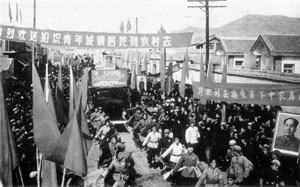
Mixed memories of 'Zhiqing' Zhiqing, or intellectual young people, has a special meaning in China. It refers to the 17 million young urban residents who were sent to the countryside during the "cultural revolution" (1966-76) for re-education.
The relocation, ordered by the central government, deeply affected a whole generation. In literature, movies and art, many who experienced the life of an "intellectual youngster" in those days think of it as a time which cost them a large part of their youth. Wang Anyi, a famous Shanghai writer who was relocated to the countryside for three years, said: "I could never adjust myself to the countryside. But the place is really a sensible world. The countryside is the root of any life". Waves of relocation The population transfer first began in 1955. The first five-year schedule (1953-57) planned to open 2.6 million hectares of land but there were not enough farmers and workers on State-owned farms. The first five-year plan was a key time for China's industrial development. But the country was also faced with an embarrassment caused by the growing number of graduates from schools - there were not enough jobs for all of them. On the other hand, the countryside needed lots more labourers, especially well-educated young people, to help with production. In December 1955, Mao Zedong wrote that the countryside was a wide place where people could fully develop themselves. This was Mao's first call for a move to the countryside. It was called "shangshan xiaxiang" (moving to the mountains and villages). In the next programme of agricultural development, the phrase was used in official documents and became the golden rule. In 1964, the central government released a regulation calling on young people in cities to take part in construction work in the countryside. In the following years encouraging young people to move to villages in rural areas was considered an important government task. At that time, the underlying principle for young people to go to the countryside was still based on freewill. In the late-autumn of 1967, 10 middle school students in Beijing swore an oath at the Tian'anmen Gate that they would go to the countryside to fully develop themselves. After swearing an oath to Chairman Mao, they left Beijing for Mongolia. What really decided the fate of other young people was a statement released by Chairman Mao on December 22, 1968. On that day, the People's Daily carried Mao's words on its front page. "It is very essential for intellectual young people to go to the countryside to receive re-education from impoverished peasants. We should persuade cadres and others in the city to send their children who graduated from middle schools and universities to the villages. Let's have a mobilization, all people in the countryside should welcome them." After his call, the movement to the countryside reached a peak. In 1969 alone, 2.6 million young people left their homes in the cities and moved to the countryside. Tough countryside life During the 10 years of the "cultural revolution" (1966-76), a total of 17 million young people relocated to the countryside. They went to every corner of the country, many to the most hard-to-live-in provinces such as the cold northeast. "I had been prepared for the fact that life in the countryside would be very hard, but I didn't imagine it would be that hard," said one man surnamed He who had relocated to East China's Jiangxi Province as an "intellectual youngster". "I could endure any difficulties except lack of food, it bothered me bitterly," he said. Having to do heavy working every day, he always felt hungry. Even a candy was seen as an expensive treat. After living in Jiangxi Province for several years, He said his black hair faded to yellow because of poor nutrition. Li Qinglin, the father of another "intellectual youngster" in East China's Fujian Province wrote a letter to Mao Zedong at the end of 1972. In the long letter of more than 2,000 characters, the old man described the difficult life faced by the young people. He also told of local cadres who took advantage of their power to send their own children to the city and to university or the army. The letter, after going from hand to hand in the Beijing bureaucracy was finally sent on to Chairman Mao on April 25, 1973. When Mao finished reading, he sobbed. He mailed 300 yuan (US$36) to Li as "compensation for Li's poverty". Mao also said his problem was common in China and must be resolved. In August 1977, when the "cultural revolution" was officially over, the number of young people being relocated to the countryside had dropped dramatically. Two years later, In 1979, only 247,000 young people went to the countryside and in the early 1980s, 10 provinces and cities stopped the movement altogether. In 1981, the focus of the central government was on rehabilitating the
960,000 intellectual young people still left in the countryside. The movement,
after lasting for more than 20 years, had ended. |
|
|
|
|
||||||||||||||||||||||||||||||||||||||||||||
|
|
|
|
|||||||||||||||||||||||||||||||||||||||||||||||