|
Home>News Center>World | |
|
|
|
|
|
|
|
|
|
|
||||||||||||||||||||||||||||||||||||||||||||||||||||||||||||||||||||||||||||||||||||||||||||||||||||||||||||||
|
|
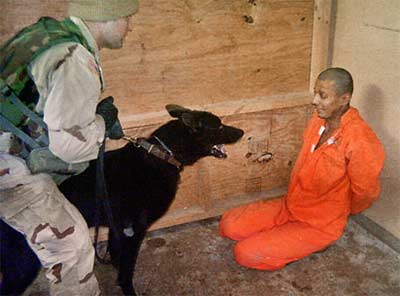
US approved use of dogs against prisoners
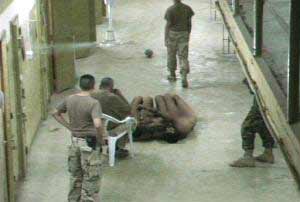
US President Bush claimed the right to waive anti-torture laws and treaties covering prisoners of war after the invasion of Afghanistan, and Defense Secretary Donald Rumsfeld authorized guards to strip detainees and threaten them with dogs, according to documents released Tuesday.
The Justice Department, meanwhile, disavowed a memo written in 2002 that appeared to justify the use of torture in the war on terror. The memo also argued that the president's wartime powers superseded anti-torture laws and treaties.
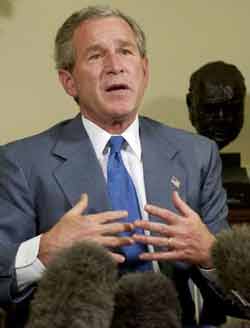
Bush outlined his own views in a Feb. 7. 2002, document regarding treatment of al-Qaida detainees from Afghanistan. He said the war against terrorism had ushered in a "new paradigm" and that terrorist attacks required "new thinking in the law of war." Still, he said prisoners must be treated humanely and in accordance with the Geneva Conventions.
"I accept the legal conclusion of the attorney general and the Department of Justice that I have the authority under the Constitution to suspend Geneva as between the United States and Afghanistan, but I decline to exercise that authority at this time," the president said in the memo, entitled "Humane Treatment of al-Qaida and Taliban Detainees."
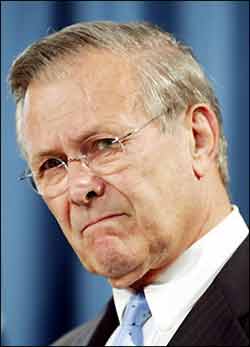
In a separate Pentagon memo, dated Nov. 27, 2002, the Defense Department's chief lawyer, William J. Haynes II, recommended that Defense Secretary Donald Rumsfeld approve the use of 14 interrogation techniques on detainees at Guantanamo Bay, such as yelling at a prisoner during questioning and using "stress positions," like standing, for up to four hours.
_ Use of 20-hour interrogations.
_ Removal of all comfort items, including religious items.
_ Removal of clothing.
_ Using detainees' "individual phobias such as fear of dogs to induce stress."
In a Jan. 15, 2003, note, Rumsfeld rescinded his approval and said that a review would be conducted to consider legal, policy and operational issues relating to interrogations of detainees held by the U.S. military in the war on terrorism.
Rumsfeld's decision was prompted at least in part by objections raised by some military lawyers who felt that the techniques approved for use at Guantanamo Bay might go too far, officials said earlier this year.
The review was completed in April 2003, and on that basis Rumsfeld reissued his guidance on April 16, 2003. He approved 24 interrogation techniques, to be used in a manner consistent with the Geneva Conventions, but said that any use of four of those methods would have to be approved by him in advance. Those four were use of rewards or removal of privileges from detainees; attacking or insulting the ego of a detainee; alternating the use of friendly and harsh interrogators, and isolation.
The April 2003 review said that removing a detainees' clothing would raise legal issues because it could be construed as degrading, which is against the international convention on torture. The removal of clothing, while approved by Rumsfeld for use at Guantanamo Bay in late 2002, was not among the authorized techniques in his revised guidelines issued in April 2003.
At the Justice Department, senior officials said that the 50-page memo issued to the White House on Aug. 1, 2002, would be repudiated and replaced because it contained what they called overbroad and irrelevant advice.
The memo, signed by former assistant attorney general Jay Bybee, included lengthy sections that appeared to justify use of torture in the war on terrorism and it contended that U.S. personnel could be immune from prosecution for torture. The memo also argued that the president's powers as commander in chief allow him to override U.S. laws and international treaties banning torture.
Critics on Capitol Hill and elsewhere have said that memo provided the legal underpinnings for subsequent abuses of prisoners in Afghanistan and Iraq.
Reacting to the White House release, Vermont Sen. Patrick Leahy, the senior Democrat on the Judiciary Committee, accused the administration of continuing to withhold information.
"Though this is a self-serving selection, at least it is a beginning," Leahy said. "But for the Judiciary Committee and the Senate to find the whole truth, we will need much more cooperation and extensive hearings." |
|
|
|
|
|||||||||||||||||||||||||||||||||||||||||||||||||||||||||||||||||||||||||||||||||||||||||||||||||||||||||||
|
|
|
|
||||||||||||||||||||||||||||||||||||||||||||||||||||||||||||||||||||||||||||||||||||||||||||||||||||||||||||||