|
Home>News Center>Life | |
|
|
|
|
|
|
|
|
|
|
||||||||||||||||||||||||||||||||||||||||||||||||||||||||||||||||||||
|
|
Wartime survivor recalls childhood without joy
I was born in 1931, two weeks after the September 18 Incident, when Japanese aggressors occupied Shenyang in Northeast China.
I spent my childhood under the shadow of the cruel Japanese invaders and my memories of my childhood are filled with the misery suffered by the Chinese people under the Japanese occupation. We lived in Hebei District in Tianjin at that time. On the street leading from the North Railway Station to Jingang Bridge, I often saw lorries roaring by loaded with Japanese soldiers in full battle gear. July 7
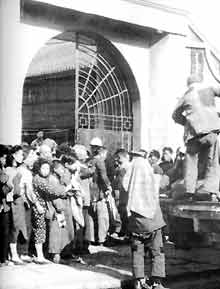
Hearing the planes howling overhead and feeling the violent shaking of the ground, my sister and I were terrified and hid under a table, fearing the roof might fall down. As soon as the planes left, the residential areas were placed under siege by Japanese troops with machine guns. Armed Japanese soldiers searched every corner, pointing their bayonets at the residents. People were terrified and fled their homes, our family among them. At dusk, with only two bundles of clothing, we followed the crowd to a safe place -- a church -- where we sat up in the yard all night. The following day, we waited the whole day at the entrance to the English concession and finally got in with the help of a friend of my father's who worked in the concession. We were very lucky, because only a few refugees were allowed to take sanctuary in the concession at that time. We stayed at the home of a student of my father's for months, but later we managed to rent a house. There were no Japanese troops stationed in the English concession, but I sometimes overheard the adults whispering about the atrocities committed by the Japanese. The first thing I heard about the July 7 Incident was that the Japanese had launched a poison gas attack in the Lugouqiao (Marco Polo Bridge) area in Beiping (now called Beijing). Luckily, that day, a timely rainstorm saved many people from death. More news came saying that the Japanese were massacring Chinese people across the nation. I saw photos of slaughter scenes that were being sold on the market in the French concession, in which lines of Chinese peasants' bodies were lying on the ground, naked, headless, with their hands tied behind their backs, and their severed heads strewn everywhere on the ground around them. Beside the rows of bodies, Japanese soldiers were chopping off more heads. Occasionally, good news came secretly about the Eighth Route Army fighting the Japanese invaders in the vast countryside, but such news was kept from the children because the adults were worried about the presence of spies. Starvation
Back at home, I had a nightmare that a Japanese soldier was cutting my head off. As hard as I tried to cry out loud, I could make no sound and I woke up in a cold sweat. Sixty years later, the memory of that nightmare still remains clear in my mind. There were traitors and informers all around at that time, and if people made any anti-Japanese comments and the Japanese military police found out about it, they would be thrown in jail where they would suffer all kinds of torture and pain, with few of them ever surviving to tell their excruciating stories. Some of my teachers disappeared all of a sudden, and we found out later that they had been thrown into jail by the Japanese and excecuted. It was regarded as an extraordinary piece of good luck if any of them managed to come back home, even if they were disabled. After the Pearl Harbour attack on December 7, 1941, the Japanese troops occupied the English concession, including its military barracks. While on the one hand mouthing "Japan-China friendship" and claiming that they were "helping China build a model monarchy," the Japanese aggressors were at the same time advocating "building a Pan-East Asian sphere of co-prosperity." At the same time as carrying out its "war-time policy" of pursuing its so-called "holy war for East Asia," the Japanese army plundered China to fuel their bloody aggression. Food, clothing, medicine, coal, salt and other necessities were all placed under the invaders' control, classified as strategic materials. As they pushed their campaign to "strengthen public security," more and more Chinese were thrown into jail and killed, while a smaller and smaller share of food and daily necessities was distributed to civilians. In the beginning, we had to start queuing up at midnight for food distribution on the following day, but eventually, grain supplies were cut off completely. As a replacement for grain, the Japanese mixed the roots of weeds with bark and other inedible elements into something they called "mixed flour," which they distributed to the Chinese, but which could hardly be digested and was the cause of serious constipation for many. I saw many starving people faint on the streets at that time. Once I ate nothing but potato for three successive days. It was the only food we could get. I started having some problems with my stomach and my stool looked like mashed potato. Even many years later, as soon as I tried to eat potato, I would get a stomachache. Moreover, my stomach would be so upset that I would start to throw up everything I had eaten. But because I felt bad about wasting valuable food at that time, I would swallow it down again. It remained a chronic problem for me for many years of my life. I also suffered from dysentery once. My parents were afraid that they couldn't find any medicine for me, but they were mostly afraid of being discovered by the Japanese Army. When the Japanese discovered any Chinese with an infectious disease, they would burn them or bury them alive. Somehow, my father got a large bottle of magnesium sulphate and asked me to take it three times a day. I did as my father told me but my dysentery was never cured; instead, it became a chronic disease, and I still suffer from it today. School life Japanese military officers were assigned to every Chinese school and were referred to as "Japanese drill masters," but they really were the bosses of the schools. Their job was to find out those who did not obey Japanese rules and have the Japanese military police put them in jail. Military training, as part of their enslavement education, was compulsory for all middle school students. Back then, I was 11 or 12 years old, the youngest and the shortest student in my class, emaciated and sickly. I wore a badly fitted Japanese style uniform, which included a cap, a waist band, leggings and a white ID label sewn on the left breast of the jacket. I looked like the thin and tiny Sanmao in the movie "Sanmao in the Army." The Japanese language was compulsory in every Chinese school during the Japanese occupation. Both students and teachers hated the course, but they had no other choice. All Chinese middle school students at that time were forced to "work hard for the war" as cheap labor. During one winter vacation, I remember the Japanese ordering my school to supply laborers for them. Fearing the school would be shut down, the principal, who was a relative of my parents, decided that for all the volunteers, the number of working days could offset the number of failed courses. As for myself, although I didn't fail any courses, I volunteered to work for the sake of the school and its principal. Early in the morning, I walked to the East Railway Station, which was 3 kilometers away, with two corn buns, some pickles and a bottle of water as my food for a whole day. There, we picked up some wagons from a warehouse. We pulled the wagons with ropes eastward along the Haihe River about 5 kilometers to a warehouse used by Japanese troops. With armed Japanese soldiers watching, we loaded the wagons with military supplies, then pulled them to the North Railway Station, which was at the other side of the city. The pain and misery of the Chinese people during the bloody and cruel Japanese occupation was not over until the Japanese surrendered on August 15, 1945. My suffering during that bloody war of aggression was not much compared to the suffering of the Chinese people as a whole. Since the normalization of diplomatic relations between China and Japan, I have seen the Japanese national flag and service caps appear in China once again. And, in fact, most Japanese I've met in recent years are friendly, including those I met during my two visits to Japan. However, quite a number of the Japanese, especially Japanese officials, do not feel sorry or apologize for what their country did. Chinese youth should bear history in mind, stay alert, guard against Japanese militarism and never allow the tragedy to happen again.
|
|
|
|
|
|||||||||||||||||||||||||||||||||||||||||||||||||||||||||||||||||
|
|
|
|
||||||||||||||||||||||||||||||||||||||||||||||||||||||||||||||||||||