|
Home>News Center>Life | |
|
|
|
|
|
|
|
|
|
|
|||||||||||||||||||||||||||||||||||||||||||||||||||||||||||||||||||
|
|
Young artists add their own inspiration to tradition
Long Yizhen, 11, wearing a traditional Miao dress with a flower embroidery pattern, sits besides a small wooden desk and works on a paper-cut.
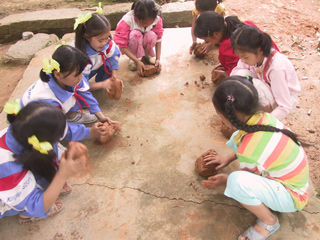
It is a luxury to own a colour pencil for the children living in the remote deep mountains in the Xiangxi Tujia/Miao Autonomous Prefecture in the west of Central China's Hunan Province. However, the children of the Miao ethnic group in the La'ershan Hope Primary School in Fenghuang County are getting the chance to enjoy an entirely new sort of fine art class. Mud, straw, bark, stones and bits of cloth have been turned into imaginative works by their nimble, little hands.
Here, the folk fine art of the Xiangxi, or Western Hunan region has been expressed by the hands of children with their special perspective. Straw dragonflies fly around the big trees, on whose branches baby dolls made from colourful cloth are attached. Below the trees are all sorts of utensils made of straw, such as brooms, baskets and bowls. The visitors are most fascinated by the different stories being told by the straw figures. Folk fairy tales and traditional holiday celebration are also the favourites of the young artists. Traditionally, paper-cuts made by Miao women are used for embroidery patterns. But nowadays, the handicraft is in danger of extinction. Fortunately, Long cherishes the art - it is her favourite subject. "The teacher does not have any particular requirement for us at all," she says. "I just cut whatever patterns I like, though sometimes he will give us a helping hand when we have difficulties." Long uses pencils to draw a Miao girl holding straws on a piece of paper, which she claims will bring a significant harvest. She wants to make her picture more beautiful, so a butterfly is added next to the girl. The paper-cut patterns created by Long and her classmates clearly reflect the Xiangxi Miao embroidery tradition, which features flowers and grasses. When looking at his students enjoying their fine art class, Long Junjia, a village teacher, recalls that two years ago, it was a great headache for him to follow textbooks to teach the class. The students could not pay for water-colour paintbrushes, which the text required. Thus, interest in the fine art class dwindled quickly. Last July, the school became one of seven in Xiangxi to be covered by the "Dandelion Action" programme, part of a three-year project for after-school fine art education. Launched by the Commission for Children's Art under the Chinese Artists' Association, the project aims at merging folk art essence and the most creative fine art education, while protecting and rescuing intangible cultural heritage. Rich tradition Xiangxi is an ancient and still very mysterious place. Ancestors of the Miao and Tujia ethnic groups settled in the region thousands of years ago. In their long history, they have created colourful folk culture and art, featuring paper-cuts, embroidery, batik, and brocade and carving. However, like almost all intangible cultural heritage products in the world, they have been eroded by modern and foreign cultures and the market economy. Wu Xiangying, a paper-cut folk artist, used to travel to Japan in the 1980s to show his craft. But nowadays, Wu is only able to survive by selling shoes at a fair. In Xiangxi, more ageing folk artists pass away each year. Others, like Wu, have to give up their beloved art for economic reasons and their children fail to pick up the skills. "If they are not rescued in time, Xiangxi's folk fine art will be lost forever," said Liu Yuxin, a researcher with the prefecture's education research institute. With the rich cultural legacy of various ethnic minorities in Xiangxi, Xie Lifang, the veteran art educator in charge of "Dandelion Action," is exploring with her colleagues a sustainable way of integrating ethnic folk art with children's fine art education. Her enlightening concept of a feasible, sustainable and practical education mode won backing from the Ford Foundation last July, which so far has 17 programmes in China focusing on rescuing intangible cultural heritage. "While emphasizing that learning fine art is deeply rooted with local culture, we enable the children to gradually attain a basic knowledge of fine art, and we try to consolidate their love of the culture of their own ethnic groups," said Xie. "Our ultimate aim is to encourage them to protect their own art and culture." Xie said she believed that only when the new generation develops a sense of protection will Chinese folk art be salvaged from the brink of extinction. She also stressed that the innovative spirit of the children must be fully encouraged during their art education. "There must be something new in the class. We are not training paper-cut craftsmen who can only strictly following traditions," said Xie. Curriculum development During last year's summer vacation, Xie joined teachers from selected experimental schools to visit the folk handicraft people in Xiangxi. This has helped enrich the fine art curriculum, she said. Xie is a tough-minded woman who impresses others with her persistence in preserving folk art. In classes, teachers only chose the types of folk fine arts that require simple tools, materials and techniques. The paper-cut, as the most influential folk art in the region, has been adopted as the elementary course for the experimental schools. At the primary school attached to the Normal College of Jishou University, located in the prefecture, the teachers found that some students had difficulty using knives and scissors in their fine art classes, preferring to tear the paper with their fingers.
"The unusual patterns fully depict their (the children's) innocence, simplicity and primitiveness," said Chen Wei, a fine art teacher at the school. The children appear to be tearing the paper at will, but the process reflects their imagination. The experimental schools are able to select and develop their own curriculums according to local conditions. The pottery making class at Beisha Hope Primary School in Luxi County and the learning of brocade at Longshan County's Min'an No 2 Primary School are typical examples of effective utilization of local cultural and natural resources. Long Yizhen and her schoolmates have made several field trips with their teacher, Long Junjia, to find new sources of artistic inspiration. With mud they dug from the fields, the students displayed their talent in making pottery. They also went to paddy fields to collect straw, to a sawmill to collect bark and to a river to gather pebbles. "In my class, I just hope that they can develop their instinctive love for fine art and let their originality flow. I just watch them and give them some guidance when necessary," Long says. All the children are happy when it is time for the fine art class. For them, it is time to play and create. But traditional folk fine art also plays a role in class. In some cases, Long has taken his students to visit the families of old Miao women, to learn their paper-cut and embroidery skills. The children's works also impress their teachers. "As a painter, I feel quite ashamed and astonished when seeing their works," said Zhu Fan, who is employed by the art commission under the Chinese Artists' Association. "I am sometimes at a loss over what to draw. But the children have helped me regain my inspiration, my creativity." He Yunlan, director of the Commission for Children's Art, says it is depressing to see that many of the fine art works being produced by adult artists have already lost the most basic elements of truth. "In the children's works, I can see innocence again," He said. "The innocence and simplicity of the children are in great harmony with those of folk art." Xie Lifang compared preserving folk fine art to protecting a rare species of fish. They could be turned into specimens and stored in a museum. But they could also be allowed to swim freely in rivers. "The second is a much better option," Xie said.
|
|
|
|
|
||||||||||||||||||||||||||||||||||||||||||||||||||||||||||||||||
|
|
|
|
|||||||||||||||||||||||||||||||||||||||||||||||||||||||||||||||||||