|
Home>News Center>Life | |
|
|
|
|
|
|
|
|
|
|
|||||||||||||||||||||||||||||||||||||||||||||||||||||||||||||||||||||||||||||||||||||||||||||||||||||||||||||||||||||||||||||
|
|
NGOs active in China's fight against AIDS
Never before has the international community seen such a diversified Chinese team at a world gathering for AIDS. But in Bangkok, Thailand, where the 15th International AIDS Conference was held from July 11 to 17, the 200 Chinese participants, including government officials, researchers, representatives of non-government organizations and non-profit agencies, volunteers and people living with HIV/AIDS (PLWA), were a noticed presence.
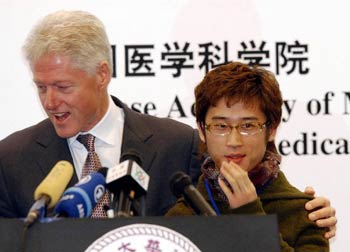
This time, however, Song himself met 20 HIV carriers from China, where an estimated 840,000 people are HIV positive. The young man, whose organization aims to express the voice and emotions of PLWA, became a media figure in November 2003 when former US President Bill Clinton shook hands with him at a symposium held at the prestigious Tsinghua University in Beijing. Song went to the conference to present about 20 pieces of the art work done by fellow PLWAs from the workshop. "We want to get the voices of China's HIV-positive people heard," he said, adding that he is very much impressed by the exhibition from China. "Thanks to negotiations by the China STD & AIDS Foundation, one of the largest NGOs in the country, the display booths of Chinese NGOs, which previously were scattered around the hall, were put together, creating a much stronger visual impact." In the first few days after the conference started, Song kept busy attending to visitors from around the world and selling the artworks he had brought along. As all the paintings, T-shirts and postcards were in the hands of those who care for Chinese AIDS patients, he was able to concentrate on the treatment and medication sessions. "I'm also keen on learning how foreign NGOs or NPOs operate, and will look for possible co-operation with the Chinese Government," he said, adding that his organization has so far trained about 100 PLWAs in China. "PLWAs in China are under great psychological pressure. They worry about their work, treatment, financial problems and ways to keep a positive attitude towards themselves. Life is particularly difficult for those living in cities. Discrimination is still the biggest problem in China," he says. Another activist at the Bangkok conference from China was Li Xiang, director of the Mangrove Support Group, a network organization created for people living with HIV/AIDS. Li, also HIV positive, is glad to see more and more NGOs are active now in China. "The NGOs are good at delivering care to HIV-positive people. They have their own personal experience to share in peer education. They also have a complementary role to play in working with prostitutes and drug abusers, because they are closer to these people than government workers, who often feel awkward working with these people." Mangrove Support Group, whose main purpose is to improve the quality of life for PLWAs through life-skill training and undertaking activities to publicize messages relating to HIV/AIDS prevention and control, has so far been involved in a number of beneficial events. Its programme has now reached Guangdong in the south, Sichuan in the southwest and Henan in Central China, where there are thousands of cases of HIV infection stemming from the operation of sub-standard blood collection stations in the early 1990s. Voices of NGOs Wang Longde, vice-minister of health and head of the Chinese delegation to the Bangkok conference, said that the government welcomes NGOs' involvement in China's battle with AIDS. But Li Xiang notes that the complicated procedures for NGOs to get officially registered and acknowledged are still blocking the way. "Without proper registration, NGOs' survival and financial support cannot be guaranteed," he said, adding that the voice of NGOs is still minimal. Even though the central government is trying to ensure free treatment and medication for certain groups, such treatment and medication might not reach the end receiver in some cases because of impediments in between. Statistics indicate that in China, as 64 per cent of HIV cases are caused by injecting drug use, and infections through sexual transmission are slowly picking up to a two-digit rate, prostitutes and drug addicts are getting increasing attention from researchers and decision makers. In the meantime, however, male homosexuals, a group with high-risk behaviour have been somewhat neglected in the government intervention measures. "Small NGOs like ours have the advantage of dealing face-to-face with HIV prevention day in and day out," says Guo Yaqi, executive director of the Beijing Gender Health Education Institute. Chung To, an officer of the Hong Kong-based Chi Heng Foundation, which brought a 25-minute documentary film on orphans in Henan for screening during the conference, knows the great difficulty of working at the grassroots level. The foundation has helped 1,200 children orphaned by the death of their AIDS-infected patients to go back to school. "Chi Heng was lucky to get accepted by the local government to work in Henan, because we've always maintained a low profile," says Chung. The local government recently announced that it would build orphanages to provide a home for children whose lives have been disrupted by HIV/AIDS. Yet Chung fears living in orphanages may result in long term psychological damage to the children. "It's better to put the children in foster families, where they can get parental love and care," Chung suggests. His other concern is that meanwhile, "it takes multi-sectoral efforts from the health, public security and civil affairs authorities" to translate the good intentions and strong political will demonstrated by the central government into proper action. Wan Yanhai, director of Beijing Aizhixing Institute of Health Education, which has been in the forefront in promoting the rights of PLWA in China, is very proud of the "revolutionary" role played by NGOs in drawing attention to corners largely unknown or neglected by society. In addition, he says, there should be transparency in government-led
programmes to ensure those in need actually benefit from the
programmes.
|
|
|
|
|
||||||||||||||||||||||||||||||||||||||||||||||||||||||||||||||||||||||||||||||||||||||||||||||||||||||||||||||||||||||||||
|
|
|
|
|||||||||||||||||||||||||||||||||||||||||||||||||||||||||||||||||||||||||||||||||||||||||||||||||||||||||||||||||||||||||||||