|
Home>News Center>World | |
|
|
|
|
|
|
|
|
|
|
||||||||||||||||||||||||||||||||||||||||||||||||
|
|
WTO OKs plan to end farm export subsidies
World Trade Organization members approved a plan Sunday to end export subsidies on farm products and cut import duties across the world, a key step toward a comprehensive global accord that has been discussed since 2001, trade officials said.
"Developed countries have recognized that agricultural trade with a heavy subsidy component is not free trade," Indian Trade Minister Kamal Nath said.
But Nath said the United States, European Union and other developed countries also will benefit by removing heavy agricultural subsidies from their budgets.
"It is incredibly important for Canada and for the world," Canadian Trade Minister Jim Peterson said. "We have a historic opportunity to get rid of agricultural subsidies and open up the world, particularly the developing world."
Brazilian Foreign Minister Celso Amorim said the framework was "a good deal for everybody."
"It's a good deal for trade liberalization. It is also a good deal for social justice ... with the elimination of subsidies," Amorim said.
The approval followed a breakthrough earlier Saturday when some 20 key countries approved a document setting out the framework for a legally binding treaty, WTO spokesman Keith Rockwell said.
The document commits nations to lowering import duties and reducing government support in the three major areas of international trade - industrial goods, agriculture and service industries such as telecommunications and banking.
The deal will set back in motion the long-stalled "round" of trade liberalization treaty talks launched by WTO members in Doha, Qatar, in 2001, but delayed by the collapse of the body's ministerial meeting in Cancun, Mexico, last year.
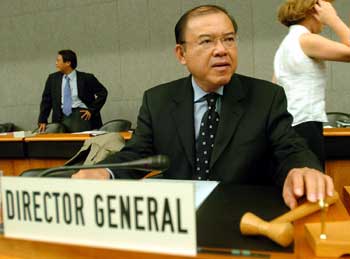
WTO Director-General Supachai Panitchpakdi, who mediated the negotiations since that collapse, was ecstatic.
"It is really a historic moment for this organization," he said.
In agriculture, the document agrees to eliminate export subsidies and other forms of government support for exports, while making big cuts to other subsidies. It includes a "down payment" that would see an immediate 20 percent cut in the maximum permitted payments by rich nations.
The highest agricultural import tariffs will face the biggest cuts, although no figures have yet been agreed. Nations will have the right to keep higher tariffs on some of the products they consider most important.
The biggest sticking point apparently was how to handle those farm products on which a group of 10 countries, including Japan and Switzerland, want to maintain higher import tariffs to protect domestic producers.
"What we regret is that some of the G10 concerns haven't fully been taken into account," said Swiss President and Economics Minister Joseph Deiss, who heads the G10. "The liberalization process will put additional economic pressure on our farmers."
But, Deiss added, "This will be a key step for the opening of the world economy and this will be of benefit for all countries."
Tariffs on industrial products also will be cut according to a formula, but the exact details have yet to be established. Developing countries will have longer to make the changes.
The deal also approves the launch of new negotiations on trade facilitation - "further expediting the movement, release and clearance of goods" by streamlining customs procedures.
Developing countries in particular have been congratulating themselves for forcing issues onto the agenda that they say were ignored by rich nations in the past - such as the devastating effect of U.S. cotton subsidies on producers in Africa.
The so-called Group of 20 developing nations, led by Brazil, has had a major influence on discussions over the past year, and Brazil was one of the major players in drafting this week's agreement.
"Post-Cancun, the G20 was seen as a destructive force. Now it's seen as an essential part of a deal, so draw your own conclusions," Amorim said.
Economic theory says reducing barriers to trade and allowing the market to dictate who produces a good and what they charge for it will boost the global economy. A recent University of Michigan study found that cutting global trade barriers by one-third would boost the world economy by $613 billion - the equivalent of adding a country the size of Canada to the world.
Nations are reluctant to agree to big cuts in some areas because free trade also creates losers, and entire industries can be devastated in some countries if they are opened to foreign competition. So trade rounds tend to be slow and laborious affairs.
This week's deal is referred to as a "framework" - it sets out a series of principles for liberalization, but stops short of details. Those must be negotiated in further talks, expected to start in September.
Everybody accepts that it will be impossible to achieve the aim of negotiators in Doha to finish the round by the end of this year. However, this week's agreement gives focus and direction to the discussions, and makes it much more likely that a fully treaty can be worked out next year.
That could lead to a final deal being signed in Hong Kong late next year, with the agreement coming into force in 2006. |
|
|
|
|
|||||||||||||||||||||||||||||||||||||||||||||
|
|
|
|
||||||||||||||||||||||||||||||||||||||||||||||||