|
Home>News Center>China | |
|
|
|
|
|
|
|
|
|
|
||||||||||||||||||||||||||||||||||||||||||||||||||||||||||||||||||||||||||||||||||||
|
|
Political ice dents cross-Straits economic ties
The whole world knows relations between Taiwan and the Chinese mainland have suffered because of Taipei's hard push for independence.
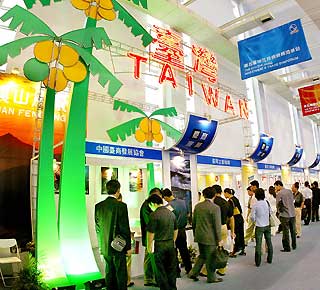
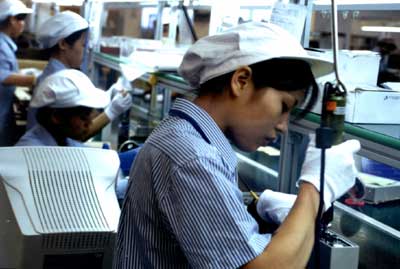
But economic and trade exchanges across the Straits have surprisingly boomed over the past two decades despite political ups and downs. Cross-Straits trade volume reached a record high of US$58.6 billion last year, with the mainland becoming Taiwan's biggest trade partner and largest source of trade surplus. The number of Taiwanese-funded projects on the mainland had risen to 62,000 by the end of May, with contract investment of US$73 billion. The warmer economic ties have prompted economists to predict an inevitable trend of closer economic integration between the highly-complementary economies of Taiwan and the mainland. Researchers in cross-Straits studies, however, have begun to worry about the prospects, given Taiwan leader Chen Shui-bian's efforts to step up his splittist timetable. "If everything goes purely in line with the principle of economics, economic relations can be strengthened to benefit both Taiwan and the mainland," says Wu Nengyuan, director of the Institute of Modern Taiwan Studies under the Fujian Academy of Social Sciences. "But uncertain factors from the impact of politics will make the situation more complicated." The researcher acknowledged that Beijing and Taipei have politically walked further apart, despite sharing increasingly close economic exchanges. Semi-official talks between the mainland's Association for Relations Across the Taiwan Straits and its Taiwan counterpart the Straits Exchange Foundation were broken off in July 1999, when former Taiwan leader Lee Teng-hui introduced the notorious "two states" theory. This defines the ties between both sides of the Taiwan Straits as a state-to-state relationship. The stalemate in bilateral relations has remained since Chen, from the pro-independence Democratic Progressive Party (DPP), took power in May 2000 to end more than 50 years of Kuomintang rule over the island. The new Taiwan leader has refused to recognize himself as Chinese, to say nothing of accepting the one-China principle that both Taiwan and the mainland are part of China. On August 3, 2002, Chen provoked new tension by preaching that "each side (of the Taiwan Straits) is a country." As he starts his second term, he has gone even further to introduce a pro-independence timetable to write a new "constitution" through referendum in 2006 and then enact the document in 2008. Political alienation "These contribution of economic exchanges to the development of bilateral political ties should not be exaggerated," Wu says.
But Deng Lijuan, a senior researcher with the Academy of Taiwan Studies at Xiamen University, believes close economic co-operation has actually played a significant part in stabilizing ties. "The existence and development of separatist forces on the island are rooted in Taiwan's special historical conditions and have nothing to do with cross-Straits trade ties," she says. Deng argues that it is unrealistic to expect the development of economic relations to eliminate the concept of "Taiwan independence" and splittist forces on the island. But because of Taiwan's growing dependence on the mainland market, the Taiwan authorities have had to modify policies that were originally aimed at alienating the island from the mainland, though with much hesitation. In 2001, Chen had to give up his predecessor's "go slow, be patient" policy, which required strict control over the island's investment in the mainland. Instead, he introduced the so-called "aggressive opening, effective management" approach to relax trade restrictions. Last October, the DPP administration had to revise the Statute Governing the Relations between the People of the Taiwan Area and the Mainland Area to ease restrictions on investment, trade and business exchanges. Tsai Ing-wen, former chairwoman of the island's "mainland affairs council," once said: "Cross-Straits economic and trade exchanges have become a critical part that cannot be ignored in Taiwan's economic development." More important, the researcher says, economic exchanges have helped form a large and important force that stands for stable relations. As the number of Taiwan-funded enterprises on the mainland rises, a few million Taiwan business people and their family members are travelling across the Straits each year. Quite a large number of them, estimated at about half a million, have even chosen to live on the mainland. Stabilizing role To help safeguard their fundamental interests, Taiwanese investors, including the island's business tycoons and owners of small and medium-sized firms, have developed into an influential political group. On the economic front, most of these business leaders and their family members call for closer economic relations and the establishment of the three direct links - trade, transport and postal services. Politically, they oppose any risky splittist moves that may threaten peace and stability and promote the maintenance of the cross-Straits status quo. To demonstrate their great disappointment at Chen's mainland policy, hundreds of thousands of Taiwanese investors flew home from the mainland to vote in the "presidential" elections in March. Some 180,000 mainland-based business people returned to cast their ballots and the bulk were believed to have voted against Chen, whose controversial victory has been widely questioned due to a mysterious election-eve shooting. Deng forecasts that the immediate interests of Taiwanese businessmen and their strong call for better cross-Straits ties will put Taipei under mounting pressure. Despite the importance of the stabilizing role of economic exchanges, Deng admits the development of ties will meet more challenges and difficulties ahead. "If the current confrontation becomes a crisis, relations will undoubtedly be severely damaged," she says. Wang Zaixi, vice-minister of the Taiwan Affairs Office of the State Council, recently told China Daily that separatist forces form the biggest hurdle blocking relations. The development of pro-independence forces, if not effectively contained, will ultimately hurt the economic growth of the mainland and Taiwan, he said on the sidelines of a seminar held in Hangzhou, capital of Zhejiang Province. For the first time, the senior official warned of the possibility of a cross-Straits military clash by 2008 if Chen sticks to his pro-independence stance. "New tensions and even a serious crisis in the situation may arise, if Chen obstinately pursues his timetable," he said. "We cannot completely rule out the possibility (of a military conflict), though it is not at all what we hope for." Beijing has stood for a peaceful reunification of Taiwan with the mainland while at the same time, not committing itself to dropping the use of force if the island declares "independence." As one of the latest signs for the urgency of curbing splittist forces, Beijing has pledged to crack down on a handful of Taiwanese investors who make money on the mainland and return to Taiwan to support independence. Guo Zhenyuan, a research fellow with the China Institute of International Relations, says instability and uncertainty in cross-Straits ties are set to dent the confidence of both mainland and Taiwanese investors. Meanwhile, the Taiwan authorities are also expected to impose stricter limits on economic exchanges, citing security concerns. Guo points out that all these negative factors may undermine the environment for smooth development of economic relations in the coming years. "We are confident that the mainland's long-standing policy of separating politics from economic affairs will continue to encourage the development of cross-Straits economic exchanges," Guo says. "But interference from pro-independence forces and splittist activities is really something we cannot ignore." |
|
|
|
|
|||||||||||||||||||||||||||||||||||||||||||||||||||||||||||||||||||||||||||||||||
|
|
|
|
||||||||||||||||||||||||||||||||||||||||||||||||||||||||||||||||||||||||||||||||||||