|
Home>News Center>Life | |
|
|
|
|
|
|
|
|
|
|
|||||||||||||||||||||||||||||||||||||||||||||||||||||||||||||||||||||||||||||
|
|
China grapples with legacy of its 'missing girls'
China is asking where all the girls have gone.
An age-old bias for boys, combined with China's one-child policy imposed since 1980, has produced what Gu Baochang, a leading Chinese expert on family planning, described as "the largest, the highest, and the longest" gender imbalance in the world.
For centuries, Chinese families without sons feared poverty and neglect. The male offspring represented continuity of lineage and protection in old age. The traditional thinking is best described in the ancient "Book of Songs" (1000-700 B.C.): "When a son is born, Let him sleep on the bed, Clothe him with fine clothes, And give him jade to play... When a daughter is born, Let her sleep on the ground, Wrap her in common wrappings, And give broken tiles to play..." After the People's Republic of China has established in 1949, Mao Zedong rejected traditional Malthusian arguments that population growth would eventually outrun food supply, and firmly regarded China's huge population as an asset, then with an annual birth rate of 3.7 percent. China's sex ratio in the 60's and 70's remained normal. Then in the early 1980s, China began enforcing an ambitious demographic engineering policy to limit families to one-child, as part of its strategy to fast-track economic modernization. The policy resulted in a slashed annual birth rate of 1.29 percent by 2002, or the prevention of some 300 million births, and the current population of close to 1.3 billion. 'Missing girls' From a relatively normal ratio of 108.5 boys to 100 girls in the early 80s, the male surplus progressively rose to 111 in 1990, 116 in 2000, and is now is close to 120 boys for each 100 girls at the present time, according to a Chinese think-tank report. The shortage of women is creating a "huge societal issue,” warned U.N. resident coordinator Khalid Malik earlier this year.
Along with HIV/AIDS and environmental degradation, he said it was one of the three biggest challenges facing China. "In eight to 10 years, we will have something like 40 to 60 million missing women," he said, adding that it will have "enormous implications" for China's prostitution industry and human trafficking. China's own population experts have been warning for years about the looming gender crisis. "The loss of female births due to illegal prenatal sex determination and sex-selective abortions will affect the true sex ratio at birth and at young ages, creating an unbalanced population sex structure in the future and resulting in potentially serious social problems," argued Peking University's chief demographer back in 1993. Prenatal sex selection The abortion of female fetuses was aided by the spread of cheap and portable ultra-sound scanners in the 1980's. Illegal mobile scanning and backstreet hospitals can provide a sex scan for as little as $50, according to one report. "Prenatal sex selection was probably the primary cause, if not the sole cause, for the continuous rise of the sex ratio at birth," said population expert Prof. Chu Junhong. A slew of reports have confirmed the disturbing demographic trend. In a 2002 survey conducted in a central China village, more than 300 of the 820 women had abortions and more than a third of them admitted they were trying to select their baby's sex. According to a report by the International Planned Parenthood Federation, the vast majority of aborted fetuses, more than 70 percent, were female, citing the abortion of up to 750,000 female fetuses in China in 1999. A report by Zhang Qing, population researcher of the Chinese Academy of Social Sciences, said the gender imbalance is "statistically related to the high death rate of female babies, with female death rate at age zero in the city or rural areas consistently higher than male baby death rate." Only seven of China's provinces are within the world's average sex ratio. Zhang Qing's report cited eight provinces from North to South China, where there were 26 to 38 percent more boys than girls. In the last census in 2000, there were nearly 19 million boys more than girls in the 0-15 age group. "We have to act now or the problem will become very serious," said Peking University sociologist Prof. Xia Xueluan. He cited the need to strengthen social welfare system in the countryside to weaken the traditional preference for boys. Gravity of imbalance beginning to be felt The hint of "serious" problems ahead can be seen in the increasing cases of human trafficking as bachelors try to "purchase" their wives. China's police have freed more than 42,000 kidnapped women and children from 2001 to 2003. The vast army of surplus males could pose a threat to China's stability, argued two Western scholars. Valerie M. Hudson and Andrea M. Den Boer, who recently wrote a book on the "Security Implications of Asia's Surplus Male Population," cited two rebellions in disproportionately male areas in Manchu Dynasty China.
According to analysis, low-status young adult men with little chance of forming families of their own are "much more prone to attempt to improve their situation through violent and criminal behavior in a strategy of coalitional aggression." The growing crime rate in China which is being linked to China's massive "floating" or transient population, some 80 million of which are low-status males, seems to add weight to their observation. Girl Care Project The imbalance has spurred some official efforts to shift public opinion. The "Girl Care Project" is described as a multi-pronged approach to encourage the birth of girls, although some experts complain that it's being framed in terms of the future needs of men. "That's too male-oriented and discriminatory of women," said Dr. Gu, the population control expert. According to one estimate, over the next decade, some 40 million Chinese men will be unable to find wives due to the "scarcity" of females, thus the growing number of so-called "bachelors' villages" in various parts of China. "This project ought to be seen as a way to foster more respect and concern for women and girls," Gu said. The program aims to end pre-birth sex selection, as well as "attacking the criminal activities of drowning and abandoning baby girls [while] rewarding and assisting families that plan to give birth to baby girls," reported The People's Daily. Benefits for girls The pilot program is being launched in more than a dozen of China's poorest provinces, with funding split between the national and local government. 'We still have a lot of work to do. There's no road map yet on how to achieve the goal of normal sex ratio.'
— Dr. Gu Baochang Population control expert
Leading the way is Fujian province where some $24 million has been allocated for distribution among nearly half a million households, with some 100,000 girls to be exempt from school fees. Under the program, couples who limit themselves to two girls would receive a combined annual pension of about $150 for the rest of their lives. Preferential treatment in health care, housing and employment would also be provided. A recent glowing report in the The People's Daily cited a village where new houses for beneficiaries worth more than $2,300 each were built along a "Family Planning Basic Policy Street.” China's birth control policy is now "a diversified mechanism," according to Population Vice-Minister Zhao Baige, which allows for one-child in the cities, two in the rural areas, and three in ethnic regions, with no limit in Tibet. "To normalize the sex ratio, illegal sex determination and sex-selective abortions must be strictly banned," Zhao declared recently. An American demographer, who has been closely following China's population program and who spoke on condition of anonymity, lauded China's "coming to grips" with the problem.
"We still have a lot of work to do," said Dr.Gu. "There's no road map yet on how to achieve the goal of normal sex ratio."
|
|
|
|
|
||||||||||||||||||||||||||||||||||||||||||||||||||||||||||||||||||||||||||
|
|
|
|
|||||||||||||||||||||||||||||||||||||||||||||||||||||||||||||||||||||||||||||
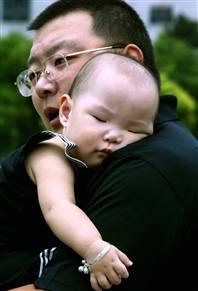
 "Still, they are in a deep dilemma -- emotional and policy dilemma --
because the solution to the problem will conflict with other parts of their
population strategy to reduce birth rate or some of the measures could perhaps
make the problem even worse," warned the demographer.
"Still, they are in a deep dilemma -- emotional and policy dilemma --
because the solution to the problem will conflict with other parts of their
population strategy to reduce birth rate or some of the measures could perhaps
make the problem even worse," warned the demographer.