|
Home>News Center>World | |
|
|
|
|
|
|
|
|
|
|
|||||||||||||||||||||||||||||||||||||||||||||||||||||||||||||||||||
|
|
'Piano Teacher' author wins Nobel Prize
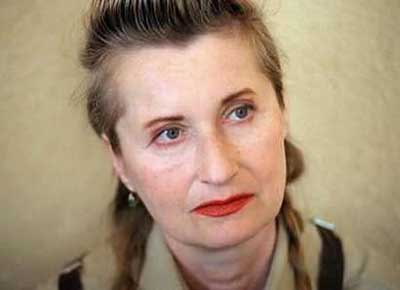
Austrian writer Elfriede Jelinek, a reclusive author whose feminism, leftist politics and pacifism are common themes in her works, won the Nobel Prize in literature Thursday for what the Swedish Academy called her "musical flow of voices and counter-voices in novels and plays."
Her most famous novel, "The Piano Teacher" in 1983, was adapted into a 2001 film by director Michael Haneke, although her other works are well-known in German-speaking countries and she is widely translated in French. Jelinek, 57, told reporters in Vienna she would not attend the Dec. 10 award ceremony in Stockholm because she suffers from "a social phobia." "When I write, I have always tried to be on the side of the weak. The side of the powerful is not literature's side," she said. Her latest play, "Bambiland," written in 2003 and translated into English in 2004, is a strident attack on the U.S. war in Iraq, although Horace Engdahl, secretary-general of the academy, emphasized that the prize should not be interpreted as a political comment. "When that play came out, this decision was — if not already made — then well under way," he said. Engdahl said "Bambiland" depicts how "the patriotic enthusiasm turns into insanity." And, he added, "she's completely right about that." The decision to award the prize to a woman, and a poet, was the first since 1996, when Wislawa Szymborska of Poland won. Since the prize first was handed out in 1901, only 10 women have won it. "They assured me that I received the prize because they value my work, not because I am a woman," Jelinek said, calling the Nobel "the biggest honor." Although happy about the prize, she said "I can't stand" the attention that comes with it. With her phone and doorbell constantly ringing, Jelinek said her plans for the coming days were simply "to disappear." Jelinek made her literary debut with the collection "Lisas Schatten" in 1967. Her writing took a critical turn after her involvement with the student movements prevalent throughout Europe in the 1970s, coming out with her satirical novel "We Are Decoys, Baby!" That was followed by other works, including "Wonderful, Wonderful Times" in 1990. "The Piano Teacher" tells the story of Erika, a demanding piano teacher who embarks on an affair with a younger music student. It's a theme redolent in most of her works, which are known for jolting readers with their frank descriptions of sexuality, pathos and conflict between men and women. Jelinek had a best seller in 1989 with "Lust," which she has described as portraying "the violence by the man against the woman" in a conventional marriage. In recent years, her plays have received an icy reception in Austria, where productions have been marred by booing, shouting matches and patrons walking out. She was shunned by some Austrian political leaders, partly because of her vehement opposition to the rise of the rightist Freedom Party led by Joerg Haider, which became part of the ruling coalition in 2000 on a platform criticized as anti-Semitic and anti-foreigner.
In 2000, she instructed her publishers to withhold the performance rights of her plays from all Austrian theaters as long as Haider's party was part of the government. But Communist Party chairman Walter Baier hailed Jelinek as "a feminist and one of the most important voices of the 'other Austria,'" and he praised her "unabashed and public attacks" on the Freedom Party. Among her fans is Andreas Kohl, the president of Austria's parliament, who said he was "pleased for her and for Austria." In her phantasmagorical novel "Die Kinder der Toten," she depicted Austria as a realm of death. Engdahl said many of her works also focus on the entertainment industry — both in Europe and the United States — which she "believes affects people in a way that makes them susceptible to the economic elite." Using parody and satire, Jelinek tries to tear down the industry's facade, he said. "Her writing builds on a lengthy Austrian tradition of linguistically sophisticated social criticism, with precursors such as Johann Nepomuk Nestroy, Karl Kraus, Odon von Horváth, Elias Canetti, Thomas Bernhard and the Wiener Group," the academy said in its citation. "The nature of Jelinek's texts is often hard to define. They shift between prose and poetry, incantation and hymn, they contain theatrical scenes and filmic sequences." Her recent works are variations on one of her basic feminist themes: the seeming inability of women to find themselves fully and live out their lives in a world where they are glossed over as stereotypes. The 18 lifetime members of the 218-year-old Swedish Academy, of whom only four are women, made the annual selection in secrecy last week. Alfred Nobel, the Swedish industrialist and inventor of dynamite who endowed the awards, left only vague guidance about the prize, saying in his will that it should recognize those who "shall have conferred the greatest benefit on mankind" and "who shall have produced in the field of literature the most outstanding work in an ideal direction." For Jelinek, the Nobel could open doors to new markets and sales. The prize also brings a financial security net, too: A check of more than US$1.3 million. The academy has given the award to Europeans nine times in the last 10 years. Since 1980, only three winners have come from Africa, four from South America, two from the United States and one from Asia. It's been 14 years since someone from the Middle East — Egyptian Naguib Mahfouz — was given the nod. Last year's award went to South African writer J.M. Coetzee, whose fiction drew on his experiences growing up there. In 2002, the prize went to Hungarian writer Imre Kertesz, whose fiction drew on his experience as a teenager in the Auschwitz concentration camp. The winner of the coveted peace prize — the only one not awarded in Sweden — will be announced Friday in Oslo, Norway. The prizes, which also include a gold medal and a diploma, are presented on Dec. 10, the anniversary of Nobel's death in 1896. |
|
|
|
|
||||||||||||||||||||||||||||||||||||||||||||||||||||||||||||||||
|
|
|
|
|||||||||||||||||||||||||||||||||||||||||||||||||||||||||||||||||||