|
Home>News Center>Life | |
|
|
|
|
|
|
|
|
|
|
|||||||||||||||||||||||||||||||||||||||||||||||||||||||||||||||||||
|
|
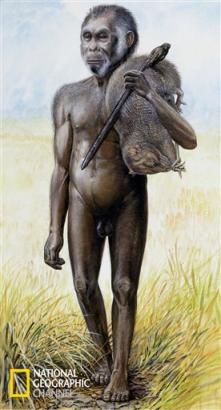
Scientists find prehistoric dwarf skeleton In an astonishing discovery that could rewrite the history of human evolution, scientists say they have found the skeleton of a new human species, a dwarf, marooned for eons in a tropical Lost World while modern man rapidly colonized the rest of the planet.
Yet biologically speaking, it may have been closely related to us and perhaps even shared its caves with our ancestors.
The 3-foot-tall adult female skeleton found in a cave is believed 18,000 years old. It smashes the long-cherished scientific belief that our species, Homo sapiens, systematically crowded out other upright-walking human cousins beginning 160,000 years ago and that we've had Earth to ourselves for tens of thousands of years.
Instead, it suggests recent evolution was more complex than previously thought.
And it demonstrates that Africa, the acknowledged cradle of humanity, does not hold all the answers to persistent questions of how — and where — we came to be.
"This finding really does rewrite our knowledge of human evolution," said Chris Stringer, who directs human origins studies at the Natural History Museum in London. "And to have them present less than 20,000 years ago is frankly astonishing."
Scientists called the dwarf skeleton "the most extreme" figure to be included in the extended human family. Certainly, she is the shortest.
She is the best example of a trove of fragmented bones that account for as many as seven of these primitive individuals that lived on the equatorial island of Flores, located east of Java and northwest of Australia. The mostly intact female skeleton was found in September 2003.
Scientists have named the extinct species Homo floresiensis, or Flores Man, and details appear in Thursday's issue of the journal Nature.
Flores Man was hardly formidable. His grapefruit-sized brain was two-thirds smaller than ours, and closer to the brains of today's chimpanzees and transitional prehuman species in Africa than vanished 2 million years ago.
Yet Flores Man made stone tools, lit fires and organized group hunts for meat. Bones of fish, birds and rodents found near the skeleton were charred, suggesting they were cooked.
All this suggests Flores Man lived communally and communicated effectively, perhaps even verbally.
"It is arguably the most significant discovery concerning our own genus in my lifetime," said anthropologist Bernard Wood of George Washington University, who reviewed the research independently.
Discoveries simply "don't get any better than that," proclaimed Robert Foley and Marta Mirazon Lahr of Cambridge University in a written analysis.
To others, the species' baffling combination of slight dimensions and coarse features bears almost no meaningful comparison either to modern humans or to our larger, archaic cousins.
They suggest that Flores Man doesn't belong in the genus Homo at all, even if it was a recent contemporary. But they are unsure where to classify it. "I don't think anybody can pigeonhole this into the very simple-minded theories of what is human," anthropologist Jeffrey Schwartz of the University of Pittsburgh. "There is no biological reason to call it Homo. We have to rethink what it is." For now, most researchers have been limited to examining digital photographs of the specimens. The female partial skeleton and other fragments are stored in a laboratory in Jakarta, Indonesia. Researchers from Australia and Indonesia found the partial skeleton 13 months ago in a shallow limestone cave known as Liang Bua. The cave, which extends into a hillside for about 130 feet, has been the subject of scientific analysis since 1964. Fenced off and patrolled by guards, it is surrounded by coffee farms. Older stone tools and other artifacts previously found on the island suggest that Flores Man is part of a substantial archaic human lineage. "So the 18,000-year-old skeleton cannot be some kind of 'freak' that we just happened to stumble across," said one of the discoverers, radiocarbon dating expert Richard G. Roberts of the University of Wollongong in Australia. But the environment in which Flores Man lived was indeed peculiar, and scientists say it probably contributed to the specimen's unusually small dimensions. Millenia ago, Flores was a kind of a looking-glass world, a real-life Middle-earth inhabited by a menagerie of fantastical creatures like giant tortoises, elephants as small as ponies and rats as big as hunting dogs. It even had a dragon, although they were giant lizards like today's carnivorous Komodo dragons rather than the treasure-hoarding Smaug described by novelist J.R.R. Tolkien in his "Lord of the Rings" trilogy. Artifacts suggest that a big-boned human cousin, Homo erectus, migrated from Java to Flores and other islands, perhaps by bamboo raft, nearly 1 million years ago. Researchers suspect that Flores Man probably is an H. erectus descendant that was squeezed by the pressures of natural selection. Nature is full of mammals — deer, squirrels and pigs, for example — living in marginal, isolated environments that gradually dwarf when food isn't plentiful and predators aren't threatening. This is the first time that the evolution of dwarfism has been recorded in a human relative, said the study's lead author, Peter Brown of the University of New England in Australia. Just how this primitive, remnant species managed to hang on is uncertain. Inbreeding certainly would've been a danger. Geologic evidence suggests a massive volcanic eruption sealed its fate some 12,000 years ago, along with other unusual island species like the dwarf elephant species, stegodon. Now, scientists are more puzzled by the specimen's jumble of features that appear to be borrowed from different human ancestors. This much is clear: Its worn teeth and fused skull show it was an adult. The shape of the pelvis is female. The skull is wide like H. erectus. But the sides are rounder and the crown traces an arc from ear to ear. The skull of H. erectus has straight sides and a pointed crown, they said. The lower jaw contains large, blunt teeth and roots like Australopithecus, a prehuman ancestor in Africa more than 3 million years ago. The front teeth are smaller and more like modern human teeth. The eye sockets are big and round, but unlike other members of the Homo genus, it has hardly any chin or browline. The rest of the skeleton looks as if it walked upright, but the pelvis and the shinbone have primitive, even apelike features. Bones from the species' feet and hands have not yet been found. Delicate artifacts found in the cave were described as "toy-sized" versions of stone tools made by H. erectus. They suggest that Flores Man retained intelligence and dexterity to flake small weapons with sharp edges, even if its body shrunk over time. "I've spent a sleepless night trying to figure out what to do with this thing," said Schwartz. "It's a mind-blower. It makes me think of nothing else in this world." Even more speculative is whether Flores Man met with modern humans, and what might've happened. Folklore experts have reported persistent legends of little people living on Flores and nearby islands. Islanders called the creature "Ebu Gogo" and say it was about 3 feet tall.
|
|
|
|
|
||||||||||||||||||||||||||||||||||||||||||||||||||||||||||||||||
|
|
|
|
|||||||||||||||||||||||||||||||||||||||||||||||||||||||||||||||||||