|
Iraq assessments: Insurgents not giving up
(Agencies)
Updated: 2004-11-18 20:14
The recapture of Fallujah has not broken the insurgents' will to fight and
may not pay the big dividend U.S. planners had hoped — to improve security
enough to hold national elections in Sunni Muslim areas of central Iraq,
according to U.S. and Iraqi assessments.
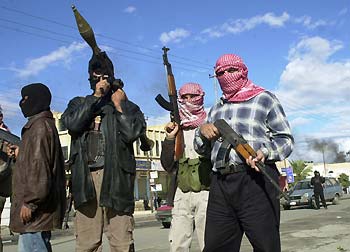 |
| Insurgents gather on the street in the northern Iraq city of Mosul
November 18, 2004. Rebels attacked the provincial governor's office in
Iraq's third city of Mosul on Thursday, killing one of his bodyguards and
wounding four more, the U.S. military said.
[reuters] | Instead, the battle for control
of the Sunni city 40 miles west of Baghdad has sharpened divisions among Iraq's
major ethnic and religious groups, fueled anti-American sentiment and stoked the
18-month-old Sunni insurgency.
Those grim assessments, expressed privately by some U.S. military
officials and by some private experts on Iraq, raise doubts as to whether the
January election will produce a government with sufficient legitimacy,
especially in the eyes of the country's powerful Sunni Muslim minority.
Even before the battle for Fallujah began Nov. 8, U.S. planners
understood that capturing the city, where U.S. troops are still fighting pockets
of resistance, was only the first step in building enough security to allow the
election to take place in the volatile Sunni areas north and west of Baghdad.
The next steps include solidifying Iraqi government control, repairing
the substantial battle damage and winning the trust of the people of Fallujah.
That requires, among other things, an effective Iraqi police and security
force.
Gen. John Abizaid, the commander of all U.S. forces in the Middle East,
said during a visit to Iraq this week that the Fallujah offensive was a major
blow to the insurgents, and he said the only way the U.S. forces and their Iraqi
allies can be defeated is if they lose their will.
"But we are also under no illusions. We know that the enemy will continue
to fight," he told the Pentagon's internal news service.
Speaking to reporters on Capitol Hill, Lt. Gen. Lance L. Smith said the
military now had to keep the insurgency from regrouping.
"The issue for us at Central Command is make sure we keep the pressure on
the terrorists and not allow another safe haven to occur, and we're going to do
that," Smith said.
The Associated Press has learned that U.S. military officials in Iraq
concluded the population of Anbar province, which includes Fallujah, Ramadi, has
been intimidated by the guerrillas and that the provincial security forces are
nonfunctioning and their ranks infiltrated by guerrilla sympathizers.
Before the attack on Fallujah began last week, Prime Minister Ayad Allawi
formally dissolved the city's police and security forces, which had fallen under
control of the radical Sunni clerics who ran the city.
Calls have already emerged for the January vote to be postponed until
security improves. Militant Sunni Arab clerics have called for a boycott to
protest the Fallujah attack.
However, Iraq's electoral commission is having none of that.
"The election will take place on schedule under laws which cannot be
changed because there is no legislative authority to do so," commission
spokesman Farid Ayar said Wednesday.
The clerical leadership of the majority Shiite community is also deeply
opposed to any delay in the election. The country's premier Shiite cleric, Grand
Ayatollah Ali al-Sistani, has been demanding elections since the early months of
the U.S. military occupation.
"I don't understand how delaying elections will improve the security
situation," Hussain al-Shahristani, a Shiite scientist who is close to
al-Sistani. "I believe that the most important reason for the deteriorating
security situation in the country is the postponement of elections."
However, pressure for a postponement is likely to increase if the wave of car
bombings, kidnappings, assassinations and armed attacks cannot be curbed as the
ballot approaches.
Since the Fallujah offensive, there has already been a marked spike in
insurgent attacks across other Sunni areas, notably Mosul where about 1,200 U.S.
troops launched an operation this week to reclaim police stations abandoned
after insurgent raids. U.S. officials say only 20 percent of the city's 5,000
police had returned to duty as of Wednesday.
"Holding the elections has become more difficult after the military
operations in Fallujah and other places," said Kurdish politician Mahmoud
Othman, a former member of the Iraqi Governing Council. "It is not impossible to
hold the election, but will it be credible, free and clean?"
Despite the risks, holding the January vote on schedule is important for
several reasons. It would produce a representative government to replace
Allawi's U.S.-backed administration — seen by many Iraqis as an unwanted legacy
of the American occupation.
Voters will choose a 275-member legislature that will draft a permanent
constitution. The document will resolve such key issues as whether Iraq adopts a
federal system — a major demand of the country's large Kurdish minority — or
remains a centralized state favored by the Arab majority.
Failure to resolve the issue satisfactorily to all could result in civil
strife or even the breakup of the Iraqi state. The Shiite Arab majority expects
the vote to formalize its domination over Iraq after decades of oppression by
the Sunni Arabs. The Kurds, about 15-20 percent of the population, want to
preserve their system of self-rule in their northern homeland.
"I will cast my vote even if I have to crawl to the polling station," said
Malik Nouri, 34, a Shiite who owns a pastry business in Baghdad. "I will go even
if bombs go off in front of my house."
Many Sunni Arabs, however, fear the vote will strip away the prestige and
power they had enjoyed for centuries. Many Sunnis accuse their Shiite and
Kurdish rivals of acquiescing the American occupation for political gains.
Despite boycott calls, many secular-minded Sunnis are expected to vote in the
election. But a low voter turnout, especially in Sunni strongholds now plagued
by insurgency, would be worse than having no election at all, according to Peter
Khalil, a national security research fellow at the Saban Center of the Brookings
Institution.
"You need at least 70 percent of the voters to take place to accord
legitimacy to the next government. If not, it will fuel the insurgency and give
it a new political dimension," said Khalil, who served for nearly a year with
the U.S.-led occupation authorities in Iraq.
| |
 |
|
|
|
|
Today's
Top News |
|
|
|
Top World
News |
|
|
|
|
|
|
|
|
|