|
Home>News Center>China | |
|
|
|
|
|
|
|
|
|
|
|||||||||||||||||||||||||||||||||||||||||||||||||
|
|
Virtual treasures get real protection
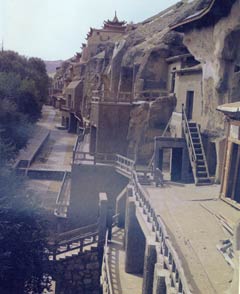
Digital technology is being used to conserve the Mogao Grottoes of Dunhuang, in Northwest China's Gansu Province. The "Digital Dunhuang" project, which aims to pool all the treasures from Dunhuang, has also paid close attention to protect its intellectual property rights (IPR) in the digital era.
It has obtained copyrights to digital images of the murals, statues and documents from Dunhuang's grottoes. No other entity, business or institution, can reproduce, transmit or display the images of Dunhuang in any form without the consent of the right holder. Digital Dunhuang Dubbed "Digital Dunhuang," the ongoing project to protect cultural relics through new technologies aims to build a database containing detailed digital information and high quality colour images of the treasures. It embraces two categories of work - one is a database of highly intelligent digital images of Dunhuang treasures and the other is a digital library containing historical records and research findings on Dunhuang and related materials, Liu Gang, a top researcher with the Dunhuang Academy, said in an interview with China Daily. The project, which started in the late 1990s, has drawn participants from more than a dozen organizations which possess related collections or have an interest in the conservation of cultural heritage. The project team includes the Dunhuang Academy, the National Library of China based in Beijing, national libraries of the United Kingdom and France, the Russian Academy of Sciences and the US-based Mellon Foundation. The most eye-catching part of the digital project is said to be the digital shooting of the grottoes, or Virtual Caves. With financial support from the Mellon Foundation, the shooting started in 2000, and was undertaken by several academic organs, including Northwestern University in the United States. State-of-the-art digital photographic technology, capable of capturing the cave murals invisible under natural light or obstructed by the structure of the caves, was used, said Liu.
The introduction of digital technology will help upgrade conservation efforts, including the control of tourist numbers, to preserve irreplaceable cultural heritage. Scholars are paying more attention to the academic aspect of the use of innovative digital means to theoretically eternally conserve, especially in an undisturbed way, the country's magnificent cultural heritage, including Buddhist manuscripts, painted scrolls and other historic documents. The city of Dunhuang, adjacent to the crossroads of the ancient Silk Road, owes its fame today to the Mogao Grottoes, one of the world's most important sites of ancient Buddhist culture. The grottoes, also known as the Caves of a Thousand Buddhas, contain some 2,000 clay sculptures and more than 45,000 square metres of murals, dating back to the 5th to14th centuries. The grottoes were put on the UNESCO World Cultural Heritage list in 1987. Of the 735 caves, about 492 remain intact. But all have been subjected to various kinds of damage or indignities to some extent, from long-term exposure to the elements to the smoke of fires made by tourists and locals, according to specialists from the Dunhuang Academy. Damage also threatens from the modern perils of mass tourism, where moisture from the breath of visiting crowds can impair delicate murals that have survived for centuries in an arid desert climate, specialists acknowledged. And down the years treasures removed from the grottoes have found their way into museums, libraries and research institutes around the world. Studies on Dunhuang began in 1900, when the Dunhuang Library Cave, which had been sealed for 850 years and housed more than 50,000 relics, was accidentally found by a Taoist priest. Some of the Dunhuang relics were taken out of China in the early years of Dunhuang's discovery and acquired by collectors in the United Kingdom, France, Russia, Japan, India, Republic of Korea and Finland. But not all of the Dunhuang collections overseas are available to researchers or the public. Demand for access from the scholars is another key factor behind the Digital Dunhuang project. In May last year, a digital Dunhuang website in Chinese opened, allowing viewers to browse nearly 10,000 titles of digitized records and 300 images, murals and sculptures. The Digital Dunhuang project demonstrates how new technology can "virtually" reunite materials scattered across the globe and will give new opportunities for scholarship in art history, archaeological linguistics, religion and other disciplines, experts believe. IPR protection in a digital world The development and application of digitized technology, in collaboration with Internet services, is expected to bring together again the scattered Dunhuang treasures and expand the scope of research into Dunhuang, said Liu. "The national treasures of Dunhuang would have likely been exploited by the Internet without any compensation if intellectual property rights protection had not been introduced," said Liu. The academy has adopted a litigation strategy to encourage a narrow interpretation of the fair use of Dunhuang images to bar intrusion of their exclusive rights. The academy has signed four contracts since May 2000 with the Mellon Foundation to highlight its exclusive property and copy-rights over Dunhuang images. The contracts specify the IPR of all the caves' images included in the process of digitalization. The IPR of the film negatives and digital images of Dunhuang, produced by both sides, solely belong to the Dunhuang Academy, state the contracts. When disputes occur, both sides have agreed to resolve them in accordance with Chinese law and regulations or to seek mediation from the China International Economic and Trade Arbitration Committee. Furthermore, new copyright protection technology has been implemented including pay-per-view technology, click-through barriers and digital watermarks which embed information about the rights owner into video, audio or graphics files. "The legal and technical measures in place will help protect the intellectual property rights of Dunhuang, and could have significant influence on other aspects of cultural heritage protection," continued Liu. The Dunhuang Academy has employed a set of strategies to identify and maximize control over its IPR assets, in order to secure an economic return and to control the misuse and improper representation of Dunhuang images, he said. The academy chose the non-profitmaking Mellon Foundation as its partner to digitize Dunhuang's treasures, in light of the foundation's reputation in aiding and promoting the well-being of mankind through charitable, scientific, literary, and educational means, explained Liu. "Co-operating with non-profitmaking organizations will help guarantee a better protection of our intellectual property rights and bar commercial exploitation of the relics," he said. In recent years, IPR owners have begun feeling very threatened by the advent of the Internet, a tool of perfect reproduction and unprecedented distributive scope. In the late 1990s, rights holders and legal experts began proposing changes to Copyright Law. In 2001, the amended Copyright Law was issued and introduced with computer and Internet related property right protection clauses. The Supreme People's Court then issued a judicial interpretation on how to resolve computer and Internet related IPR disputes. "The country has provided a specific legal environment to protect computer and network related IPRs," said Li Shunde, professor of law with the Chinese Academy of Social Sciences. One of the virtues of the Web is its reach - the ability to widely distribute digital works less expensively and faster than ever before. The downside is the lack of control creators and rights holders are able to exert on the subsequent dissemination and use of their work, said Professor Li. "Rights holders need to increase self-protection awareness and to make their rights extend into the digital environment," added Li. In 1996, the World Intellectual Property Organization regarded the storing of products in digital form in the electronic media as "copying." Offering digitized works for others to skim, read, copy and print through networking also amounts to "copying." People who download, copy or print the works of others without the authors permission violate copyright laws and are liable. At a virtual library, books are digitized and distributed online. The current laws in almost all countries stipulate that a book's publication, circulation and usage involves intellectual property rights. And this applies to electronic books, continued Li. China's first National Digital Library is expected to become the country's main online information centre and service database when completed in 2007. Researchers in library and information sciences, engineering and computer science have combined to better protect digital copyright by introducing such measures as charging browsers and using codes and digital watermarks to prevent illegal downloading. |
|
|
|
|
||||||||||||||||||||||||||||||||||||||||||||||
|
|
|
|
|||||||||||||||||||||||||||||||||||||||||||||||||