|
Home>News Center>China | |
|
|
|
|
|
|
|
|
|
|
||||||||||||||||||||||||||||||||||||||||||||||||||||||||||||||||||||||||||||||||||||||||||||||||||||||||||||
|
|
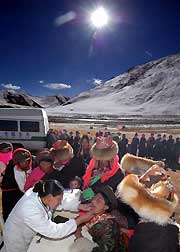
Changes transform childbirth in Tibet During her first six years of working as the only obstetrician in the Pozhang Township Hospital in the Tibet Autonomous Region, Mima only delivered 20 babies among a childbearing population numbering 1,700.
The turning point came last May when Mima attended a course sponsored by the United Nations Children's Fund (UNICEF) in the capital Lhasa. There she not only learnt from the lectures given by experienced county doctors, but was also given the opportunity to put into practice some of teaching. "I performed my first Caesarean operation during the training. I was both excited and nervous. It was an emergency when the woman in labour was rushed to hospital, but eventually both the mother and baby were safe after a one-hour operation. I am so proud of myself. I finally have the feeling of being an obstetrician," said Mima. Her dream of specializing in obstetrics began soon after graduation, but in the six years before the course, she had "only performed some basic prenatal examinations." Pozhang Township Hospital, the only one for the local population of 7,000 in Shannan Prefecture, possesses just one bed, bought in the 1980s, two pairs of scissors and one set of obstetric forceps for midwifery. "It is far below the required sanitation and safety standards. No one dares to deliver babies in such conditions," she said. "Some of the pregnant women go to the county hospital to deliver, which takes them at least an hour by car. Most others would rather have their baby at home with the help of relatives to save both time and expense. This is very dangerous." But it was not only knowledge Mima, 29, took away from the course, she was given an obstetrics kit, courtesy of UNICEF, and, in terms of her work and equipment, an invaluable asset. "It even includes a sucker to drain amniotic fluid from the newborn's mouth, nose and ears. With that you can save the infant from suffocation. In the past I have had to solve the problem using my hand, which is very unprofessional and dangerous to the baby," explained Mima. Suolang Zizheng, 29, has no doubts about the benefits of recent changes at the township hospital. Her first baby suffocated soon after a home delivery in 2001. In July 2004, Suolang successfully delivered her second child at the township hospital with Mima's help. "Starting from the sixth month of my pregnancy, Mima gave me regular prenatal examinations every month,'' said Suolong. Sterile measures were in place for the actual delivery and 80 per cent of the 1,000 yuan (US$120) medical fees were exempted, a major consideration for a family with an annual per capita income of 3,000 yuan (US$360). Infant mortality in Tibet, used to be as high as 430 per thousand births, a direct result of poor midwifery services. Improved health facilities had drastically cut the figure to 399 in 100,000 by 2003, although that is still much higher than the national average of 10 in 100,000 in Shanghai and 15 in 100,000 in Beijing. But many hospitals in Tibet still cannot provide appropriate labour facilities., Only 42 per cent of the 119 medical institutions in the prefecture are equipped to handle childbirth, said Ciren Dundan, head of the Medical Bureau of Shannan Prefecture. As for Caesarean sections, "only hospitals in Lhasa and a few other major cities are able to perform the operation. At county level, five out of the 73 hospitals can do Caesarean sections," says Luosang, director of the Department of Basic Medical Protection for Women under the Medical Bureau of the Tibetan Autonomous Region in Lhasa. "Caesarean sections require an anesthetist and obstetric table, which most of the Tibetan hospitals cannot afford." The vast area that comprises the region and its small, but scattered population also hinder development of obstetric and neonatal services. "Highway transportation and communications are not so convenient partly due to its high elevation ," says Luosang. "It takes at least one hour to get to the nearest hospital by car in most Tibetan counties. Although the local medical institutions waive 80 to 100 per cent of delivery fees, transportation expenses alone can be a problem." Then there are traditional taboos.. "Tibetans used to regard giving birth as something secret and private," says Luosang. "A newborn is kept from visitors until it is one month old. So many Tibetan women feel it strange to have their baby delivered in hospital in front of strangers." For this reason many would rather resort to unprofessional relatives to act as midwives, he says. "Newborns, often delivered unprofessionally in cold and dirty houses, are also very likely to die from measles and other contagious diseases," he added. Since 1999, UNICEF has funded projects in 15 counties and all seven prefectures, including Lhasa, in a bid to cut maternal mortality and neonatal tetanus by increasing the number of hospital deliveries, says UNICEF National Health Nutrition Project officer, Liu Bing. "The strategy of the project is to increase the quality and decrease the cost of hospital deliveries by equipping them with sophisticated facilities, trained staff and encouraging women to give birth in hospital," he says. To this end, the projects give 20 yuan (US$2.4) to every woman who has her baby in hospital and 10 yuan to the person who accompanies her, be it a relative or a medical worker. The relative can also sleep at the hospital and cook meals in the patient-friendly kitchen close to the hospital. In the past five years, a total of 420,000 yuan (US$50,000) has been spent in this regard. In addition, since 1998 central government has allocated 200 million yuan (US$24 million) to improving medical services in Tibet. Of the 672 counties and townships, each has benefited by 100,000 yuan (US$12,000) to update their obstetric facilities and build new hospitals. Medical training in Lhasa for grassroots medical workers like Mima have also helped improve the rate and conditions for hospital deliveries. Besides the basic theory of hospital delivery, medics from poor counties and townships have been given the opportunity to intern in large hospitals in Lhasa. About 1,000 nurses and medics have been trained in the past four years, at a cost of 300,000 yuan (US$36,000) annually. And the efforts are beginning to bear fruit.Hospital deliveries were up from 13 per cent in 1998 to 40 per cent in 2003 in the 15 UNICEF targeted counties, said Liu Bing. And the figure for Shannan prefecture reached 57 per cent. "There has been much progress for women and children in Tibet, although there is still much work to do to catch up with the rest of China," remarked Bellamy, UNICEF executive director during her visit to Tibet last September. "We need to strengthen preventative health and expand the project to more counties." Mima hopes Pozhang Township Hospital can get more obstetric tables and that more experienced doctors will join her, thus sparing pregnant women a long journey to reach a proper childbirth unit . "I enjoy midwifery, simply because it is such a huge pleasure to see the faces of new mothers when shown the clean and healthy new childbirth facilities." |
|
|
|
|
|||||||||||||||||||||||||||||||||||||||||||||||||||||||||||||||||||||||||||||||||||||||||||||||||||||||||
|
|
|
|
||||||||||||||||||||||||||||||||||||||||||||||||||||||||||||||||||||||||||||||||||||||||||||||||||||||||||||