|
Home>News Center>World | |
|
|
|
|
|
|
|
|
|
|
||||||||||||||||||||||||||||||||||||||||||||||||
|
|
US foresaw terror threats in 1970s: AP
Nearly three decades before the Sept. 11 attacks, a high-level government panel developed plans to protect the nation against terrorist acts ranging from radiological "dirty bombs" to airline missile attacks, according to declassified documents obtained by The Associated Press. "Unless governments take basic precautions, we will continue to stand at the edge of an awful abyss," Robert Kupperman, chief scientist for the Arms Control and Disarmament Agency, wrote in a 1977 report that summarized nearly five years of work by the Cabinet Committee to Combat Terrorism.
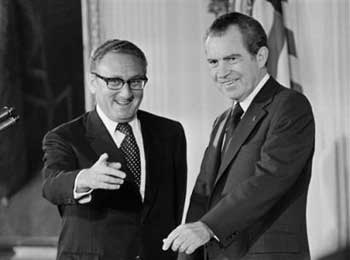
"It is vital that we take every possible action ourselves and in concert with other nations designed to assure against acts of terrorism," Nixon wrote in asking his secretary of state, William Rogers, to oversee the task force. "It is equally important that we be prepared to act quickly and effectively in the event that, despite all efforts at prevention, an act of terrorism occurs involving the United States, either at home or abroad," the president said. The full committee met only once, in October 1972, to organize, but its experts did get together twice a month over nearly five years to identify threats and debate solutions, the memos show. Eventually, the group's influence waned as competing priorities, a change of presidents ushered in by Watergate, bureaucratic turf battles and a lack of spectacular domestic attacks took their toll. But before that happened, the panel identified many of the same threats that would confront President Bush at the dawn of the 21st century. The experts fretted that terrorists might gather loose nuclear materials for a "dirty bomb" that could devastate an American city by spreading lethal radioactivity. "This is a real threat, not science fiction," National Security Council staffer Richard T. Kennedy wrote his boss, Kissinger, in November 1972. Rogers, in a memo to Nixon in mid-1973, praised the Atomic Energy Commission's steps to safeguard nuclear weapons. Rogers, however, also warned the president that "atomic materials could afford mind-boggling possibilities for terrorists." Committee members identified commercial jets as a particular vulnerability, but raised concerns that airlines would not pay for security improvements such as tighter screening procedures and routine baggage inspections. "The trouble with the plans is that airlines and airports will have to absorb the costs and so they will scream bloody murder should this be required of them," according to a White House memo from 1972. "Otherwise, it is a sound plan which will curtail the risk of hijacking substantially." By 1976, government pressure to improve airport security and thwart hijackings had awakened airline industry lobbyists. The International Air Transport Association said "airport security is the responsibility of the host government. The airline industry did not consider the terrorist threat its most significant problem; it had to measure it against other priorities. If individual companies were forced to provide their own security, they would go broke," according to minutes from one meeting. Thousands of pages of heavily blacked out records and memos obtained by the AP from government archives and under the Freedom of Information Act show the task force: -- discussed defending commercial aircraft against being shot down by portable missile systems;
-- recommended improved vigilance at potential "soft" targets, such as major holiday events, municipal water supplies, nuclear power plants and electric power facilities; -- supported cracking down on foreigners living in and traveling through the
United States, with particular attention to Middle Easterners and
Arab-Americans; Though the CIA routinely updated the committee on potential terrorist threats and plots, task force members learned quickly that intelligence gathering and coordination was a weak spot, just as Bush would discover three decades later. Long before he was mayor and helped New York City recover from the Sept. 11 attacks on the World Trade Center, Giuliani told the committee in May 1976 that he feared legal restrictions were thwarting federal agents from collecting intelligence unless there had been a violation of the law. Giuliani, who at that time was the associate deputy attorney general in President Ford's Justice Department, suggested relaxing intelligence collection guidelines — something that occurred with the Patriot Act three decades later Other committee members said that obstacles to intelligence gathering were more bureaucratic than legal. Lewis Hoffacker, a veteran ambassador who served as chairman of the terrorism working group, told the AP that institutional rivalries, particularly between the FBI and CIA, were a constant source of frustration even in the 1970s. "That was our headache, a quarter-century ago," said Hoffacker, now retired. "They all pulled back into their little fiefdoms. The CIA was always off by itself, and the FBI was dealing with the same situation they're dealing with today." Finding the political will to fight terrorism in the absence of a major attack in the United States also quickly became a problem. Proposals for international penalties against countries harboring terrorists drew little support from the United Nations (news - web sites), the memos show. "The climate at the 1974 General Assembly was such that no profitable initiative in the terrorism field was feasible," Ford heard from Kissinger, his secretary of state, in early 1975. Two years later, the working group was absorbed by the National Security Council. In a 1978 report, the Senate Governmental Affairs Committee worried that the Carter administration was not giving enough attention to terrorism. "The United States will not be able to combat the growing challenge of terrorism unless the executive policy-making apparatus is more effectively and forcefully utilized," the Senate committee warned. |
|
|
|
|
|||||||||||||||||||||||||||||||||||||||||||||
|
|
|
|
||||||||||||||||||||||||||||||||||||||||||||||||